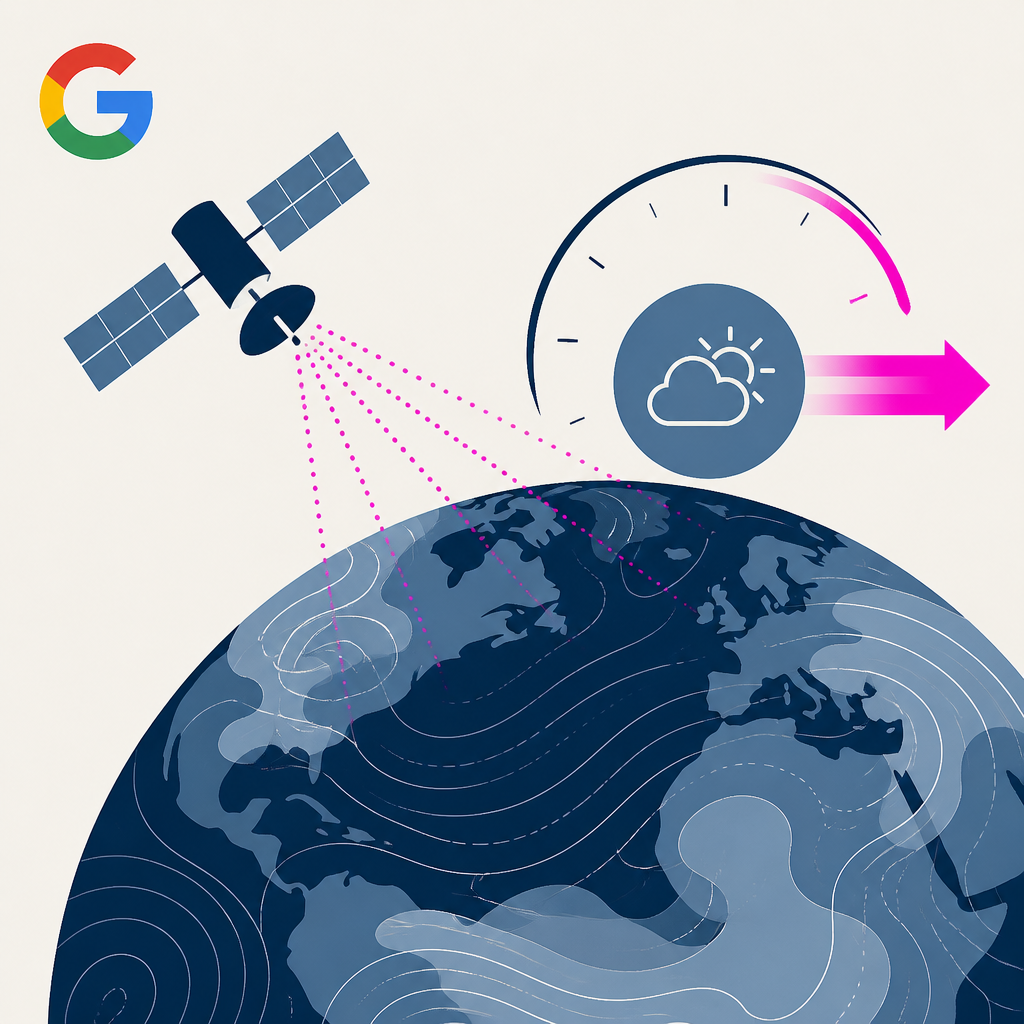
Google DeepMind’s WeatherNext 3 Trains on Weather Station Observations to Deliver 5 km Global Forecasts, Refreshed Every Hour
MarkTechPost Michal Sutter ● Covered by 5 sources
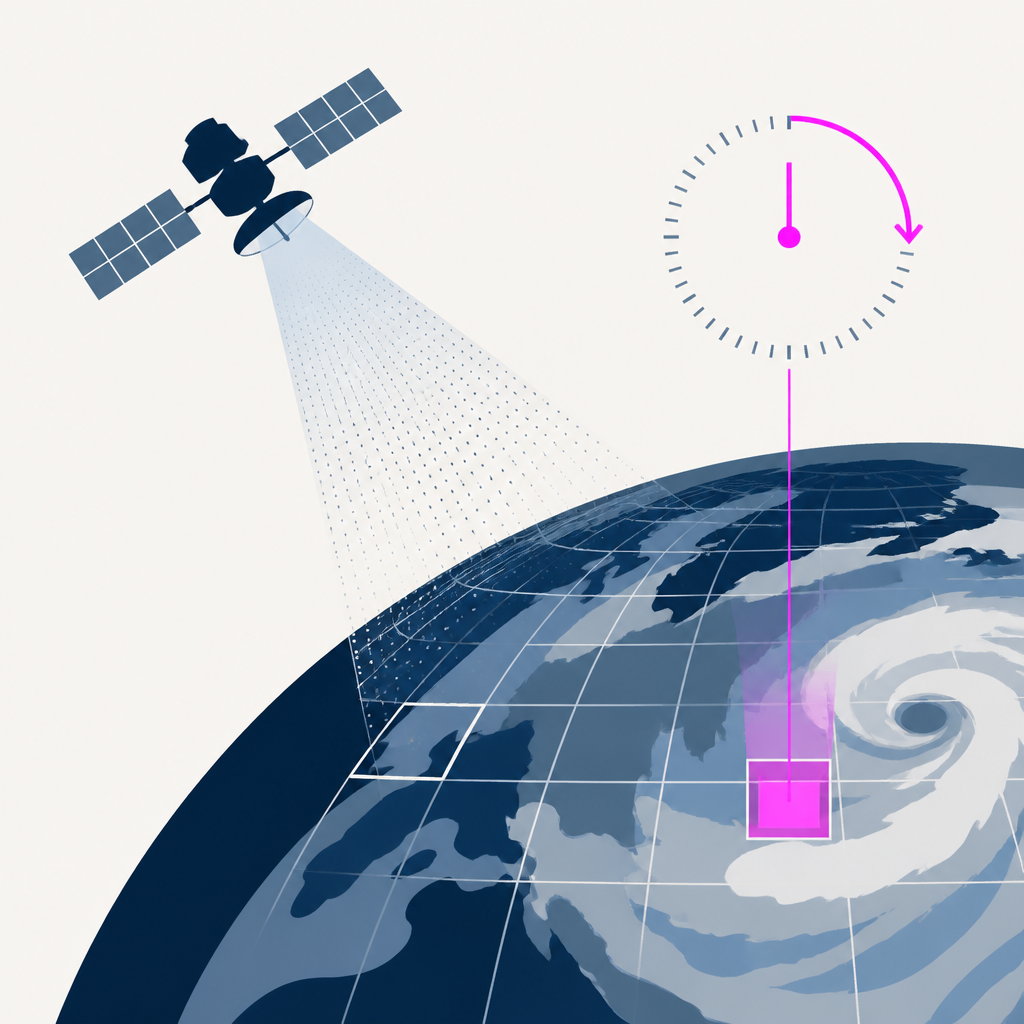
Google DeepMind’s WeatherNext 3 now does 5 km global forecasts and refreshes every hour. That cuts the usual six-hour lag and should help with fast-changing weather.
Based on reporting by MarkTechPost, Michal Sutter — read the original for the full story.
Summary, retelling and take written by AI under human oversight; images are AI-generated illustrations. How we work · Report an error
Google DeepMind and Google Research have pushed WeatherNext 3 into a sharper corner of weather forecasting. The model now produces global forecasts at about 5 km resolution, updates every hour, and trains directly on weather station observations instead of relying only on reanalysis grids. That matters because the old problem wasn’t just accuracy. It was timing, and the delay in standard numerical weather prediction analysis left models starting from stale data.
The system is built as a Functional Generative Network mesh transformer, the same probabilistic family used in WeatherNext 2, but scaled to multi-resolution output. It takes a live global geostationary satellite mosaic plus ECMWF HRES analysis as input. In practice, that means WeatherNext 3 is no longer waiting around for a six-hour-old analysis feed to catch up before it starts forecasting.
Its output is split into three layers. The finest layer is 0.05° weather fields for 2 m temperature and dew point, trained against raw station measurements. A 0.1° layer covers surface wind at 10 m and 100 m, pressure, sea surface temperature, cloud layers, solar radiation and 1-hour precipitation. A 0.25° layer handles atmospheric fields across 13 pressure levels. WeatherNext 2 did 0.25° output in 6-hour steps, so the new system’s roughly five-times sharper claim is tied to both finer grids and faster refresh.
Google is also leaning hard into precipitation and energy use cases. The model trains on ECMWF reanalysis, NASA’s IMERG satellite retrievals and Google’s own satellite-radar precipitation reanalysis, and Google says its evaluations show improvements of up to 60% against IMERG, 30% against MRMS and 10% against rain gauges at early lead times. The research also cites up to a 50% reduction in Brier score and CRPS versus NWP baselines when checked against IMERG. For wind and solar forecasting, it outputs 100 m wind speed, cloud distributions and solar irradiance components, which is a pretty clear hint at who the buyers are supposed to be.
Access is the catch. Forecast data is available through BigQuery, Earth Engine and Cloud Storage after an allowlist request, but the weights are not open source. On-demand custom inference still runs WeatherNext 2, so this is a real release, not a full handoff.
My take — AI-written commentary, not fact-checked reporting
This is the familiar Google move: give people the data, keep the model behind the glass. Fine for operators, annoying for everyone who wants to inspect, fork, or beat it. Weather models are becoming infrastructure, and infrastructure locked to an allowlist is still a moat with a nicer name.
Read more about this at: MarkTechPost