
Dyna-2: General Purpose Physical Agents with Hour-Long Autonomy — Jason Ma, Dyna Robotics
Latent Space
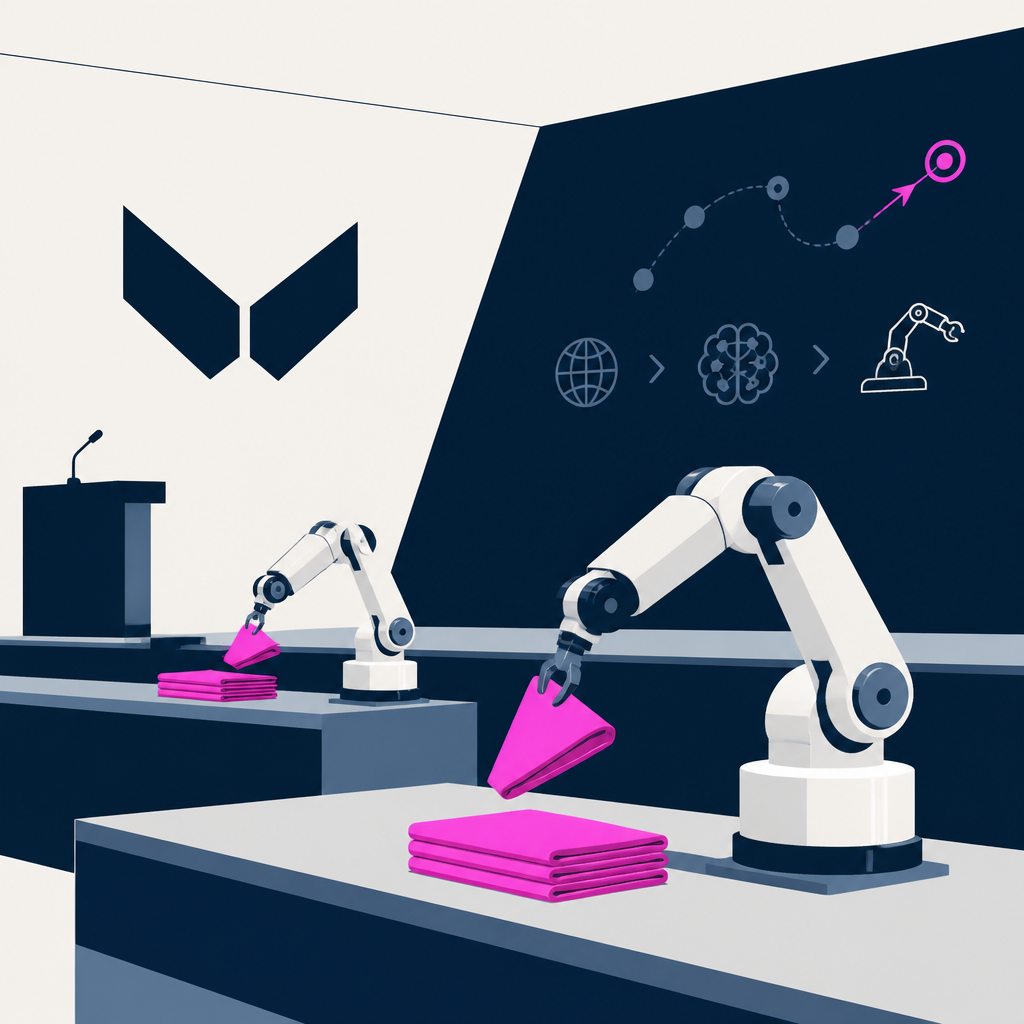
Dyna says its robot model learns from over a million hours of video. The pitch: hour-long physical tasks, not cute demos.
Based on reporting by Latent Space — read the original for the full story.
Summary, retelling and take written by AI under human oversight; images are AI-generated illustrations. How we work · Report an error
Dyna Robotics is trying to push robots past the demo table. Its latest system, Dyna-2.1, sits on top of Dyna-2, a world-action model trained on more than one million hours of human video. The company’s claim is blunt: this isn’t just about making a robot move. It’s about giving it enough world sense to keep going for long stretches and recover when things go wrong.
Jason Ma, Dyna’s co-founder and chief scientist, framed the core problem as long-horizon autonomy. In one example, he said the system reached a 99.4% success rate folding restaurant napkins for 24 hours straight, even after it pulled over the whole stack and had to recover. That’s a very different test from a polished one-off demo. It is also the kind of metric that hints at where Dyna thinks robotics has to go if it’s going to work for real customers.
The model itself is built around prediction. Dyna describes Dyna-2 as a world-action model that takes video, robot state, and language instructions as inputs, then outputs actions and a prediction of what the future video should look like. Ma compared that to a kind of visual chain of thought: the system reasons about how the physical world will change, then uses that reasoning to choose what the robot should do next. Under the hood, the model uses a diffusion transformer with an encoder-only transformer architecture, and Dyna says flow matching makes the process easier to tune.
Training data is the other big bet. Dyna says the model starts from that million-hour pile of human video, then adapts to new tasks with as little as 45 minutes of demonstrations. The company is also betting on synthetic environments and self-generated training data, because robotics does not have an internet-sized data supply waiting around. That scarcity is the real story here. Dyna’s pitch is that the path to general-purpose robots is not more clever hand-tuning, but more scale, more data, and systems that can learn fast enough to matter.
There’s also a hardware argument tucked inside the software one. Ma said Dyna builds its own hardware instead of relying on off-the-shelf humanoids, and the company uses wheeled semi-humanoids rather than traditional bipeds. The reason is practical: on-device inference, model distillation, and custom hardware all matter when a robot is supposed to execute hour-long workflows in the real world. Dyna is trying to look less like a robotics lab and more like a production stack, which is exactly where most robotics startups get exposed.
My take — AI-written commentary, not fact-checked reporting
The robotics hype cycle always loves a shiny hand-wave about generality, then quietly trips over the laundry pile. Dyna sounds more serious than most because it’s talking about recovery, long workflows, and real deployments instead of superhero humanoids. That’s the right direction: fewer movie trailers, more napkins.
Read more about this at: Latent Space
Related stories
 Dyna-2.1 demo video: survival of fitted-sheet style tasks
X · 2 weeks ago ·
42
Dyna-2.1 demo video: survival of fitted-sheet style tasks
X · 2 weeks ago ·
42
 Dyna Robotics Introduces Dyna-2: A World-Action Model Pre-Trained on 1 Million Hours of Human Video
MarkTechPost · 2 months ago ·
10
Dyna-2.1: a semi-humanoid robot does uncut hotel laundry on camera
DYNA · 2 weeks ago ·
5
Dyna Robotics Introduces Dyna-2: A World-Action Model Pre-Trained on 1 Million Hours of Human Video
MarkTechPost · 2 months ago ·
10
Dyna-2.1: a semi-humanoid robot does uncut hotel laundry on camera
DYNA · 2 weeks ago ·
5