
China's AI startups can match the U.S.'s models. They can't yet match the U.S.'s money
Fortune Alvin Yap ● Covered by 4 sources

China’s AI models are catching up fast with the U.S. The catch: the money gap is still huge, and that may decide who keeps up.
Based on reporting by Fortune, Alvin Yap — read the original for the full story.
Summary, retelling and take written by AI under human oversight; images are AI-generated illustrations. How we work · Report an error
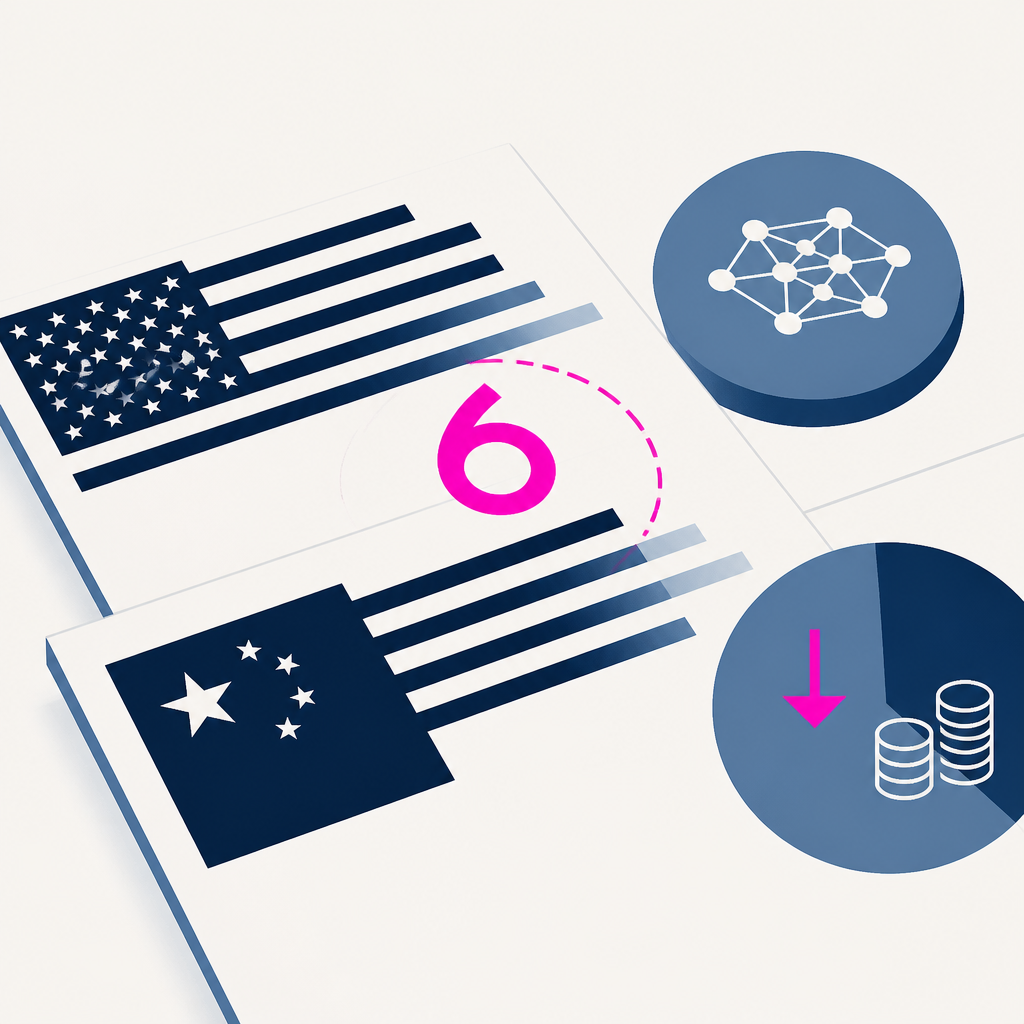
China’s AI startups have done something that would’ve sounded far-fetched not long ago: they’ve nearly closed the model-quality gap with the U.S. Moonshot’s Kimi K3, described as the world’s largest open-weight model, is now close to America’s frontier systems. Analysts say the best Chinese models are about four months behind the most advanced releases from OpenAI and Anthropic, down from seven months at the start of the year.
That progress has shown up in usage too. Chinese models accounted for 1.2% of token traffic in 2024, then more than half by the summer of 2026. But the piece’s blunt point is that the next bottleneck isn’t model quality. It’s capital. Between 2023 and 2026, U.S. AI companies pulled in more than $380 billion in venture funding, while Chinese startups got barely a tenth of that, according to Boston Consulting Group.
The money shortage is showing up in a few places at once. Prices are rising inside the AI supply chain, with CXMT pushing up memory prices for months even as Huawei pressed for relief. AI hiring has also turned brutal: job postings in the field jumped roughly twelvefold year on year in early 2026, and large language model engineers can command some of the highest pay packages in China. At the same time, external funding remains thin. China saw just $20 billion in venture investment in the first quarter of 2026, versus $267 billion in the U.S.
There are other constraints too. China’s state-backed funding tends to favor later-stage companies, while early-stage venture capital is only starting to recover from a three-year fundraising drought. State banks are being pushed toward tech lending, but rising bad loans elsewhere could tighten credit. And Chinese enterprise software firms mostly sell at home, which limits revenue. U.S. rivals, meanwhile, can lean on global customers, stronger brands, and far deeper R&D budgets.
Hong Kong is becoming one of the few ways Chinese companies can still tap global capital at scale. More than 430 applicants are in the IPO pipeline in the second half of 2026. But that route has its own message: companies are going public earlier because they do not have many other options. Zhipu AI and MiniMax listed in Hong Kong in January, raising $558 million and $620 million respectively, while OpenAI and Anthropic kept growing through giant private rounds. China can match the software. Matching the war chest is a different story.
My take — AI-written commentary, not fact-checked reporting
This is the part everyone keeps pretending is temporary, and it isn’t. China’s AI scene has figured out how to build strong models with less, which is impressive and very on-brand for a system that treats scarcity like a feature. But if the funding gap stays this wide, the real story won’t be who has the smartest researchers — it’ll be who can afford to keep them, pay for compute, and survive the bruising middle years without selling early.
Read more about this at: Fortune
Related stories
 China only six months behind US in AI development
The New York Times · 2 months ago ·
56
China only six months behind US in AI development
The New York Times · 2 months ago ·
56
 Faced with less compute and fewer tokens, Chinese AI labs are tightening the gap with the US by just being more efficient
Fortune ·
24
China delivers a one-two punch to America’s AI dominance
The Verge · 2 months ago ·
15
Faced with less compute and fewer tokens, Chinese AI labs are tightening the gap with the US by just being more efficient
Fortune ·
24
China delivers a one-two punch to America’s AI dominance
The Verge · 2 months ago ·
15