
🔮 A world of many minds & the future of work
Exponential View Azeem Azhar ● Covered by 9 sources
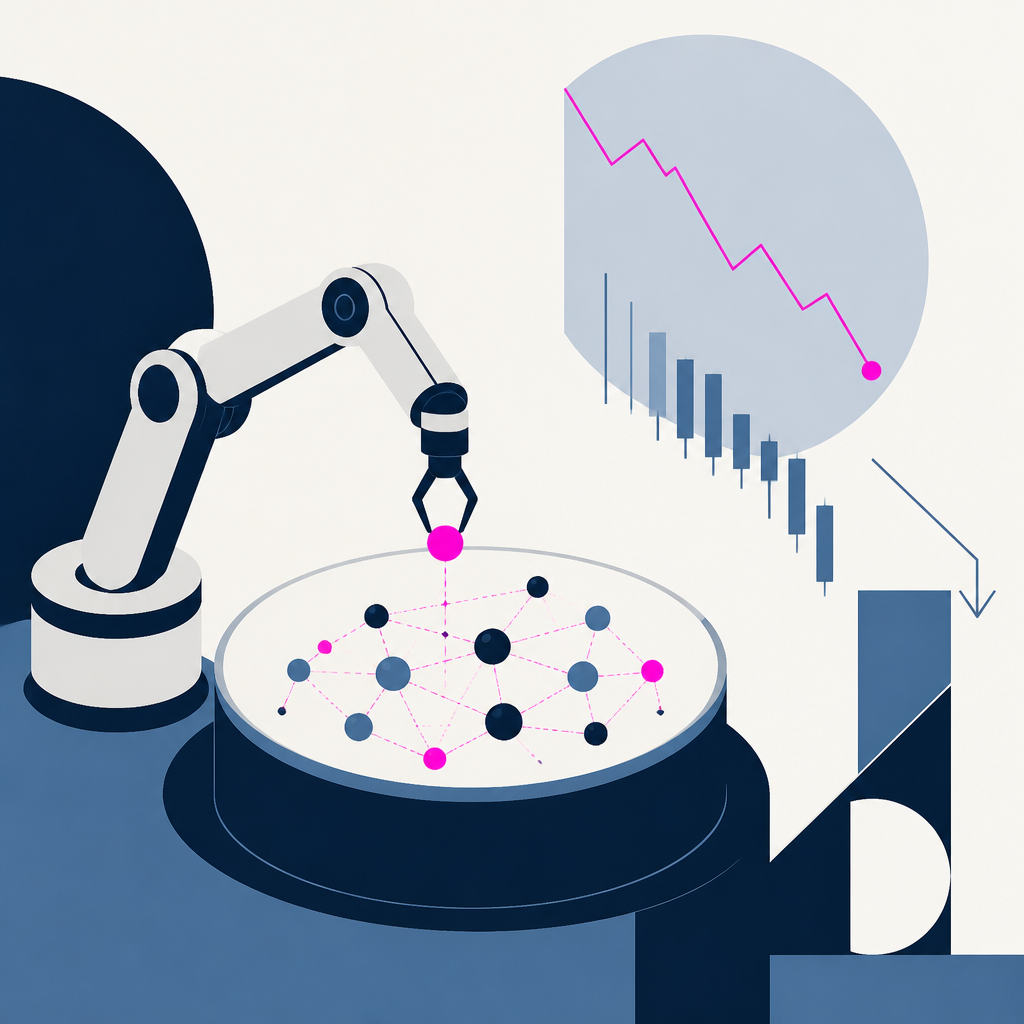
Anthropic’s private investor briefing leaked almost immediately. The numbers spooked markets, and the AI trade is suddenly looking shaky.
Based on reporting by Exponential View, Azeem Azhar — read the original for the full story.
Summary, retelling and take written by AI under human oversight; images are AI-generated illustrations. How we work · Report an error
Anthropic’s much-hyped private investor briefing didn’t stay private for long. It leaked within minutes, and the figures were striking enough to land like an auditor’s ledger dropped at a Christmas party. That reaction is now spilling into markets, where people are openly asking whether the AI trade can actually pay off.
The tremors are visible in Korea, where the KOSPI is down 7.57% today and 16.2% this month. Tech stocks tied to the AI trade are set to open sharply lower. For a sector built on momentum and expectation, that is not a small wobble.
At the same time, there’s a more interesting debate running underneath the market noise. Gardens of Intelligence’s Swarm Intelligence essay imagines a future with a whole ecosystem of specialized AI minds, not one giant system calling the shots. Kevin’s picture is vivid: a coral reef of minds, some barely above insect-level, others brilliant at math, most tuned for specific boring jobs.
That sits well with an idea from the same school of thought: monocognitism, the belief that there will be one all-powerful AI, looks unlikely. The alternative is polycognitism, where many systems coexist but remain separate. Then there’s syncognitism, where intelligence emerges from the interactions between many systems and starts to feel like a collective substrate rather than a single machine. The speed of light alone makes the singleton fantasy awkward; even a system controlling bots on the Moon would be dealing with a 1.3-second delay one way.
There’s also a more practical angle in Yue Xu’s early working paper, which tries to measure what work can be handed off economically, including the cost of checking outputs and the damage from mistakes. That matters because the next big change may not be one magic AI taking over everything. It may be firms becoming AI native in messy, distributed ways, with intelligence spread across a lot of narrow systems instead of centered in one throne room.
My take — AI-written commentary, not fact-checked reporting
The market keeps acting as if AI needs one grand winner to justify the whole boom, which is a very expensive habit. The more likely future is a swarm of narrower systems, which is less cinematic and much harder to hype in a keynote. That’s usually how real technology works: not with a crown, but with a pile of tools that quietly replace jobs one by one.
Read more about this at: Exponential View