
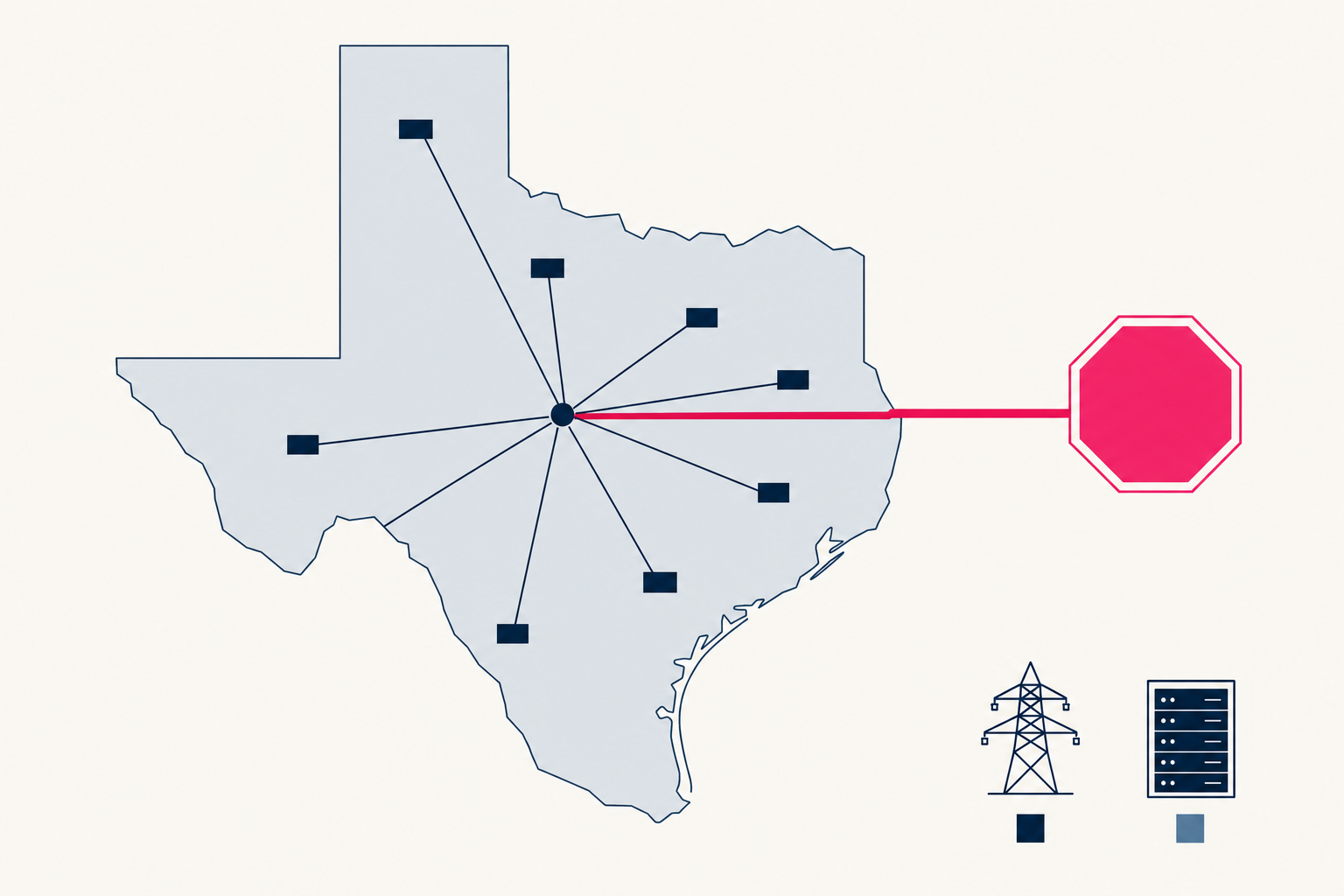
High-voltage transmission lines cross the Texas power grid.
Analysis · 5 August 2026
AI's Power Crisis Hits Texas, and It's Just the Start
The numbers stopped making sense sometime around January. Texas's ERCOT grid had 233 gigawatts of data center projects queued for connection. By August, that figure had grown to 474 gigawatts — more than five times the grid's actual peak demand, and more than 90 percent of it driven by AI infrastructure. Last week, Governor Greg Abbott did the only thing a governor can do when an unstoppable force meets an immovable grid: he called a halt.
Texas's moratorium on new data center power connections is the most visible symptom yet of an industry that has built its ambitions faster than the physical world can accommodate them. ERCOT must now audit every project in its interconnection queue before approvals resume. For a state that spent years courting data centers with tax breaks and light-touch regulation, this is a significant reversal — and a signal to the rest of the industry that power is no longer an abstraction.
The Infrastructure Appetite Is Enormous and Growing
To understand why Texas reached this point, look at what is actually being built. Anthropic just signed a $10 billion compute deal with Volta, a newly founded cloud startup, for six years of capacity from a 133-megawatt Norway data center running Nvidia's Vera Rubin chips. One deal, one facility, 133 megawatts. At scale across dozens of providers, the aggregate demand is staggering.
SpaceX offers another illustration of the appetite. The company has purchased $329 million worth of Tesla Megapacks so far in 2026 — $295 million of that in the second quarter alone — deploying them at xAI data centers to smooth the violent power swings that come from GPU clusters cycling between training and inference workloads. Before the xAI merger, xAI itself had already spent $430 million on Megapacks. These are not rounding errors. They are the cost of keeping the lights on when you are running AI at scale.
AMD's earnings crystallise the commercial logic driving all of this. Data center revenue hit $6.7 billion in the latest quarter, more than doubling year-over-year, and now represents 58 percent of AMD's total revenue of $11.5 billion. Gaming, which defined AMD's consumer identity for decades, fell 31 percent to $779 million. The company is not pivoting toward enterprise AI out of ideology — the demand is simply that much larger.
The Real Cost Is Starting to Appear in the Ledger
For much of the past three years, AI infrastructure costs were treated as a future problem. Capital was cheap, growth projections were optimistic, and the assumption was that revenue would catch up. The Texas moratorium — and several quieter signals emerging simultaneously — suggest that reckoning is arriving.
Microsoft has begun imposing token budgets on engineers, designated GPT-5.6 as the standard default, and explicitly told staff that maximising AI token consumption is not the goal. Individual employees are currently spending hundreds to thousands of dollars a month on AI tools. Multiply that across a company of 200,000 people and the number becomes uncomfortable quickly. The internal phrase "tokenmaxxing" — using more tokens than the task requires — has become something Microsoft management wants to actively discourage.
OpenAI, meanwhile, provided a genuinely useful data point when it disclosed that its Astra model generated machine-verified proofs for 10 long-standing mathematical theorems at a cost of approximately $2,000 in API tokens. That framing — frontier reasoning priced as an inference budget rather than a capital expenditure — is how organisations will increasingly think about AI. Not "can we afford to train a model" but "how much is this reasoning task worth to us."
That shift in accounting perspective matters for infrastructure planning. If inference is a per-task cost, the demand curve for compute is far less predictable than training cycles. Data centers must be sized for peak inference demand across millions of concurrent users, and that peak is hard to forecast. Which is precisely why grid operators like ERCOT are overwhelmed.
The Governance Gap Closes Slowly
The Texas halt is a blunt instrument, but it reflects a broader pattern: the institutions responsible for managing AI's physical and regulatory consequences are running several years behind the technology's deployment curve. ERCOT's interconnection queue doubling in seven months was not a surprise to anyone paying attention — it was the foreseeable result of state policy that actively recruited data centers without modelling aggregate grid impact.
The same lag applies to safety governance. China's GLM-5.2 open-weight model has narrowed the capability gap with frontier models in cyber and biological tasks while refusing none of the offensive prompts that SaferAI tested — compared to Claude Opus 4.7, which consistently declined. The capability is spreading faster than the safeguards. Anthropic's appointment of Mariano-Florentino Cuéllar as Chief Global Affairs Officer — a former California Supreme Court Justice and Carnegie Endowment president — signals that at least one major lab understands the next phase of AI development will be fought in legislatures and ministries as much as in model evaluations.
The Texas moratorium will eventually lift. ERCOT will complete its audits, some projects will be approved, and the queue will grow again. But the episode establishes something important: physical infrastructure constraints are now a binding variable in AI development timelines, not a footnote. The industry built plans around the assumption that power and grid capacity were someone else's problem. Texas just clarified whose problem it actually is.