AMD will acquire the AI company World Labs by the end of the year, pending regulatory approval. The deal is valued at $8.2 billion. The acquisition brings World Labs’ world-model AI work into AMD and escalates competition against Nvidia.
Anthropic filed an IPO prospectus (S-1) as it prepares to enter public markets. The filing shows an $8bn operating loss for 2025 and a $42bn net loss (including an accounting charge). The company projects revenue growth that outpaces costs into 2026, with a likely move to profitability afterward.
AMD agreed to acquire World Labs through an all-stock deal. The transaction is valued at approximately $8.2 billion and is expected to close by the end of 2026, pending regulatory approvals. Fei-Fei Li will move into a new top AMD executive role while World Labs’ spatial-intelligence team continues to lead its work as AMD expands its Physical AI push.
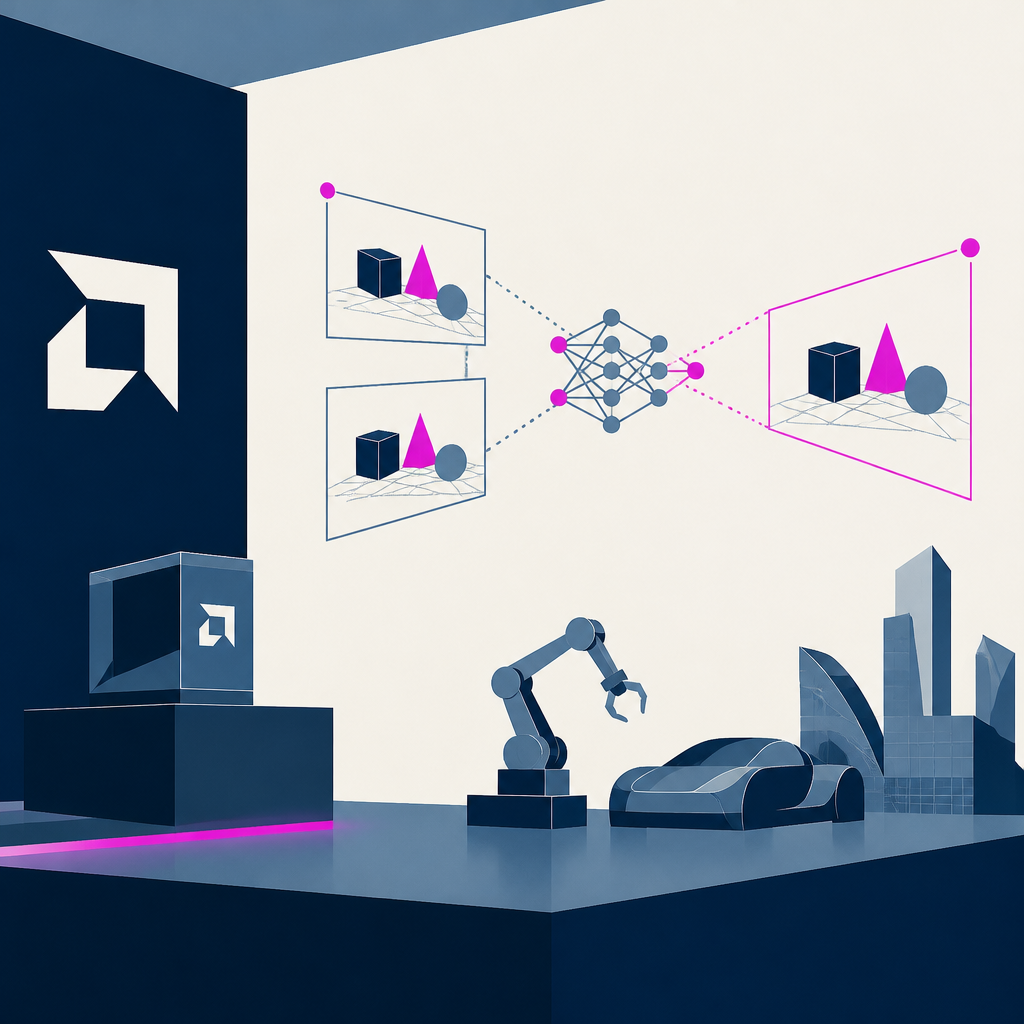
AMD bought World Labs for $8.2B, and World Labs says its Atlas spatial-intelligence model predicts the next camera view from 2D images to address sparse reconstruction in multiview geometry. Atlas is presented as improving results versus specialized models and applying to robotics simulation, design/engineering, science, and real-world reconstruction. The acquisition and Atlas work together to expand AMD’s (through World Labs) capabilities for spatial intelligence and robotics-related use cases.
AMD is acquiring World Labs, the two-year-old physical AI startup cofounded by Fei-Fei Li. The all-stock deal is valued at $8.2 billion. The acquisition will bring World Labs’ AI and world-model technology and team into AMD, with Li joining as executive VP and chief scientist and AMD expected to advance physical-AI hardware and compete more closely with Nvidia.
Every AI story that matters,
in your inbox by 8am.
TLDRocket reads all relevant sources, removes duplicate coverage, and summarises the
day in two minutes. Follow companies and topics for alerts, or get the
briefing in Slack. Free, no spam, unsubscribe anytime.
Reading TLDRocket needs no cookies, and the readership counts we rely on come from
our own cookieless analytics. Google Analytics is the exception: it sets cookies and
reports to Google, so it stays switched off until you allow it. You can change your
mind any time from “Cookie settings” in the footer.
Strictly necessary
Session security and form protection (tldrocket-session,
XSRF-TOKEN, 2 hours). The site cannot work without them,
so they need no consent.
Always on
Google Analytics 4 (_ga,
_ga_<id>, up to 2 years). Measures which
stories and sections readers use. Google acts as a third-party processor and may
store the data outside the EU. No advertising, no profiling, no data sold.