
Ubitium raises $14M to bring universal computing to physical AI
Tech.eu Tamara Djurickovic
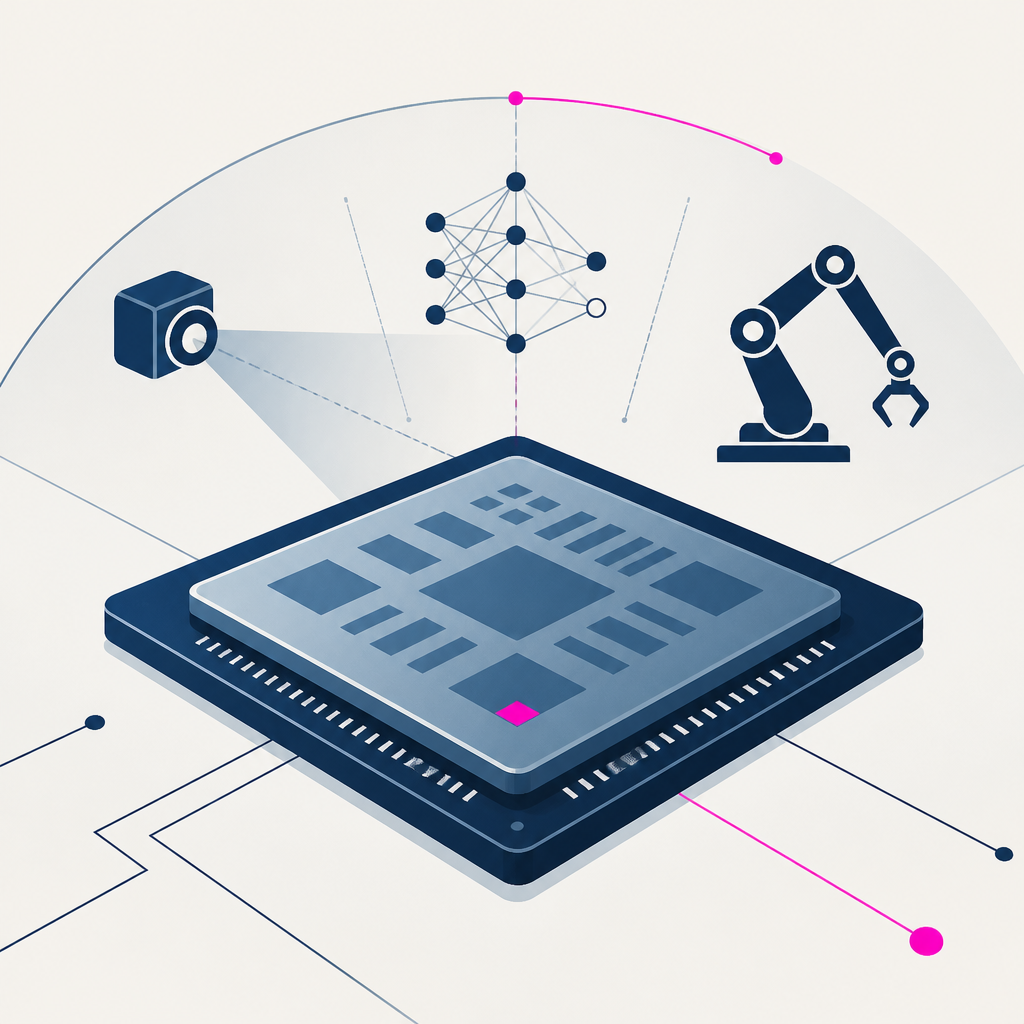
Ubitium just raised $14M to build one chip for sensing, AI and control. It’s trying to cut the chip sprawl that slows robots, drones and other physical AI machines.
Based on reporting by Tech.eu, Tamara Djurickovic — read the original for the full story.
Summary, retelling and take written by AI under human oversight; images are AI-generated illustrations. How we work · Report an error
Ubitium has pulled in $14 million in new seed funding to push its universal processor for physical AI out of the lab and toward a product. The startup says the round lifts its total seed funding to $18 million since it was founded in 2024. Ibex Investors led the deal, with OpenOcean joining in, along with existing backers KBC Focus Fund, Runa Capital and Inflection. Florian Seibel, who co-founded and co-runs Quantum Systems, also invested personally.
The pitch is simple enough, even if the engineering isn’t: robots, drones, vehicles and industrial machines all need to sense the world, infer what’s happening and react in real time. Today, those jobs are usually split across different chips, which means extra data transfers, more software complexity and more moving parts to manage. Ubitium wants to fold those functions into one reconfigurable architecture instead.
That architecture uses programmable processing elements that can shift compute resources between sensing, AI inference and real-time control depending on what the machine needs at the moment. Ubitium says it pairs that with unified memory and standard RISC-V development tools, so manufacturers can work from a common processor and software stack instead of stitching together several specialized chips. The company argues that should reduce both complexity and cost.
There is at least one piece of silicon behind the story. Ubitium’s first chip, the UB108, has 256 processing elements and was built on Samsung’s 8nm process. The company says it has already shown signal processing, AI inference and real-time control on the same reconfigurable array. Now it is moving on to the UB410, a commercial processor planned with 4,096 processing elements.
Ubitium says the first uses for the UB410 will be high-resolution radar and audio systems, with autonomous systems such as drones also on the list. The funding will help advance that chip toward commercialisation, with tape-out and evaluation units planned for 2027. Hyun Shin Cho, the company’s CEO and co-founder, frames the bet as a practical one: inference is only part of the problem, and the real world still has to be sensed and controlled on separate chips in most systems.
My take — AI-written commentary, not fact-checked reporting
This is the kind of hardware pitch that actually makes sense: fewer chips, less glue code, fewer headaches. Physical AI is already crowded with people selling “autonomy” while pretending the boring parts don’t matter. Ubitium is at least aiming at the boring parts, which is usually where the real product lives.
Read more about this at: Tech.eu
Related stories
 Ultra raises $62 million for fast-growing ‘robots as a service’ business, announces tie-up with AI research firm Physical Intelligence
Fortune ·
44
Ultra raises $62 million for fast-growing ‘robots as a service’ business, announces tie-up with AI research firm Physical Intelligence
Fortune ·
44
 Embedd raises $2.7M to tackle physical AI infrastructure challenge
Startups Magazine ·
46
Embedd raises $2.7M to tackle physical AI infrastructure challenge
Startups Magazine ·
46
 Multiverse Computing targeting up to $570M in latest round
Tech.eu · 2 months ago ·
53
Multiverse Computing targeting up to $570M in latest round
Tech.eu · 2 months ago ·
53