‘They are in a casino’: Broadcom is making billions off the AI boom, but CEO Hock Tan said many AI investors have ‘no clue’ what they’re investing in
Fortune Mia Osmonbekov ● Covered by 7 sources
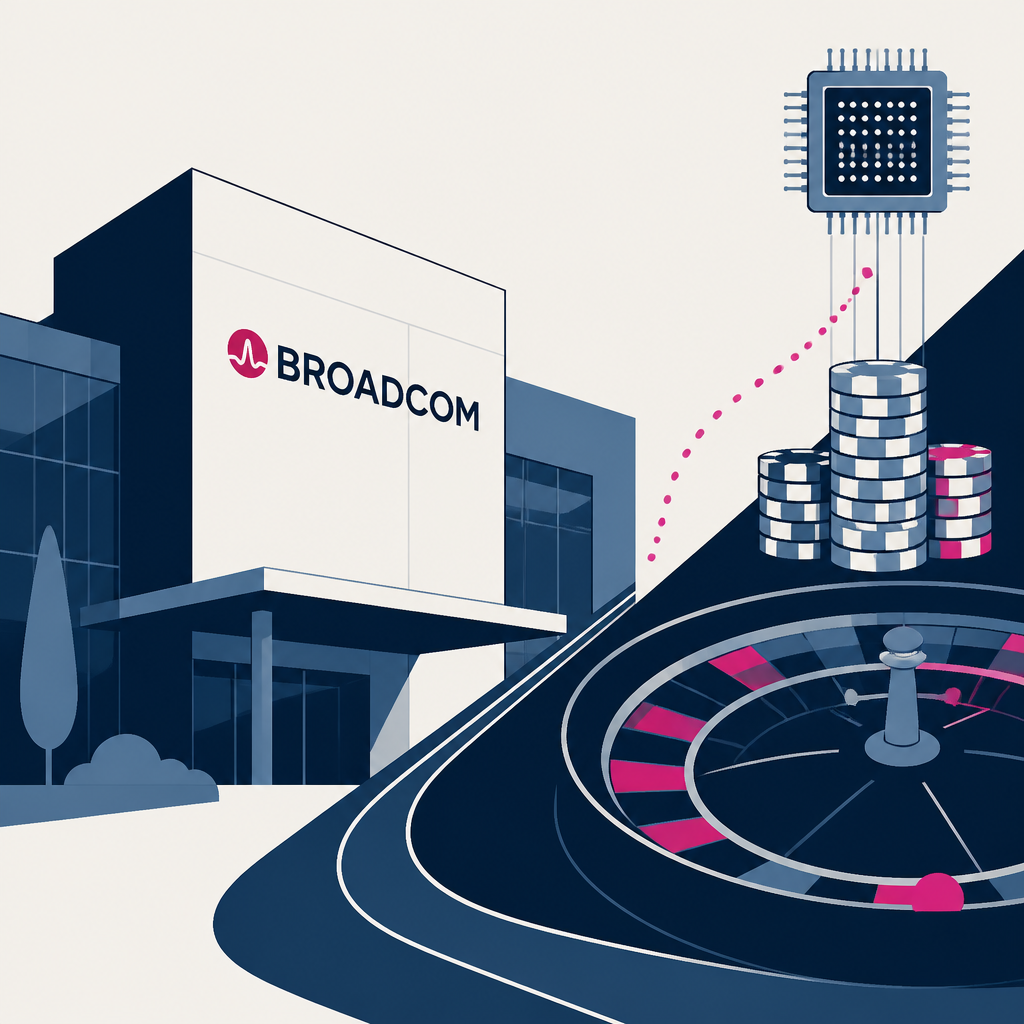
Broadcom is raking in AI-chip money, but Hock Tan says many AI investors are basically gambling. He thinks the real bottleneck may be cash, not chips or power.
Based on reporting by Fortune, Mia Osmonbekov — read the original for the full story.
Summary, retelling and take written by AI under human oversight; images are AI-generated illustrations. How we work · Report an error
Broadcom has turned the AI buildout into a money machine. The company says it has brought in about $68 billion in AI semiconductor revenue since late 2023, and in the fiscal third quarter that ended Aug. 2, AI chip revenue more than tripled from a year earlier to $16.7 billion.
That windfall comes from a simple setup: hyperscalers are throwing billions at data centers, and Broadcom sells the custom chips they need. But on Monday, CEO Hock Tan used a very different tone for the rest of the AI trade. Speaking at the DBS Asia Future Forward Conference in Singapore, he said many investors drawn to AI have “no clue” what they’re buying and are setting expectations so extreme that it feels “almost like they are in a casino,” according to Bloomberg.
Tan’s real concern is not Broadcom’s side of the equation. It’s the economics for the AI labs and the companies using their models. Hardware vendors can sell into the boom, but the labs still have to find paying customers who cover the cost of training and running the systems. Tan pointed to OpenAI’s reported $50 billion in annualized revenue at the end of September as evidence that there may be a business model there, but he said that does not mean profitability is close. OpenAI expects to spend more than $25 billion on training alone this year.
“For now it’s still losing money because they’re spending a lot on training,” Tan said. “So frankly, it doesn’t tell anything at this point except that there is a lot of potential revenue growth out of providing frontier generative AI models.” He also said capital could become the industry’s biggest constraint, even more than shortages of memory, semiconductors or electricity.
That warning is starting to show up in the market. Firmus, an Australian data center company backed by Nvidia, pulled its planned IPO on Oct. 9 after weak investor demand. And while Intel CEO Lip-Bu Tan said hardware could stay tight for another two to three years, Tan’s point was sharper: demand for chips does not automatically mean the buyers of those chips will make enough money to justify the bill.
My take — AI-written commentary, not fact-checked reporting
This is the part of the AI boom everybody keeps skipping over: buying the picks and shovels is not the same as finding gold. Broadcom gets paid either way, which is a lovely place to be. The rest of the market is still trying to prove it isn't just feeding tokens into a very expensive arcade.
Read more about this at: Fortune