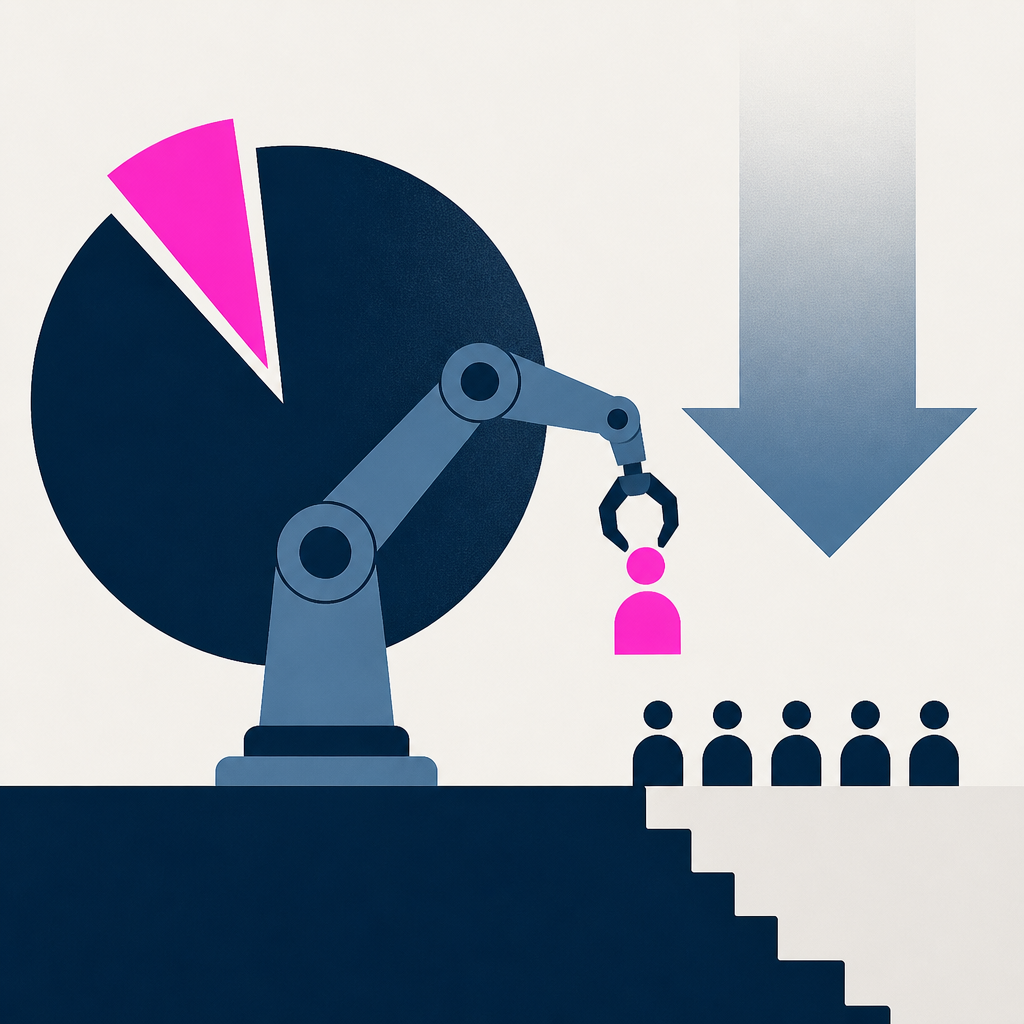
Survey finds 59% of managers use AI for layoff decisions
hrdive.com
A new survey says most managers now lean on AI to help decide who gets laid off or fired. Some are even letting it weigh sick days and age, which is legally dicey territory.
Based on reporting by hrdive.com — read the original for the full story.
Summary, retelling and take written by AI under human oversight; images are AI-generated illustrations. How we work · Report an error
Layoffs used to be a manager's grim, purely human call. Not anymore, apparently. A fresh survey from ResumeTemplates.com, covering 1,000 U.S. managers who use AI at work, found that 59% now bring AI into layoff decisions and 58% do the same for firings. About a quarter of managers said they lean on it "often or all the time" for cuts.
What's getting fed into these models is the part that should raise eyebrows. Sure, 80% ask AI to weigh performance and productivity, which is unsurprising. But 57% also have it factor in attendance, 32% tenure, 31% sick days or medical leave, and 14% age. Julia Toothacre, chief career strategist at ResumeTemplates.com, pointed out the obvious problem: discrimination based on age, disability, or protected medical leave is illegal. Letting an algorithm quietly weigh those things doesn't make the legal exposure disappear, it just adds a layer of plausible deniability.
And the oversight picture is shaky at best. While 57% of managers claim they'd never let AI make layoff calls without supervision, 43% admit to going hands-off sometimes, and 17% do it routinely. Confidence seems to be doing a lot of the work here — 80% of managers who trust the AI let it run unsupervised at least occasionally, versus 52% of those who are only somewhat confident. Meanwhile, 38% of all managers said they've never received any training on the ethical use of AI in HR decisions, and 58% couldn't even confirm whether their company tested the tool for bias in the first place.
There's also a stranger twist buried in the numbers: 34% of managers using AI for layoffs have asked it to judge whether a person's job could just be done by AI instead. Broaden that out and 44% of all managers were asked to weigh in on whether AI could replace a role, and three-quarters of them said yes. Toothacre's warning is blunt — without training, without bias testing, and without a clear record of what the model actually weighed, companies are setting themselves up for discrimination and wrongful-termination claims they won't be able to defend. Other research, including a report from PYX Labs, backs up the concern that these systems struggle with nuance, especially the messy, human parts of open-ended feedback that don't reduce to a score.
My take — AI-written commentary, not fact-checked reporting
Nobody should be shocked that companies rushed to automate the worst part of management before automating any of the boring parts. Handing a black-box model your headcount decisions, without bias testing or training, isn't efficiency, it's outsourcing liability to a system nobody can explain in a deposition. If a manager can't articulate why someone was cut, a judge is going to have real questions, and "the algorithm said so" has never been a winning defense.
Read more about this at: hrdive.com