
Samsung’s chip workers are jumping ship to rival SK Hynix
MIT Technology Review Michelle Kim
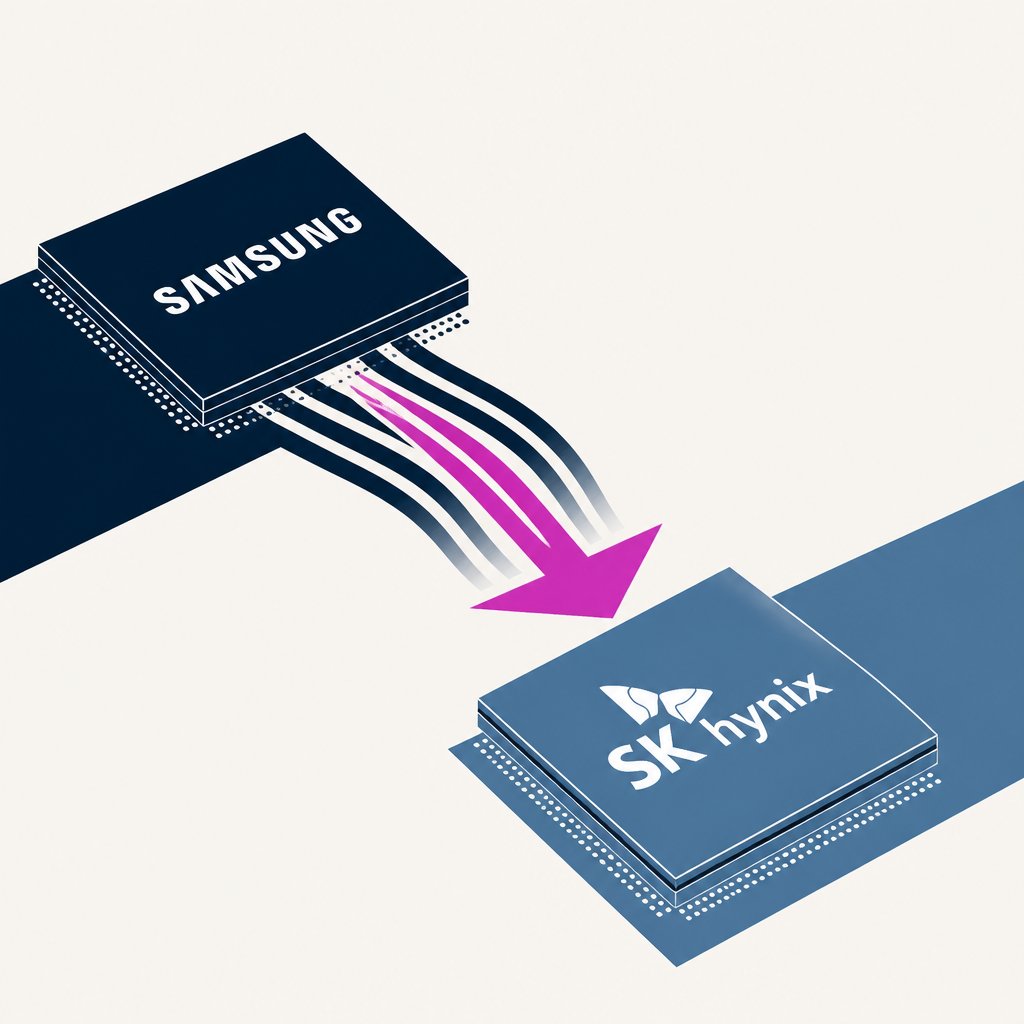
Samsung chip engineers are quitting in droves for rival SK Hynix, chasing bonuses nearly four times bigger. The brain drain could hurt Samsung's edge in the AI memory chips (HBM) powering Nvidia's boom.
Based on reporting by MIT Technology Review, Michelle Kim — read the original for the full story.
Summary, retelling and take written by AI under human oversight; images are AI-generated illustrations. How we work · Report an error
Lee still shows up to his job at Samsung's chip division every day. He just doesn't stay late anymore. Instead he goes home and works on his SK Hynix application, trading personal-statement tips with coworkers who are doing the exact same thing. Even his team lead is telling people to leave. That's not a rogue manager venting — it's basically the mood across Samsung's semiconductor business right now.
The number driving all this is $476,000. That's the bonus SK Hynix employees are getting this year, on the back of record profits from high-bandwidth memory chips that feed Nvidia's AI accelerators. Samsung's foundry workers, by contrast, are looking at roughly $135,000, because Samsung ties bonuses to each division's own performance and the foundry business has been losing money. Even Samsung's memory workers, who make comparable HBM chips, are getting around $400,000 — still short of Hynix's payout. A Samsung labor union survey found 81.5% of foundry employees and nearly half of all semiconductor staff want out within two years. More than 200 union members reportedly left for SK Hynix in just four months earlier this year.
The irony is thick. SK Hynix spent decades as Samsung's less-glamorous little sibling, the memory maker top graduates overlooked. Then in 2019 Samsung shrank its HBM team, betting the tech would stay a niche product, while SK Hynix kept investing. The AI boom proved Samsung wrong in spectacular fashion, and SK Hynix now leads the global HBM market outright, briefly overtaking Samsung as Korea's most valuable company this June. Both firms are now worth over $1 trillion and plan to pour more than $2 trillion combined into new capacity by 2040 — expansion plans that require exactly the engineers who are currently fleeing.
What's actually at stake is Samsung's structural advantage: it's the only memory maker that also owns its own advanced foundry, letting it manufacture the tricky logic base chips that HBM4 requires in-house, while SK Hynix has to outsource that step to TSMC. If Samsung keeps bleeding foundry engineers, researchers like Park Jun-young argue the tight collaboration between its memory and foundry teams could break down — just as SK Hynix starts hiring its own foundry talent and closing that gap. Samsung has already gone to court, winning an injunction blocking two former engineers from joining SK Hynix for 18 months on national-security grounds, a sign of how seriously it's taking the leak.
Meanwhile the daily reality inside Samsung sounds less like a battle for AI supremacy and more like quiet resignation. Choi, a seven-year veteran once praised in performance reviews, says he and his team now spend their spare time tracking new SK Hynix job postings instead of doing extra work for a company that, in his words, gives him no reason to bother anymore.
My take — AI-written commentary, not fact-checked reporting
This is what happens when a company tries to run a talent-and-technology race using an accounting spreadsheet instead of a strategy. Samsung built the one asset — an in-house foundry — that could have made it untouchable in HBM4, and it's now watching that advantage evaporate because it couldn't stomach paying foundry engineers like their memory colleagues. If you want to know why Korea's chip industry keeps underestimating scrappy challengers, start with a bonus formula that punishes the division holding your future.
Read more about this at: MIT Technology Review
Related stories
 Samsung Reveals New 3D-Memory Roadmap in Bid for AI Tech Lead
Bloomberg · 1 month ago ·
50
Samsung Reveals New 3D-Memory Roadmap in Bid for AI Tech Lead
Bloomberg · 1 month ago ·
50