
Samsung Reveals New 3D-Memory Roadmap in Bid for AI Tech Lead
Bloomberg ● Covered by 3 sources
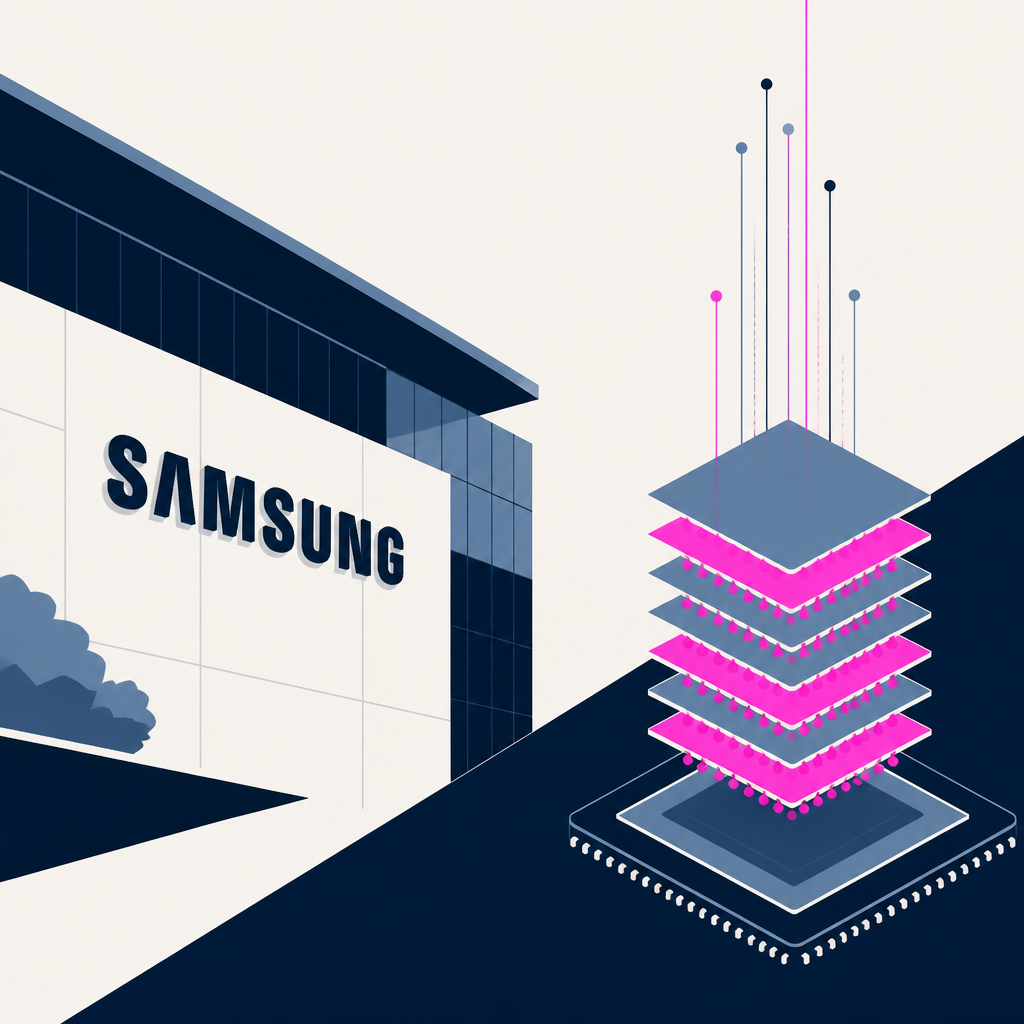
Samsung just unveiled a plan to stack memory chips right on top of AI processors instead of beside them. That could make future AI chips way faster and denser, and it's aiming to beat rivals to market with HBM4 later this year.
Based on reporting by Bloomberg — read the original for the full story.
Summary, retelling and take written by AI under human oversight; images are AI-generated illustrations. How we work · Report an error
Samsung is done thinking about memory and processing as separate neighborhoods. Its new roadmap calls for stacking high-bandwidth memory directly on top of AI accelerators, rather than placing them side by side on a chip package the way HBM has worked for years. The company says this vertical approach delivers roughly eight times the performance of upcoming HBM5 chips, along with more than ten times the memory density.
That's a bold claim, and it's arriving at a moment when the entire AI industry is bottlenecked less by raw compute and more by how fast data can move between memory and processors. Nvidia's GPUs are only as good as the memory feeding them, and HBM has become the quiet battleground where Samsung, SK Hynix, and Micron fight for dominance in AI infrastructure. Stacking memory directly onto the accelerator shortens the distance data has to travel, which is exactly the kind of physical constraint that's been limiting how much faster these systems can get.
Samsung isn't waiting around to prove out this 3D-stacking idea before shipping product, either. The company says it will ramp up mass production of HBM4, the current-generation standard, in the second half of this year. That's a direct shot at SK Hynix, which has held the lead in HBM4 supply deals with Nvidia and other AI chipmakers. Getting HBM4 out the door at volume matters just as much as the flashier long-term roadmap, since customers building next-gen AI servers need supply now, not in three years.
What Samsung is really betting on is that the next leap in AI hardware won't come from a single faster chip, but from rethinking the plumbing between chips. If the eight-times performance figure holds up outside a lab demo, it would reshape how AI hardware makers design entire server racks, not just individual chips.
My take — AI-written commentary, not fact-checked reporting
Samsung loves a big roadmap slide, and eight-times-faster numbers always deserve a raised eyebrow until third-party benchmarks show up. Still, the underlying instinct is right: memory bandwidth, not raw FLOPs, is the actual ceiling on AI progress right now, and whoever solves the physical packaging problem first gets to set the pace for everyone else's chip designs. Worth watching whether Nvidia actually adopts this before crowning a winner.
Read more about this at: Bloomberg