Revealing a key protein behind heart disease
Google DeepMind
Scientists finally mapped the huge protein that shapes 'bad cholesterol,' using AlphaFold plus microscopy. It's a 50-year puzzle solved, and it could reshape heart disease treatment.
Based on reporting by Google DeepMind — read the original for the full story.
Summary, retelling and take written by AI under human oversight; images are AI-generated illustrations. How we work · Report an error
For half a century, apoB100 sat there taunting biochemists. It's the scaffold protein that gives LDL — bad cholesterol — its structure, and it's a monster: too big, too tangled up with fats, too weirdly shaped for standard imaging tools to pin down. Researchers knew it mattered enormously. Atherosclerotic cardiovascular disease, the condition LDL drives, remains the single biggest killer on the planet. Knowing exactly how apoB100 is built matters if you ever want to interrupt that process with precision rather than guesswork.
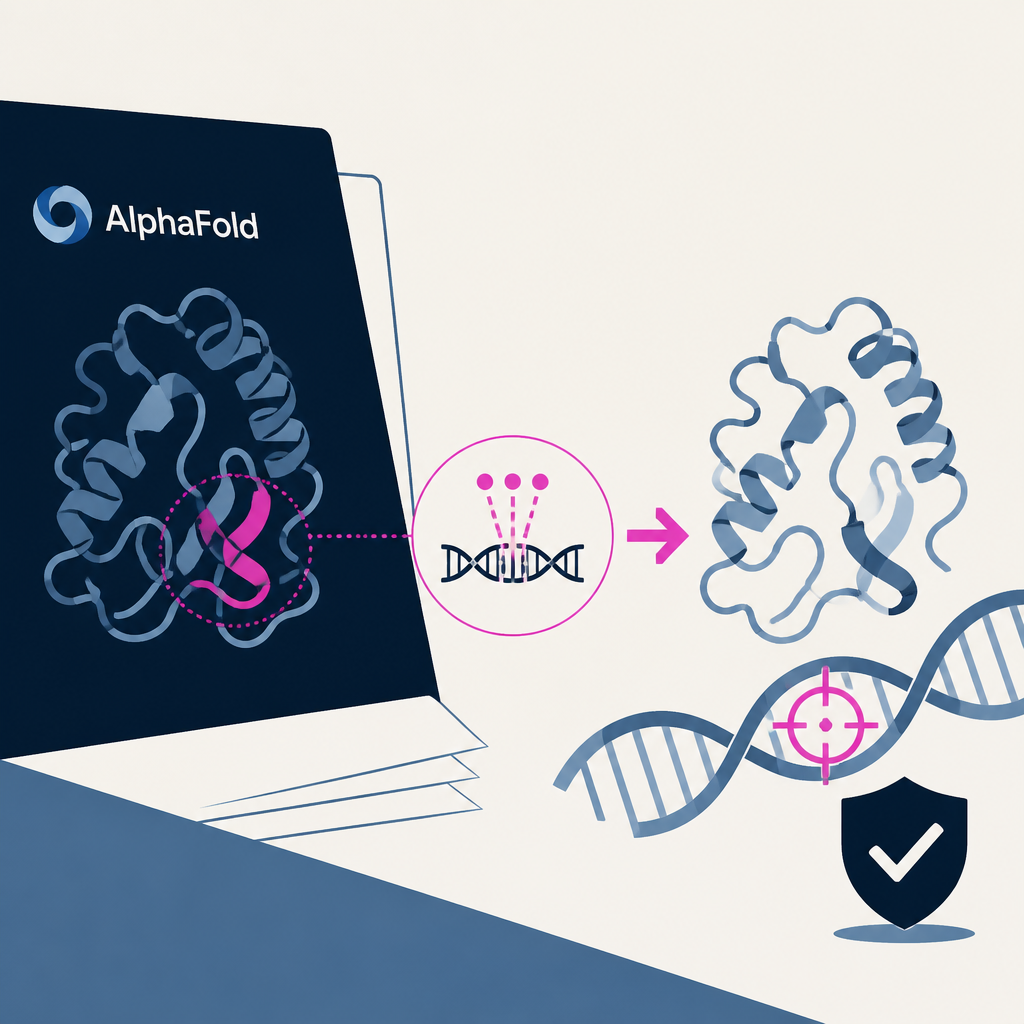
The breakthrough came out of the University of Missouri, from two assistant professors who each have skin in the game — literally, given their family histories with heart disease. Zachary Berndsen, a biochemist, started with cryo-electron microscopy, capturing images of actual LDL particles. But the resolution wasn't good enough to place atoms exactly where they belong. That's where his collaborator, physicist Keith Cassidy, stepped in with AlphaFold, generating atomic-level structural predictions and then cross-checking them against the blurry experimental images until the two datasets locked together.
Neither tool alone would have cracked it. Cryo-EM gave the real-world shape; AlphaFold gave the fine detail needed to interpret it. Cassidy calls the AlphaFold contribution 'profound,' saying it handed them raw material that simply didn't exist as an option before. The result is a startlingly clear picture: apoB100 forms a cage-like shell wrapped around each LDL particle, held together by a ribbon-like belt that keeps the whole thing from falling apart as it travels through the bloodstream.
That structural map doesn't cure anything by itself, and the path from structure to therapy is long — nobody's pretending otherwise. But now researchers have an actual blueprint to design drugs that target LDL more precisely, rather than blunt interventions aimed at cholesterol levels broadly. For Berndsen, there's a nice bit of symmetry here too: apoB100 was the very first structure he ran through AlphaFold the week it launched, and the first thing he pointed his lab's cryo-EM machine at. Fifty years of frustration, closed out by pairing an old imaging technique with a new prediction engine.
My take — AI-written commentary, not fact-checked reporting
This is exactly the kind of AlphaFold story that doesn't get enough attention next to all the chatbot hype — a genuinely hard biological puzzle cracked because a prediction model and old-school microscopy filled in each other's blind spots. I'd rather see ten more headlines like this than another leaderboard benchmark, because heart disease kills more people than any AI safety debate ever will, and DeepMind's actual receipts here are structural biology, not marketing copy.
Read more about this at: Google DeepMind