
How a Google DeepMind Spin-off Hunts Hidden Drug Targets
IEEE Spectrum Eliza Strickland
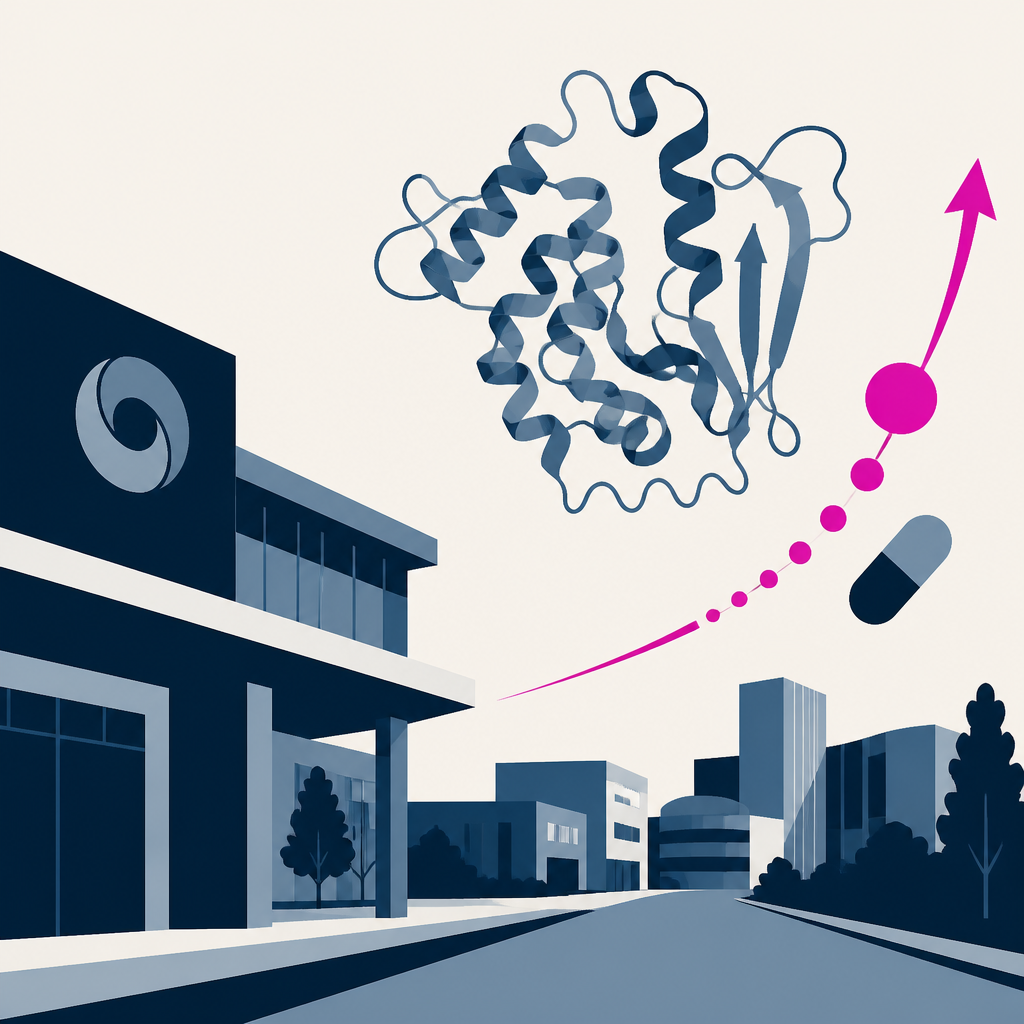
Google DeepMind's drug-discovery spinoff built a new AI system that finds hidden pockets on proteins where medicines could attach. It just proved the model can spot binding sites nobody had ever seen before—even predicting one from a paper published this January.
Based on reporting by IEEE Spectrum, Eliza Strickland — read the original for the full story.
Summary, retelling and take written by AI under human oversight; images are AI-generated illustrations. How we work · Report an error
AlphaFold cracked protein folding and won a Nobel Prize for it, but folding a protein correctly and turning that shape into a usable drug are two very different problems. Isomorphic Labs, spun out of Google DeepMind, has spent the time since AlphaFold3's release building something meant to close that gap: the Isomorphic Drug Design Engine, or IsoDDE, detailed in a technical report published in February.
The core issue, according to Isomorphic machine learning group leader Adrian Stecuła, is that AlphaFold3's accuracy drops off the moment a target protein pocket looks unlike anything in its training data. That's a real problem for drug hunters, because the most promising new medicines often need to hit binding sites nobody has characterized before. IsoDDE is built to handle exactly that scenario, combining structure prediction, pocket identification, and binding affinity prediction into one system rather than treating them as separate problems.
The test case Isomorphic leaned on involves cereblon, a protein central to how cells tag and destroy other proteins, and a category of drugs known as molecular glues. In January, a Nature paper described a newly discovered cryptic pocket on cereblon — a binding site that simply doesn't exist as a cavity until the right molecule forces it open, like a lock that only reveals itself to the correct key. Stecuła's team fed IsoDDE nothing but the protein's sequence and asked it to find that pocket cold. It did, locating the exact site before checking its work against the published structure. The model also correctly placed both the known ligand and the newly discovered one in their proper spots.
What makes this more than a party trick is the target-selection problem it points toward. Plenty of diseases have a protein clearly implicated in causing them, but no obvious way to drug that protein because it lacks a conventional binding pocket. Stecuła argues IsoDDE's real value is surfacing mechanisms that were previously invisible, and that the approach isn't limited to small-molecule drugs — it extends to antibodies, peptides, and molecular glues too.
Still, Stecuła is careful to push back on the idea that solved structure prediction equals solved drug discovery. Isomorphic has raised $2.1 billion and struck partnerships with Novartis and Eli Lilly, and its president Max Jaderberg has talked publicly about agentic AI systems eventually generating and testing their own drug hypotheses. But getting a molecule into a patient still runs through years of trials that no amount of computation can shortcut, and Stecuła's own framing — a unified system with a plethora of endpoints — sounds like a company still building toward that future, not one that's arrived.
My take — AI-written commentary, not fact-checked reporting
I'll believe AI drug discovery has turned a corner when one of these AlphaFold-descended molecules actually clears trials, not when a model retroactively nails a pocket that a wet-lab paper already published in January. That said, retrofitting predictions against fresh experimental data is exactly the kind of unglamorous validation this field needs more of, and Isomorphic deserves credit for showing the receipts instead of just hyping a demo.
Read more about this at: IEEE Spectrum
Related stories
 Why AlphaFold Didn't Solve Protein Folding — Pushmeet Kohli, Google DeepMind & Sal Candido, Biohub
Latent Space · 1 week ago ·
39
🔬 The Coolest Diffusion Research Isn't in LLMs — Evan Feinberg & Sergey Edunov, Genesis Molecular AI
Latent Space · 3 months ago ·
45
Why AlphaFold Didn't Solve Protein Folding — Pushmeet Kohli, Google DeepMind & Sal Candido, Biohub
Latent Space · 1 week ago ·
39
🔬 The Coolest Diffusion Research Isn't in LLMs — Evan Feinberg & Sergey Edunov, Genesis Molecular AI
Latent Space · 3 months ago ·
45