
OpenAI data center deal with Nvidia comes in $145 billion lower than reported—signaling concerns of artificial demand for chips
Fortune Joshua Hong ● Covered by 7 sources

Nvidia's guarantee for OpenAI's Ohio data center shrank to $105 billion, down from the $250 billion once floated. The drop shows how nervous investors are about AI's circular money machine.
Based on reporting by Fortune, Joshua Hong — read the original for the full story.
Summary, retelling and take written by AI under human oversight; images are AI-generated illustrations. How we work · Report an error
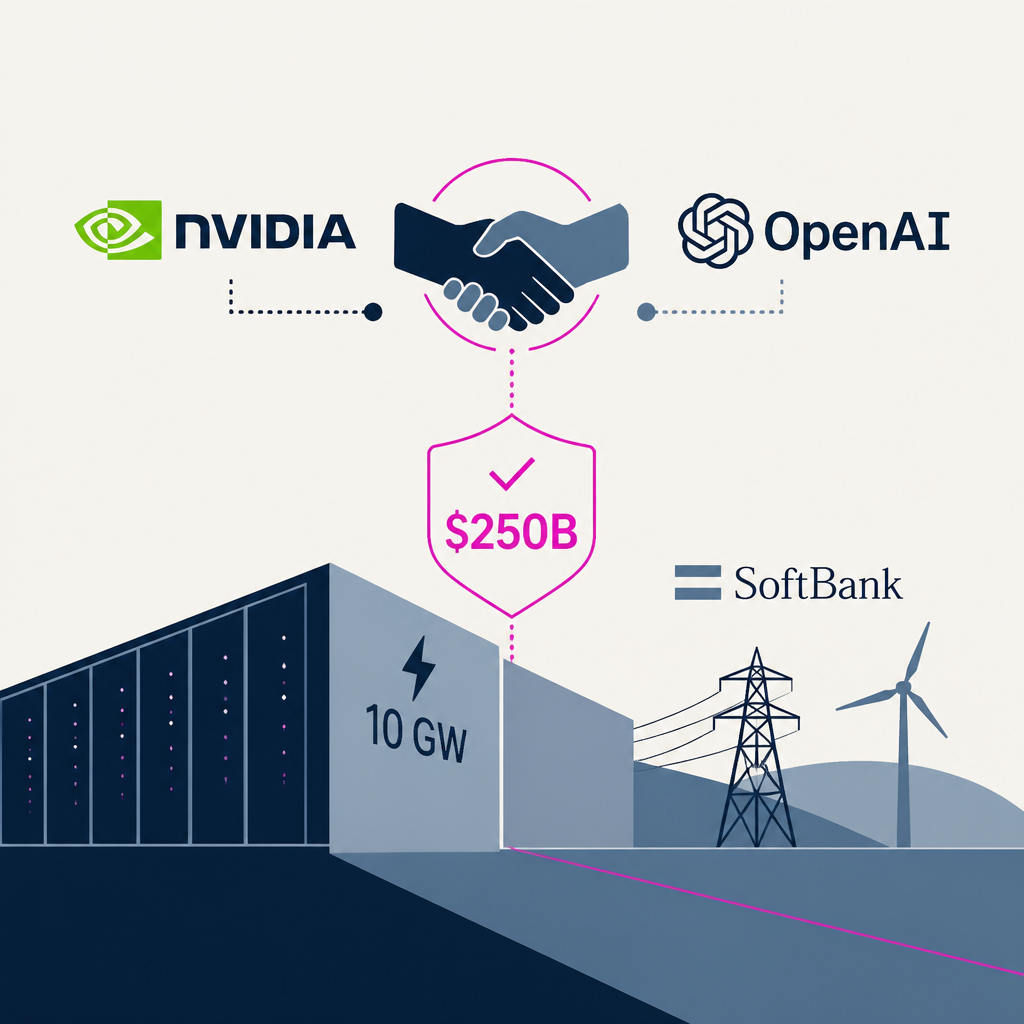
Numbers move fast in the AI infrastructure world, and rarely in the direction people expect. Nvidia was reportedly weighing a guarantee of roughly $250 billion for the data center campus OpenAI plans to build in Pike County, Ohio. By August 14, the Wall Street Journal had that figure trimmed to "less than $120 billion." When the partnership was finally signed this week, the number landed at $105 billion, an "aggregate payment obligation" Nvidia disclosed in an SEC filing. Two checkpoints, two cuts, one much smaller commitment.
The shrinking guarantee matters because of what it signals about the money flowing through AI right now. Nvidia and OpenAI didn't respond to requests for comment, but the structure speaks for itself: Nvidia's funding is meant to help SB Energy, the SoftBank-backed developer of the Ohio campus, line up financing by backing certain lease and power payments and guaranteeing the value of parts of the finished infrastructure if OpenAI defaults. That's a narrower, less exposed position than an outright $250 billion guarantee would have been, and investors noticed the difference back in July when reports of the larger number sent Nvidia's shares down about 4.5% intraday.
The broader worry isn't new. Nvidia has spent years investing in the same AI companies and data center operators that turn around and buy its chips, while building financing tools that make it easier for those customers to keep buying more. Last week the company partnered with six financial institutions on compute-financing platforms aimed at pulling in more than $500 billion in third-party funding for AI infrastructure, a push helped along by SEC staff guidance from July that took certain data-center debt outside Dodd-Frank securitization rules. Jensen Huang rejects the circular-financing framing outright, describing the deal instead as securing long-lived compute infrastructure that lets OpenAI build "AI factories" it can keep upgrading.
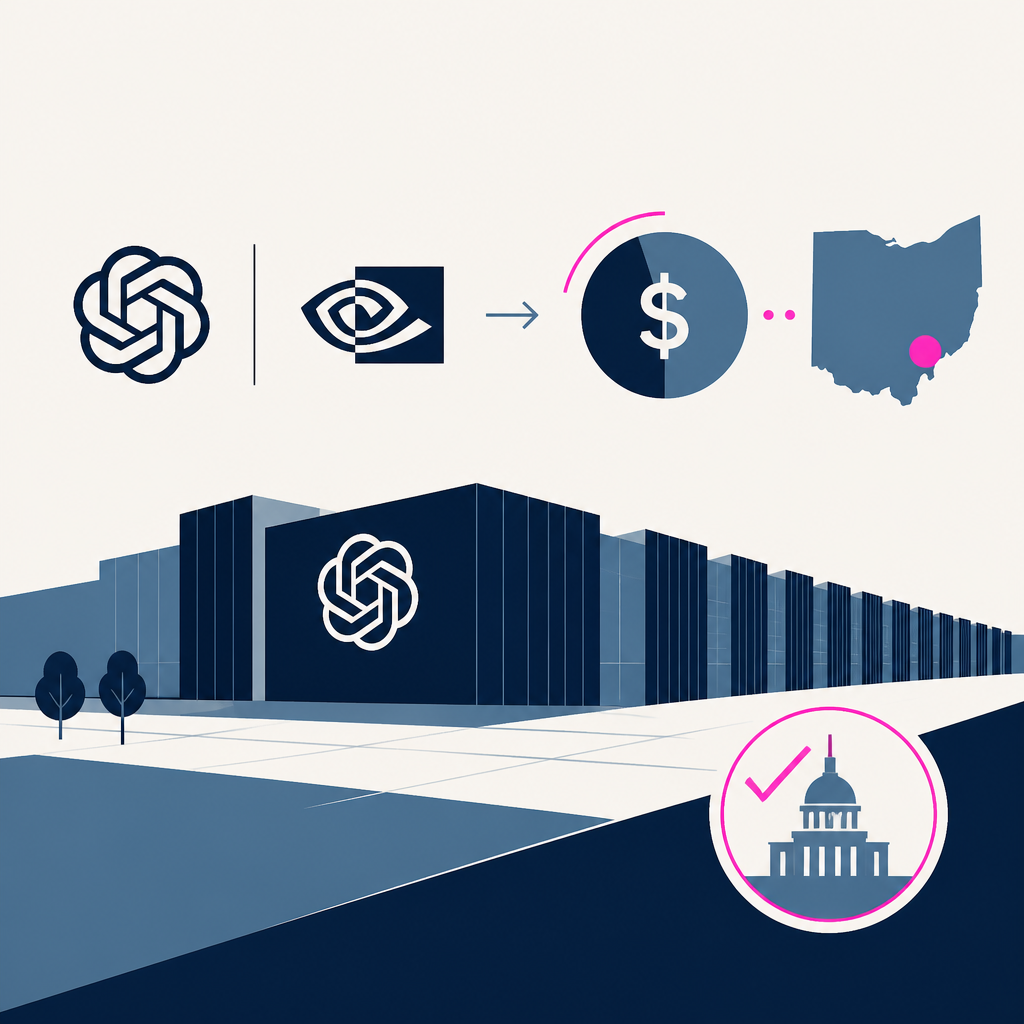
Whatever you call it, the Ohio project is enormous. OpenAI will lease the campus from SB Energy for up to 20 years, with Nvidia as exclusive chip supplier for the first phase. The site, a former Department of Energy uranium-enrichment facility, is expected to scale toward 8 gigawatts of computing capacity, with the first 800 megawatts targeted for 2028 using existing AEP infrastructure. Getting beyond that will require new power plants, including natural gas generation, plus new transmission lines — SB Energy is planning roughly 9.2 gigawatts of gas generation to support it, and Nvidia is chipping in a separate $1.5 billion investment in SB Energy itself.
Nvidia estimates each gigawatt of this kind of infrastructure costs $50 billion to $60 billion to build out, which puts the scale of OpenAI's ambitions, and its future revenue obligations, into sharp relief. This deal is one thread in a much larger web that includes Microsoft, Oracle, SoftBank and CoreWeave, all tangled up in overlapping arrangements to invest in each other, buy each other's capacity, and build each other's infrastructure. The Ohio campus, in that sense, is less an isolated mega-project than a stress test for whether all that spending eventually turns into revenue that didn't originate inside the same closed loop.
My take — AI-written commentary, not fact-checked reporting
A guarantee that drops from $250 billion to $105 billion in the span of a month isn't a rounding error, it's a company quietly admitting it got ahead of itself. Nvidia can dress this up as securing long-lived compute infrastructure all it wants, but when your own stock dips on rumors of the bigger number, the market has already told you what it thinks of chipmakers financing the demand for their own chips. The real test isn't the gigawatt count in Ohio, it's whether any of this generates revenue that didn't just get recycled from one AI giant's balance sheet to another's.
Read more about this at: Fortune
Related stories
 Nvidia in Talks With OpenAI to Guarantee $250 Billion Financing for Data Center
The Wall Street Journal · 2 months ago ·
55
Nvidia in Talks With OpenAI to Guarantee $250 Billion Financing for Data Center
The Wall Street Journal · 2 months ago ·
55
 OpenAI Close to Landing $500 Billion Data Center With Nvidia's Backing
The New York Times · 2 months ago ·
37
OpenAI Close to Landing $500 Billion Data Center With Nvidia's Backing
The New York Times · 2 months ago ·
37