
NVIDIA Transforms European Retail, From Digital Discovery to Physical Operations
NVIDIA Blog Mavi Nafria ● Covered by 2 sources
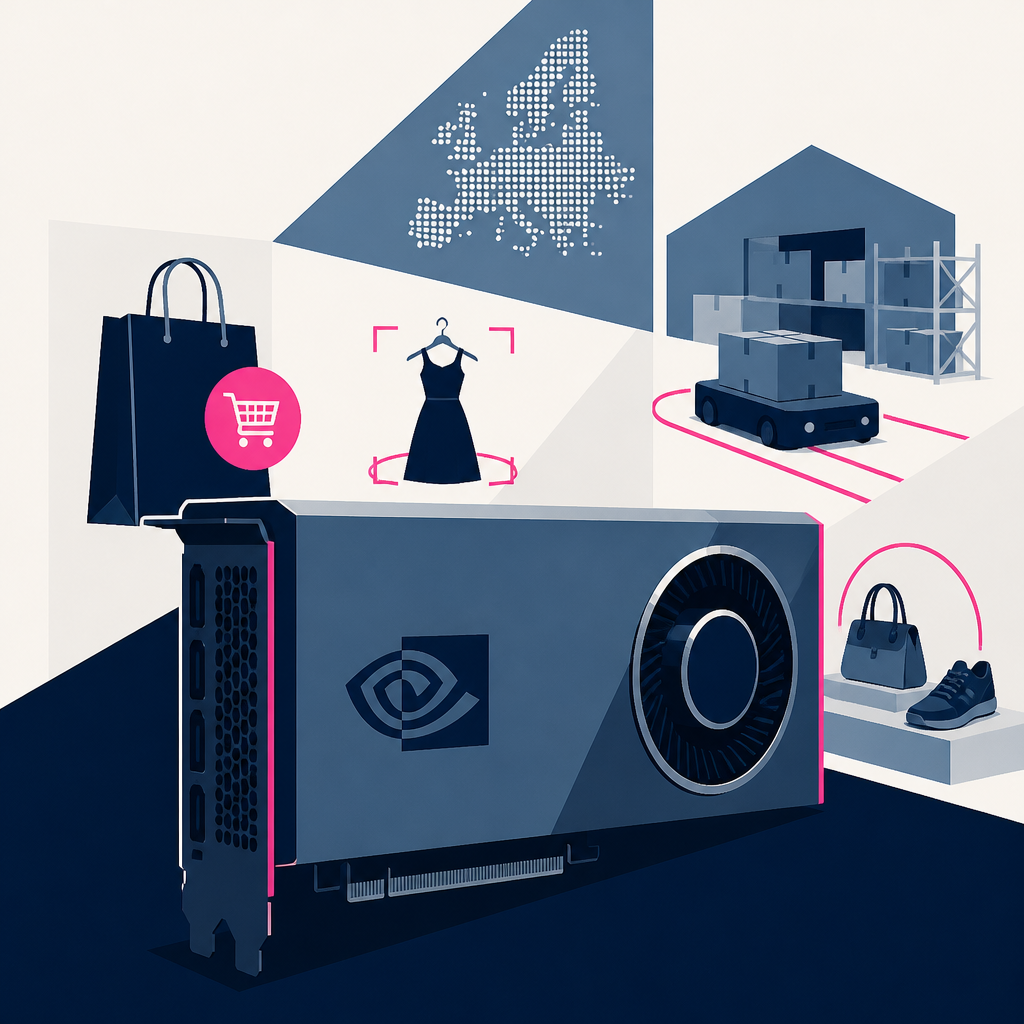
European retailers are using NVIDIA models and digital twins to cut costs and simulate stores. Some are seeing faster search, cheaper inference, and better product listings without moving more data around.
Based on reporting by NVIDIA Blog, Mavi Nafria — read the original for the full story.
Summary, retelling and take written by AI under human oversight; images are AI-generated illustrations. How we work · Report an error
European retail is getting a very practical AI makeover. NVIDIA’s latest examples aren’t about flashy chatbots. They’re about merchants, warehouses and catalogs doing more work with less friction, whether that means cheaper inference, better search, or a warehouse that can be tested before anyone pours concrete.
Shopify is the sharpest proof point in the batch. The company is post-training open models and using NVIDIA Megatron Bridge and NeMo RL to speed up fine-tuning and reinforcement learning. It has already post-trained NVIDIA Nemotron 3.5 Lightning for the GraphQL subagent inside Sidekick, Shopify’s AI assistant for merchants. On Shopify’s internal benchmark, that model beat a leading frontier model in accuracy while cutting serving costs by 90% and returning answers 7x faster.
And that was only the start. NVIDIA says CCluster vLLM inference optimization software helped Shopify improve performance by 4.5x and cut inference costs by up to 12x across five other uses, including catalog enrichment, merchant assistant work, shopping simulation, taxonomy classification, and recommendations. Zooplus, meanwhile, used Infosys and NVIDIA tools to rebuild product discovery for the agentic era, with a prototype in its AWS environment reaching 86% search accuracy through NVIDIA Nemotron Retriever and a retail catalog enrichment blueprint.
The physical side is getting the same treatment. Otto Group pushed its autonomous warehouse work to its largest fulfillment center in Haldensleben, Germany, using Reply and NVIDIA Omniverse libraries on Google Cloud to design and test operations in simulation before touching the real site. ALLSIDES is using its 3D Digital Twin Factory to turn objects into SimReady digital twins in minutes, with enough accuracy to support store-layout simulation and checkout tracking under changing light. Its platform already serves adidas, Amazon, Nike, Zalando and Zara.
The fashion and beauty examples are even more blunt about what this tech is for: fewer mistakes, faster listing, faster experimentation. Photoroom says its image pipeline with Vestiaire Collective standardizes about 40,000 primary images a day across 70 countries, and those listings sold at a 5% higher liquidity rate with 3% to 7% more unique views per page. Omi’s ProductDrop keeps generated images tied to approved digital twins, while L’Oréal is using that idea in CreAItech and also speeding ingredient screening from months to hours with NVIDIA ALCHEMI. This is what retail AI looks like once the demos stop pretending the point is conversation.
My take — AI-written commentary, not fact-checked reporting
The interesting part isn’t that retail is adopting AI. It’s that the winners are the boring parts: catalogs, replenishment, search, listings, warehouse planning. That’s where the money leaks out, not in the flashy demo booth. Europe’s retailers seem to get this, which is refreshing for an industry that usually discovers automation one painful stockout at a time.
Read more about this at: NVIDIA Blog
Related stories
 European Cities Deploy NVIDIA-Powered AI Agents to Run Smarter Urban Operations
NVIDIA Blog · 1 week ago ·
4
 NVIDIA Cloud Partners Scale Across Europe — Sovereign, Open and Built for Safe AI Agents
NVIDIA Blog · 1 day ago ·
2
 The Nordics and NVIDIA Show What’s Possible When a Region Commits to Advanced Computing
NVIDIA Blog · 1 week ago ·
13