
Laplace Intelligence red-teams robots and self-driving cars before they hit the real world
TechCrunch Rebecca Bellan
Laplace is using AI to stress-test robots and self-driving cars before they ship. Its bet: machines should find the failures first, not the real world.
Based on reporting by TechCrunch, Rebecca Bellan — read the original for the full story.
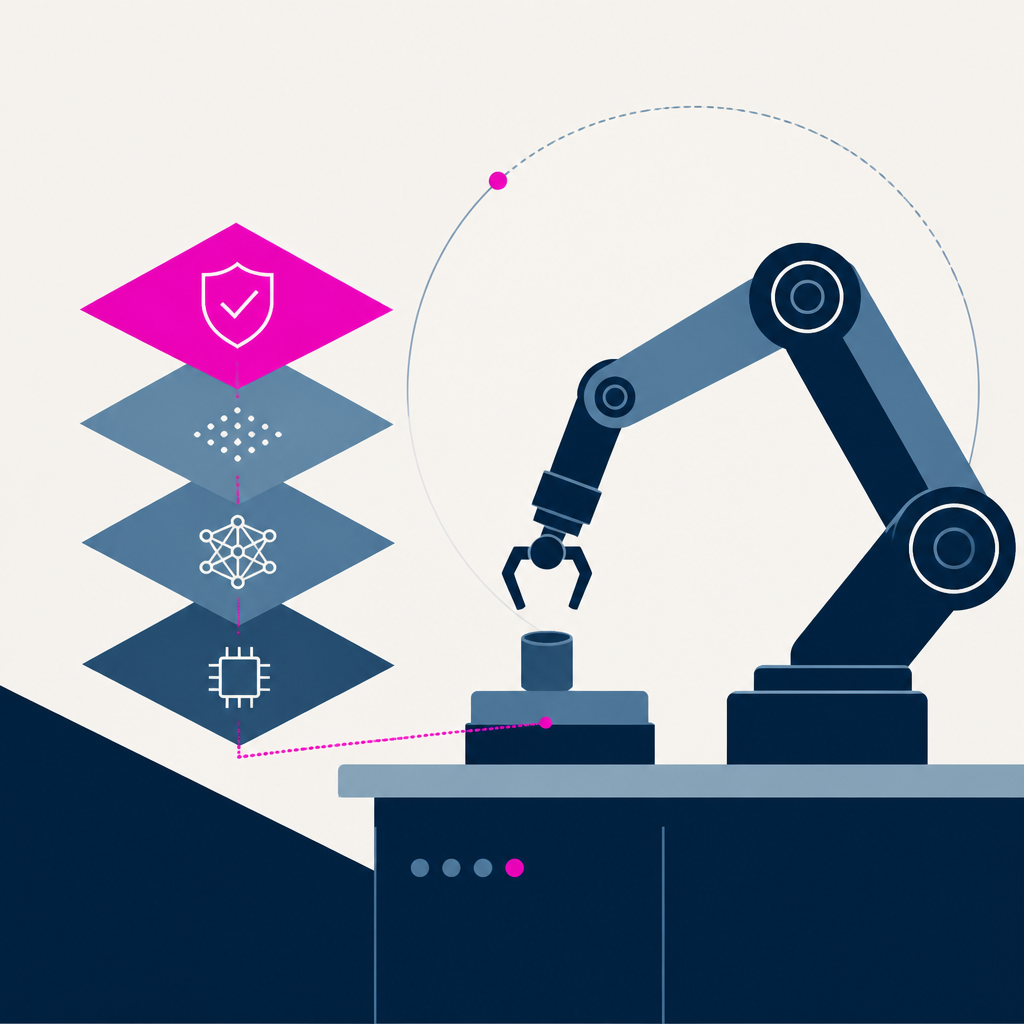
Summary, retelling and take written by AI under human oversight; images are AI-generated illustrations. How we work · Report an error
A startup out of Ann Arbor wants to make sure robots and self-driving cars get embarrassed in simulation, not on a street with pedestrians. Laplace Intelligence is building automated red-teaming for physical AI: software that deliberately hunts for the weird, rare failure cases before deployment. The company’s pitch is simple and a little unsettling. If AI agents can be unpredictable on a computer, what happens when they’re controlling something with wheels, arms, or both?
CEO and co-founder Howie Sun says the company is trying to push testing into a more dynamic phase, where AI checks AI. Laplace was founded a year ago by Sun and chief scientist Henry Liu, then his PhD advisor, after years of academic work on autonomous driving simulation. Their 2023 paper landed on the cover of Nature and started pulling in interest from autonomous vehicle companies. Sun, who has spent eight years in academia, says that was the point where the research stopped feeling purely academic.
The product sits on top of a high-fidelity simulation built from real-world data and a post-trained version of Nvidia’s Cosmos. Laplace can reconstruct places like an Arizona highway or a Paris pedestrian crossing by blending map data, Street View imagery, and other sources. Developers can then tweak the scene with language prompts, such as adding afternoon traffic. Sun says the company also pulls live traffic and congestion data from navigation providers like TomTom. In demos, the simulation is interactive enough that other vehicles react too, instead of behaving like props.
That interactive bit matters because Laplace isn’t just trying to recreate the world. It’s trying to provoke it. The startup’s AI agents are designed to create corner cases from sources like news and police collision reports, moving humans further out of the loop. That’s especially relevant for generalized robotics, where Sun argues there simply isn’t enough data yet to know what the dangerous edge cases will be.
Laplace is already making money, mostly from autonomous driving customers. Those include Isuzu, Bot Auto, and Nvidia, and it is also working with T-Mobile on a free smart city pilot for San Jose. The company is in the early stages of working with humanoid robotics partners for warehouses. It is project-based for now and wants to turn that into recurring revenue, while using its Disrupt appearance to raise money and scale against better-funded rivals like Applied Intuition.
My take — AI-written commentary, not fact-checked reporting
This is the right kind of paranoia. Physical AI doesn’t need more demo videos; it needs more ways to fail privately, cheaply, and repeatedly. The industry loves to talk about autonomy, then acts surprised when reality behaves like reality. Benchmarks are cute. Corners, traffic, and bad assumptions are where the bill comes due.
Read more about this at: TechCrunch
Related stories
 Why Deploying Physical AI at Scale Demands Safety at Every Layer
NVIDIA Blog · 3 weeks ago ·
50
Why Deploying Physical AI at Scale Demands Safety at Every Layer
NVIDIA Blog · 3 weeks ago ·
50