
Why Deploying Physical AI at Scale Demands Safety at Every Layer
NVIDIA Blog Riccardo Mariani

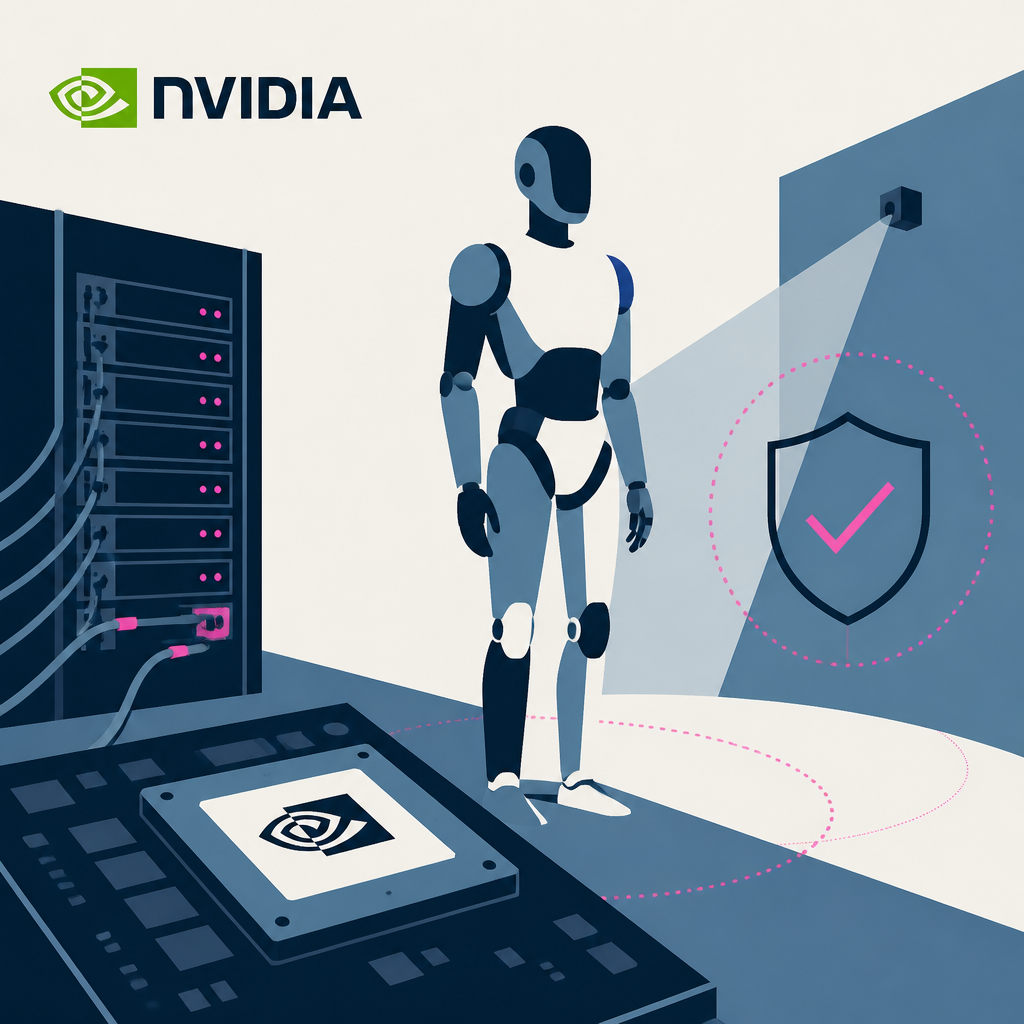
NVIDIA says physical AI needs safety built into every layer, not added at the end. That matters as AVs and robots move from pilots into roads, factories and warehouses.
Based on reporting by NVIDIA Blog, Riccardo Mariani — read the original for the full story.
Summary, retelling and take written by AI under human oversight; images are AI-generated illustrations. How we work · Report an error
Physical AI is leaving the lab and heading for places where mistakes have weight. NVIDIA says that shift means safety can’t be a final checkbox anymore. It has to cover the hardware, the software, the AI itself, the operating environment and the whole deployment lifecycle.
The scale now being discussed is not small. ABI Research projects 49 million level 3-5 autonomous vehicles installed by 2035, and Omdia expects roughly 60 million industrial robots to be deployed between 2026 and 2035. Put those systems into roads, factories and warehouses, and the old idea of safety as a pre-launch review starts to look thin.
NVIDIA’s pitch is that physical AI needs a different model because the world keeps changing around it. Roads and factories aren’t neat test tracks. Systems have to handle shifting conditions, update through software and model changes, take on new tasks and still know how to reach a safe state when something goes wrong. That means testing AI behavior alongside traditional functional safety, not pretending one covers the other.
The company is tying that argument to Halos, which it calls the first full-stack safety system for physical AI. For autonomous vehicles, that includes DRIVE AGX Thor, Hyperion, Halos OS, Halos Core, Halos Middleware, Alpamayo and the Halos Safety Evaluation Framework. For robotics, the stack includes IGX Thor, Halos Core for IGX, Holoscan Sensor Bridge, Isaac Lab, Omniverse libraries and an outside-in safety blueprint built around external cameras and vision AI agents.
There’s also a certification angle here, and NVIDIA leans hard on it. TÜV SÜD has certified parts of its automotive software process and DriveOS 6.0 to ISO 26262 ASIL D, while TÜV Rheinland has done an independent UNECE safety assessment of NVIDIA DRIVE AV. On the robotics side, TÜV Rheinland is inspecting IGX Thor, Halos OS and Holoscan Sensor Bridge for readiness, and ANAB has accredited the Halos AI Systems Inspection Lab as an ISO/IEC 17020 inspection body. The message is plain: if physical AI is going to scale, it has to survive scrutiny, not just demos.
My take — AI-written commentary, not fact-checked reporting
This is the right fight. Physical AI doesn’t need more swagger; it needs boring, inspectable safety processes that regulators and insurers can actually use. The industry loves to act like autonomy is won with better models alone, but the real moat is proof.
Read more about this at: NVIDIA Blog
Related stories
 Nvidia Seeks to Make Humanoid AI Robots Safer Around Humans
Bloomberg · 2 months ago ·
14
Physical AI Takes the Wheel: How the World’s Robotaxi Leaders Are Building With NVIDIA Technologies
NVIDIA Blog · 1 week ago ·
42
Physical AI’s moment has arrived – but moving from demo to deployment is the hard part. AWS wants to fix that
SiliconANGLE · 4 weeks ago ·
51
Nvidia Seeks to Make Humanoid AI Robots Safer Around Humans
Bloomberg · 2 months ago ·
14
Physical AI Takes the Wheel: How the World’s Robotaxi Leaders Are Building With NVIDIA Technologies
NVIDIA Blog · 1 week ago ·
42
Physical AI’s moment has arrived – but moving from demo to deployment is the hard part. AWS wants to fix that
SiliconANGLE · 4 weeks ago ·
51