
Industrial Next wants factory robots to switch tasks in minutes, not weeks
TechCrunch Aisha Malik
Industrial Next says its robot stations can switch factory jobs in minutes, not weeks. That could make complex manufacturing less brittle, and a lot harder to lock into one product.
Based on reporting by TechCrunch, Aisha Malik — read the original for the full story.
Summary, retelling and take written by AI under human oversight; images are AI-generated illustrations. How we work · Report an error
Most factory robots are still stubborn little specialists. They get one job, one product, one setup, and any real change means reprogramming, retooling, or replacing gear. That can drag on for weeks or even months. Industrial Next says it has built a way out of that trap.
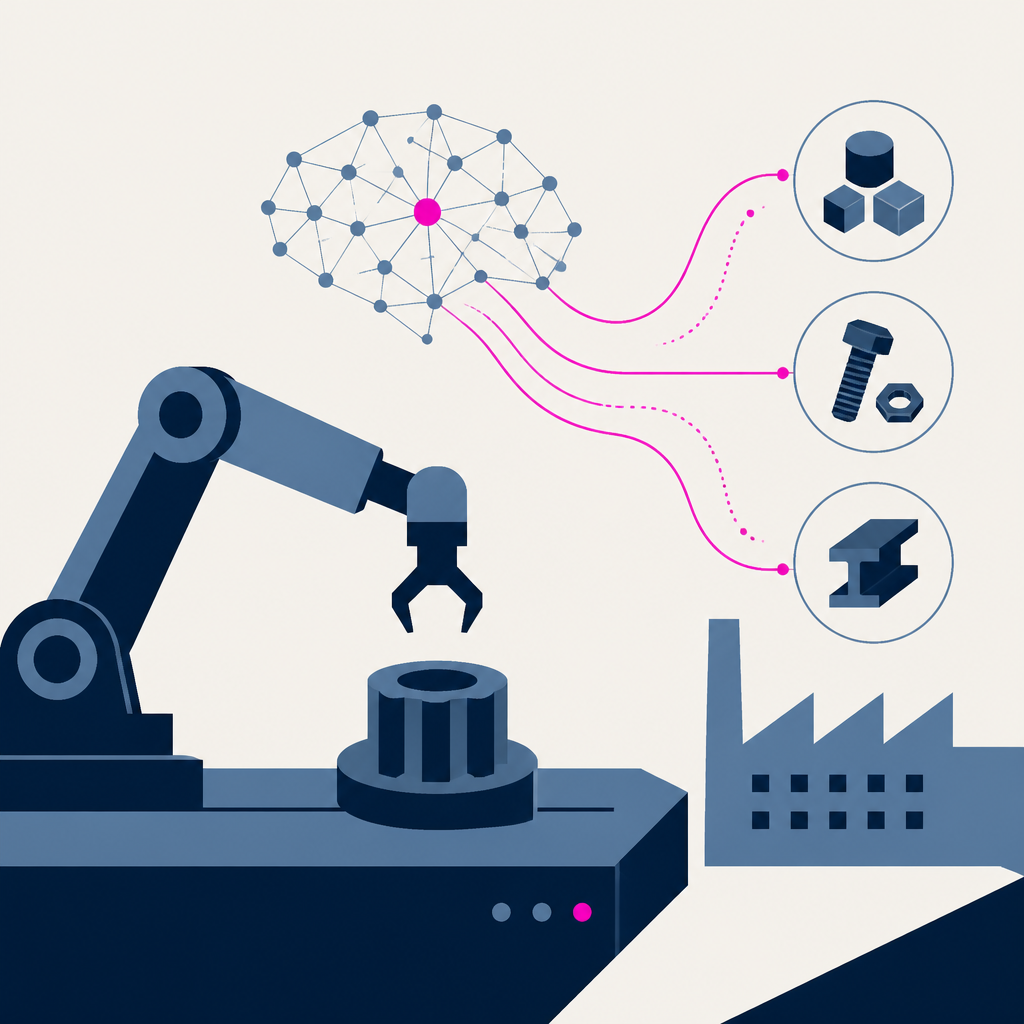
The San Francisco startup showed up on the Startup Battlefield stage at TechCrunch Disrupt 2026 with AI-driven robotic stations that are self-contained and powered by proprietary foundation models. Those models tie together vision, task context, and motion. The pitch is simple even if the tech isn’t: reconfigure a production line in minutes, not weeks, without the old-school programming grind.
That promise is aimed at the awkward middle of manufacturing, where tasks are too delicate or too complex for conventional automation but still happen over and over again. Industrial Next says its stations can be reconfigured, combined, and moved across product lines. New jobs are taught through simulation and demonstration instead of hard-coded scripts. The company says it leans on a high-fidelity simulation engine that gets close enough to real-world dynamics for robots to practice precision work before they ever touch the line.
The founders know the pain firsthand. Industrial Next was founded in 2021 by Lukas Pankau and Allen Pan, both former Tesla employees. Pankau later worked at Waymo, while Pan went on to lead Tesla’s autonomous factory efforts before becoming a chief architect at Neolix and later working at Momenta. The company grew out of years of frustration with factory equipment that couldn’t keep up with the software and vehicle systems being built around it.
Industrial Next says some of its stations are already in use making one of the world’s most popular smartphones. The tasks include threading a fragile flex cable, snapping in a tiny connector cap, and a film-peeling job that the company says runs at or above human speed with 100% accuracy, even after being moved to a new phone model and production line. The startup also announced a partnership with BMW Group Technology Office to evaluate its dexterous manipulation for manufacturing. And yes, the long-term goal is the full car, built end to end without human hands touching it.
My take — AI-written commentary, not fact-checked reporting
This is the rare factory-AI pitch that sounds less like demo theater and more like a real insult to bad industrial software. The interesting part isn’t the robot choreography; it’s the refusal to accept that manufacturing has to stay frozen around ancient equipment just because that’s how it’s always been done. Open-model enthusiasts may love the software layer, but the bigger story is simpler: if the line can change fast, the old automation monopoly starts looking very tired.
Read more about this at: TechCrunch
Related stories
 Forget robots on assembly lines. Foundational Industries wants AI to run the entire factory
Fortune ·
54
Forget robots on assembly lines. Foundational Industries wants AI to run the entire factory
Fortune ·
54