Hugging Face Unveils Microduck: A $399 Open-Source 25 cm Biped You Train with Reinforcement Learning
MarkTechPost Michal Sutter ● Covered by 4 sources
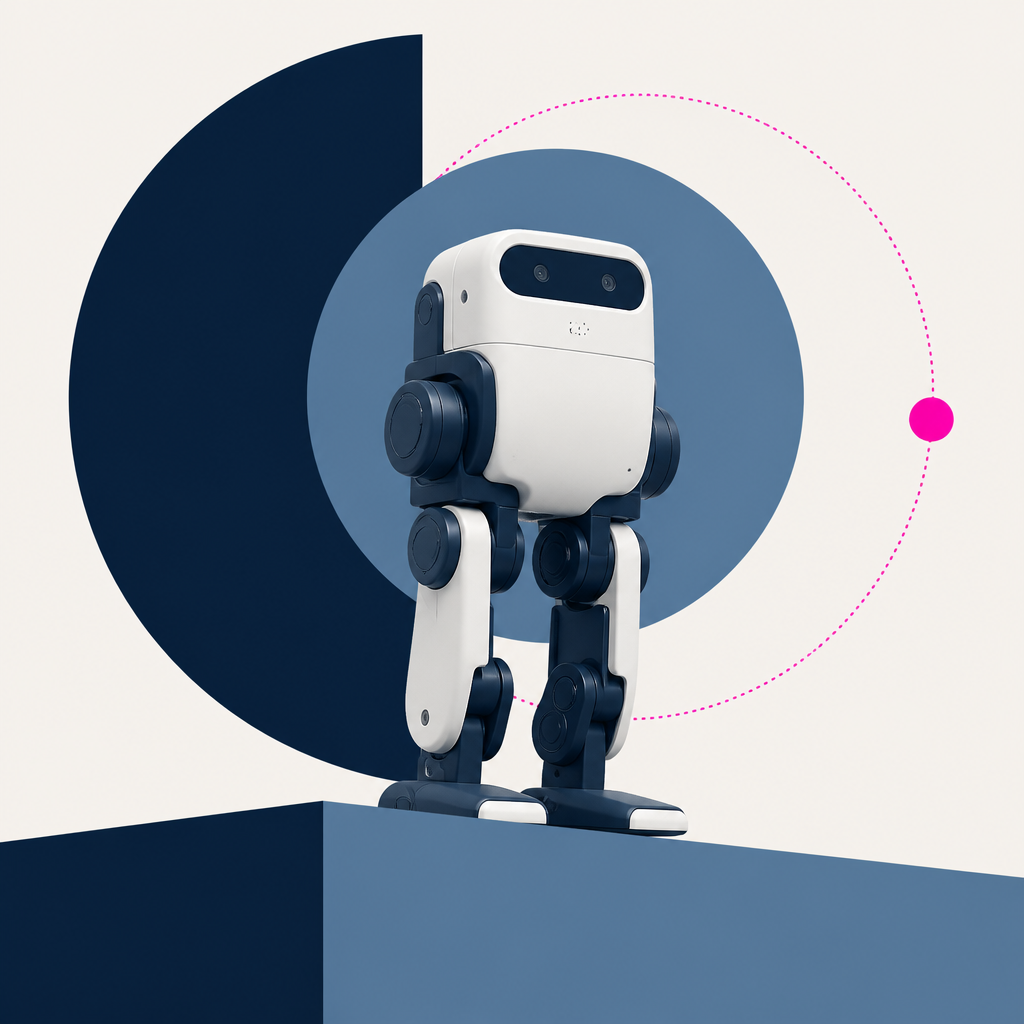
Hugging Face opened pre-orders for Microduck, a $399 little biped you train with reinforcement learning. It ships the training loop too, not just a glossy demo.
Based on reporting by MarkTechPost, Michal Sutter — read the original for the full story.
Summary, retelling and take written by AI under human oversight; images are AI-generated illustrations. How we work · Report an error
Most robot launches lean on polished video and a hope that the magic survives contact with reality. Microduck takes the opposite route. Pollen Robotics, the Bordeaux team inside Hugging Face, is selling a 25 cm biped for $399 and handing over the simulator setup, reward functions, domain randomization, and sim-to-real recipe on GitHub.
The hardware is small, but the spec sheet is not shy. Microduck stands 25 cm tall, measures 14 cm wide, weighs under 800 g, and uses 15 motors across its legs, neck, and head. There’s a front camera with its own indicator light, two IMUs, compact LiDAR in the form of an 8×8 time-of-flight matrix, microphones, a speaker, two NFC antennas, Wi-Fi, Bluetooth, and a removable NP-F550 battery rated at 2600 mAh for about an hour.
It also ships with seven trained moves already loaded: walk, sit, stand, kick, grab, roller-skate, and self-recovery. A bundled game controller drives those behaviors before the user writes any code. And unlike a desk toy, this one is built to fall over and get back up. The robot does not speak, though each unit generates its own audio identity the first time it wakes and keeps that voice.
The real bet is in the training stack. Policies are trained in microduck_rl on top of mjlab, which uses MuJoCo Warp and PPO. Pollen says a usable gait takes about one to two hours on a CUDA GPU with 4,096 parallel environments, or the same command can run on Hugging Face Jobs if there’s no local GPU.
The sim-to-real side is where the project gets unusually serious for a $399 machine. Each servo uses the BAM M6 model of the Dynamixel XL330, including voltage control law, back-EMF, and friction terms, instead of pretending the motor behaves like an ideal PD controller. Training randomizes battery voltage, sag under load, command delay, friction magnitude, and even backlash of ±1° per joint. The published registry covers 13 tasks, but the company is also drawing a line: the software is Apache-2.0, while the mechanical and electronic design files are not open.
My take — AI-written commentary, not fact-checked reporting
This is the right kind of open robotics move: ship the ugly training details, not just the glossy shell. The catch is familiar — the software is open, the hardware stays guarded, which means the community gets to inspect the trick but not fully remake the toy. That’s very 2026: open enough to earn trust, closed enough to keep the moat warm.
Read more about this at: MarkTechPost