How Companies Are Using NVIDIA DSX to Break the Power Bottleneck
NVIDIA Blog Vladimir Troy ● Covered by 6 sources
Companies are using NVIDIA DSX to plan AI factories and power systems together. It’s NVIDIA’s bet that software can loosen a bottleneck where more than $300 billion is stuck.
Based on reporting by NVIDIA Blog, Vladimir Troy — read the original for the full story.
Summary, retelling and take written by AI under human oversight; images are AI-generated illustrations. How we work · Report an error
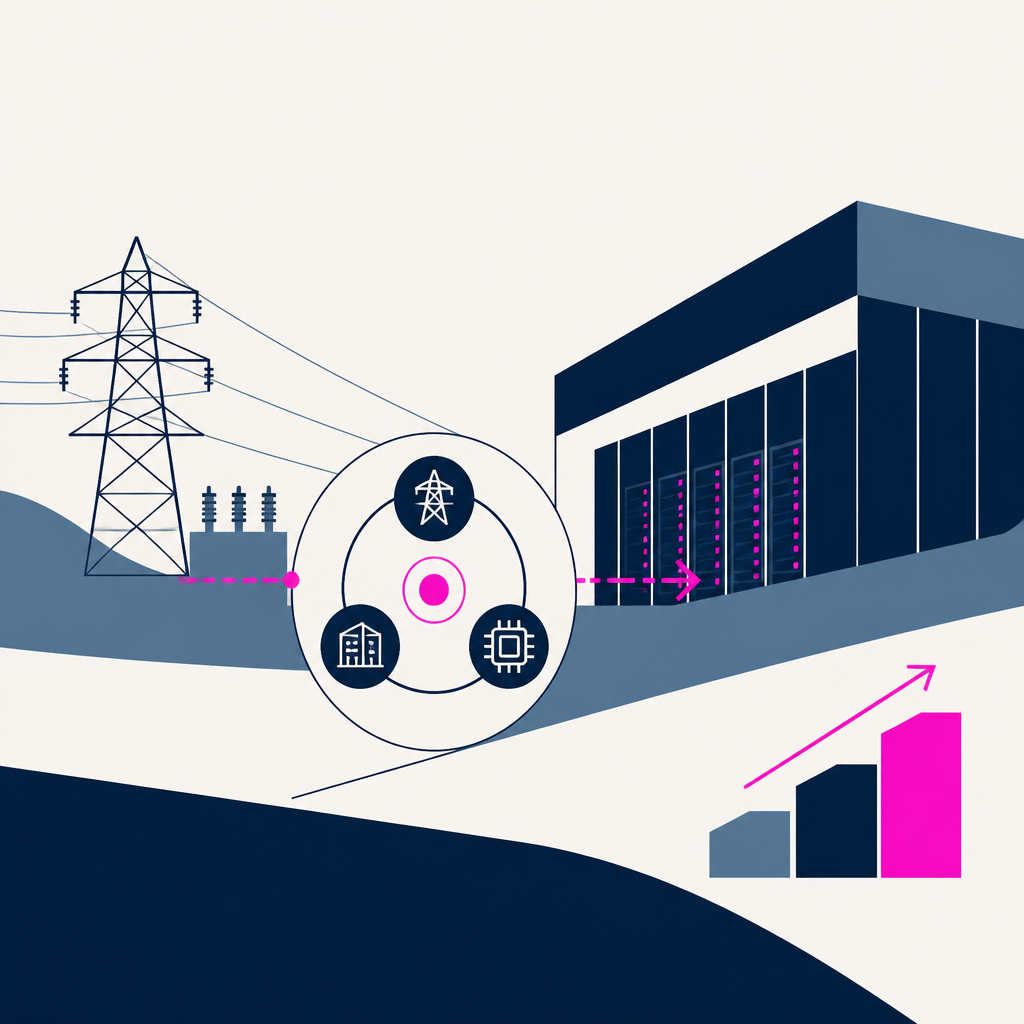
Companies around the world are starting to use NVIDIA DSX as a way to stop treating the grid, the building and the compute rack like separate problems. The pitch is simple: plan, simulate and run them as one system, from the substation to the rack. That matters because power has become the choke point, with more than $300 billion in equipment backlogged and over 200 gigawatts of projects sitting in U.S. interconnection queues.
The company says one big reason for the slowdown is that these systems were designed in silos. Grid planners, facility teams and compute operators have long worked on different assumptions, which leaves room for delays, risk and stranded capacity. DSX is meant to pull those pieces together before anyone pours concrete.
The platform includes DSX Sim and SimReady assets from energy manufacturers, letting engineers model the grid, substation and AI factory together before ground is broken. DSX Flex is aimed at matching AI factory demand with grid conditions and onsite generation, so an AI factory can behave more like a flexible grid asset than a fixed load. DSX MaxLPS and DSX Exchange are about getting more compute out of every watt and moving signals securely across compute, networking, energy, cooling and operations.
Several companies are already building around that idea. GE Vernova is contributing grid-to-facility and rack power expertise. Hitachi Energy has a battery energy storage system qualified as NVIDIA DSX Ready. Schneider Electric, with AVEVA and ETAP, is working on validated NVIDIA Vera Rubin power and cooling reference architectures and an Omniverse-powered digital twin. Siemens Energy is developing a reference design for resilient, scalable and grid-aware power infrastructure, and is also exploring NVIDIA tools for its Noedra digital twin platform.
There are also more direct efficiency claims. Phaidra says it integrated DSX Flex, DSX Max-Q and DSX Exchange into self-learning agents and can deliver about 10% more compute within the same power envelope. Emerald AI says its Conductor platform, integrated into DSX Flex, could help utilities tap underused grid capacity, with a modeled path to unlocking up to 100 gigawatts on the existing U.S. grid. NVIDIA is taking that message to GTC Berlin, where it is pushing the idea that the AI factory and the power system should be designed as one machine.
My take — AI-written commentary, not fact-checked reporting
The obvious read here is that NVIDIA is trying to turn power scarcity into a software category, and that’s very on brand. It’s also sensible: if the grid is the bottleneck, then the companies that can make loads behave better get to write the rules. Funny how “AI infrastructure” now means a lot more than chips and a rack with a fan.
Read more about this at: NVIDIA Blog