How America’s Dizzying AI Strategy Plays Into China’s Hands
CSET Georgetown Jason Ly ● Covered by 13 sources
Opinion — commentary, not a factual news event.
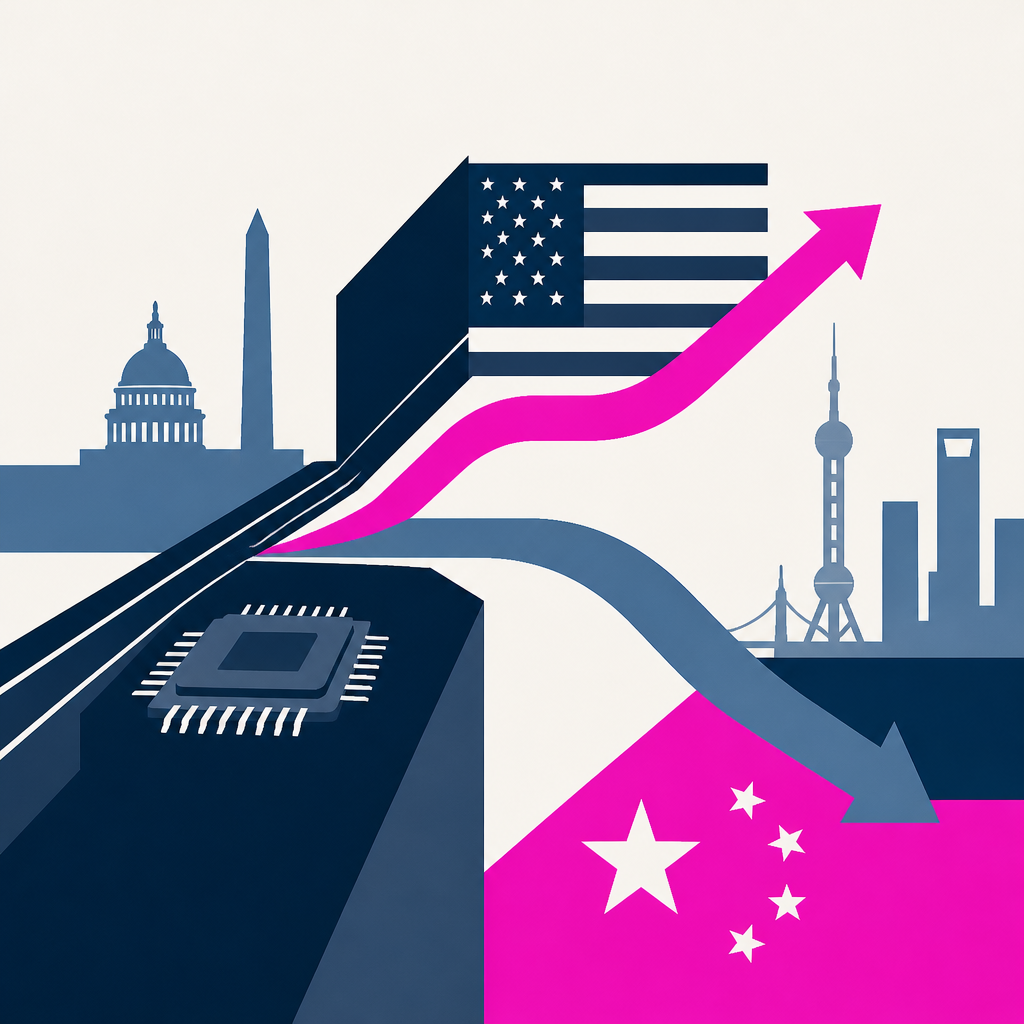
Trump’s AI plan pushes exports and security at the same time. That combo could help China if Washington can’t balance it.
Based on reporting by CSET Georgetown, Jason Ly — read the original for the full story.
Summary, retelling and take written by AI under human oversight; images are AI-generated illustrations. How we work · Report an error
CSET’s Sam Bresnick argues that the Trump administration is trying to do two things at once with AI policy: drive huge sales of AI and semiconductor exports, and still protect U.S. national security. Those goals sound tidy in a statement. In practice, they pull in opposite directions.
Bresnick’s case, laid out in a Barron’s op-ed, is that Washington wants massive export volumes while also staying ahead of China in AI. That is a hard line to walk, and maybe not a real one. The more the U.S. pushes its tech abroad, the more it has to worry about where that tech ends up and what it does there.
The point isn’t that exports are bad. It’s that a strategy built on selling more and restricting more at the same time can start to eat itself. China does not need Washington to make perfect decisions. It only needs the U.S. to get tangled up in its own priorities.
Bresnick, a CSET research fellow and Andrew W. Marshall Fellow, frames this as a competitiveness problem, not just a trade issue. The White House wants to move fast on AI and chips, but if its policy keeps sending mixed signals, the result may be less advantage, not more.
My take — AI-written commentary, not fact-checked reporting
This is the old Washington trick: promise to outcompete China while also cashing the export checks. That usually ends with everyone calling it strategy and nobody admitting it’s a compromise. On AI, mixed messages are not a clever balance; they’re a gift to the other side.
Read more about this at: CSET Georgetown