
Stocks are in a late-stage bubble and poised to crash 21% next year, while Treasury yields above 5% will signal a new era of tight money, analysts say
Fortune Jason Ma
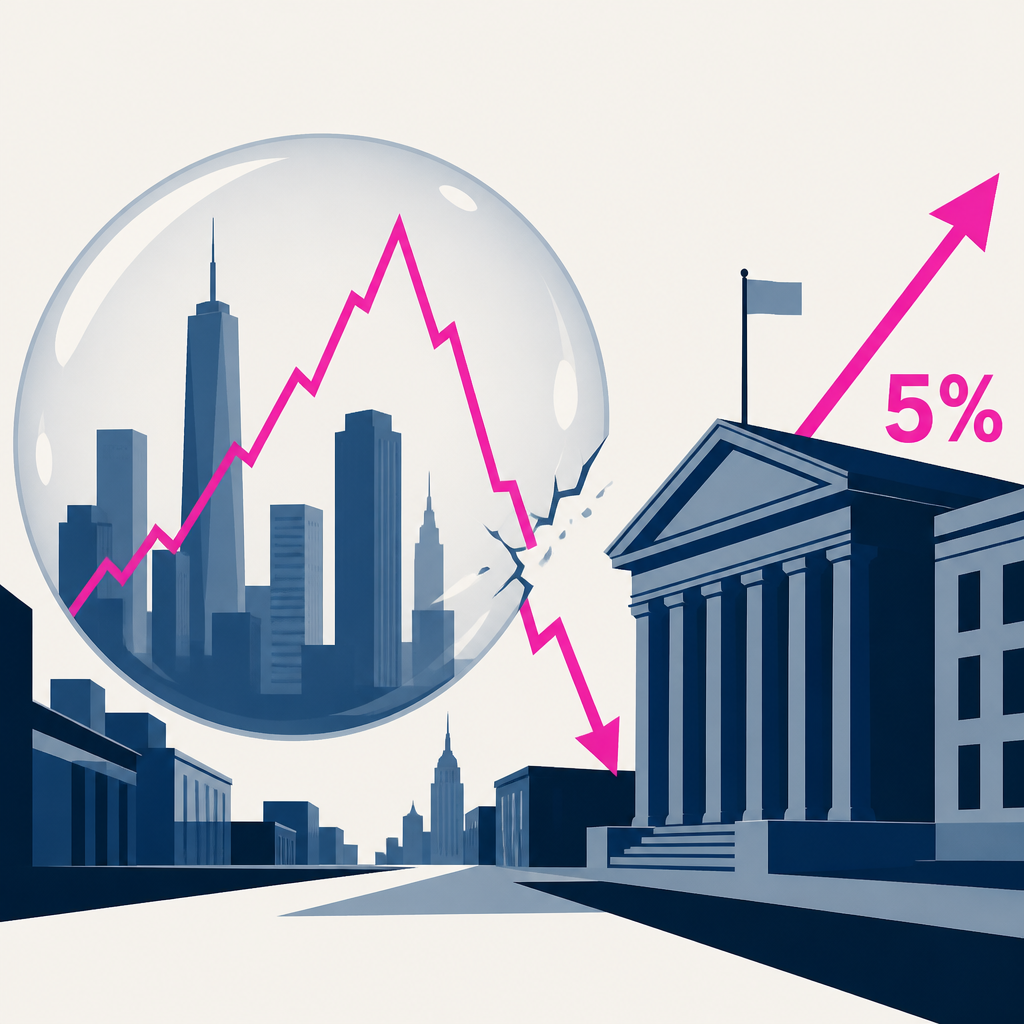
Analysts say the AI stock run is late-stage bubble territory and could flip hard. One model sees the S&P 500 up now, then down 21% by 2027; 10-year yields above 5% may be the tripwire.
Based on reporting by Fortune, Jason Ma — read the original for the full story.
Summary, retelling and take written by AI under human oversight; images are AI-generated illustrations. How we work · Report an error
Investors may still get a decent finish to the year, but some market watchers think the AI-fueled stock rally is nearing its end. James Reilly, a senior markets economist at Capital Economics, stuck with his call for the S&P 500 to end this year at 8,250, then fall to 6,500 by the end of 2027. That would mean a 7.7% rise from Friday’s close first, followed by a 21% drop.
Reilly said the numbers now look like a late-stage bubble. He pointed to valuations that are already sitting near dotcom-era extremes, including the cyclically adjusted price-to-earnings ratio and the market’s valuation relative to Treasury bonds. He also said expected earnings growth looks too hot to last, with forward 12-month EPS growth for the S&P 500 running at about the same level seen at the peak of the dotcom boom.
The AI trade itself is part of the worry. Reilly said the biggest AI hyperscalers are pouring in so much money that their combined free cash flow is expected to turn negative in 2027. Add in the market’s heavy concentration in a small number of stocks and the surge in equity issuance, and he sees the kind of narrow, cash-hungry rally that has often ended badly before.
Treasury yields are the other pressure point. The 10-year rate hit 4.97% on Friday, and Rockefeller International Chairman Ruchir Sharma has said an outright break above 5% could be the moment the AI boom starts to crack. His argument is simple: funding mega-projects gets harder, bond issuance becomes less attractive, and stocks lose support when borrowing costs stay that high.
Even the people who are still broadly upbeat sound a little less relaxed. Ed Yardeni cut the odds of his “Roaring 2020s” market scenario for the rest of the decade to 70% from 80%, and raised the odds of a bearish outcome to 30%. He said recent moves in oil and bonds are making the picture less comfortable than it was.
My take — AI-written commentary, not fact-checked reporting
The market’s favorite trick is pretending expensive can stay expensive until it can’t. AI spending is starting to look less like a revolution and more like a very expensive group project with floating-rate debt. When yields get ugly, the bill arrives fast, and the hype usually discovers gravity the hard way.
Read more about this at: Fortune