Give Your Coding Agents a Memory You Own
Hugging Face
Hugging Face launched funes, a local memory layer for coding agents. It lets Claude Code, Codex, pi, and Hermes keep and share old reasoning instead of starting over.
Based on reporting by Hugging Face — read the original for the full story.
Summary, retelling and take written by AI under human oversight; images are AI-generated illustrations. How we work · Report an error
Hugging Face has put out funes, a memory layer for coding agents that tries to fix a simple annoyance: every new session acts like it has never seen your project before. The tool is aimed at agents such as Claude Code, Codex, pi, and Hermes, and it builds its memory from the sessions already sitting on your machine. It works locally first, and it can also publish that memory to a Hugging Face dataset you own, private by default.
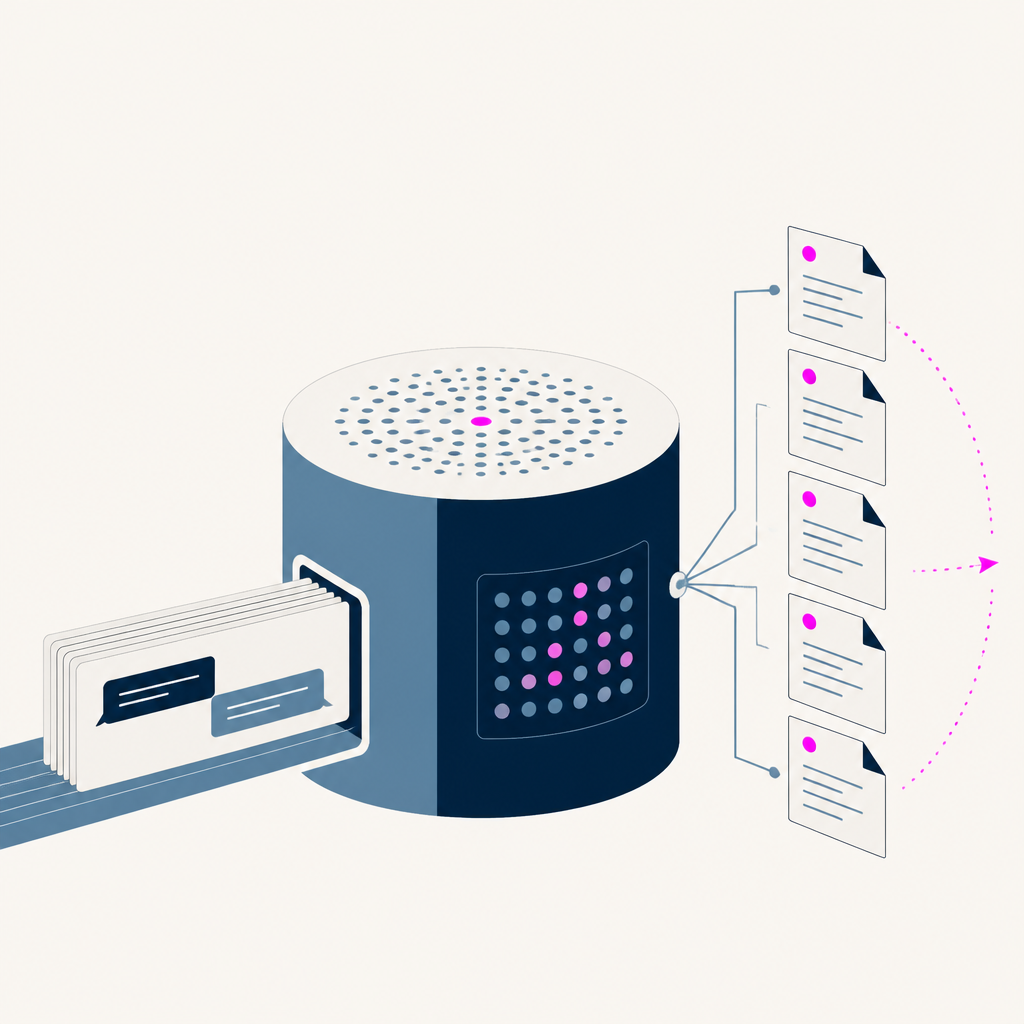
The pitch is not just “save logs.” The blog argues that agent traces already contain the real record — the search paths, dead ends, documentation reads, and course corrections that explain why a decision happened. funes turns that archive into something an agent can actually query while working. It adds recall and get tools, indexes completed turns as you go, and keeps the old text intact so a hit can point back to the exact session, timestamp, turn, and surrounding context.
Under the hood, it uses a deterministic pipeline that parses supported traces into turns and blocks, chunks them, embeds them with a pinned local model, and stores everything in a local Lance dataset. Search mixes vector results with BM25, reranks them with a cross-encoder, reweights by recency, and attaches neighboring chunks. The result is a memory that stays grounded in raw evidence instead of turning everything into a summary too early.
The more interesting bit is that the memory can move. Bind an agent to a Hugging Face dataset and funes keeps publishing updates at session boundaries, so the same memory can follow you from one machine to another. The blog also says credentials are redacted before anything reaches the Hub, with another scan for anything that still looks like a secret, and that remote datasets are cached locally for speed.
Hugging Face says it tested this against compaction and handoff flows on a benchmark built around tasks that depend on prior session knowledge. Recall was cheaper on both tasks, and compaction was the only approach that failed on one of them. That is the real argument here: agents do not just need better prompts, they need a memory they can carry without renting it back through another service.
My take — AI-written commentary, not fact-checked reporting
This is the right kind of boring infrastructure: not a grand new agent, just a way to stop forcing smart tools to act amnesiac. The industry keeps selling bigger brains, while the actual pain is continuity. Open, local, queryable memory is the part that sounds unglamorous and ends up mattering most.
Read more about this at: Hugging Face