
Fortune Tech: Nvidia buys Hugging Face, OpenAI debuts GPT-6 Astra
Fortune Andrew Nusca ● Covered by 16 sources
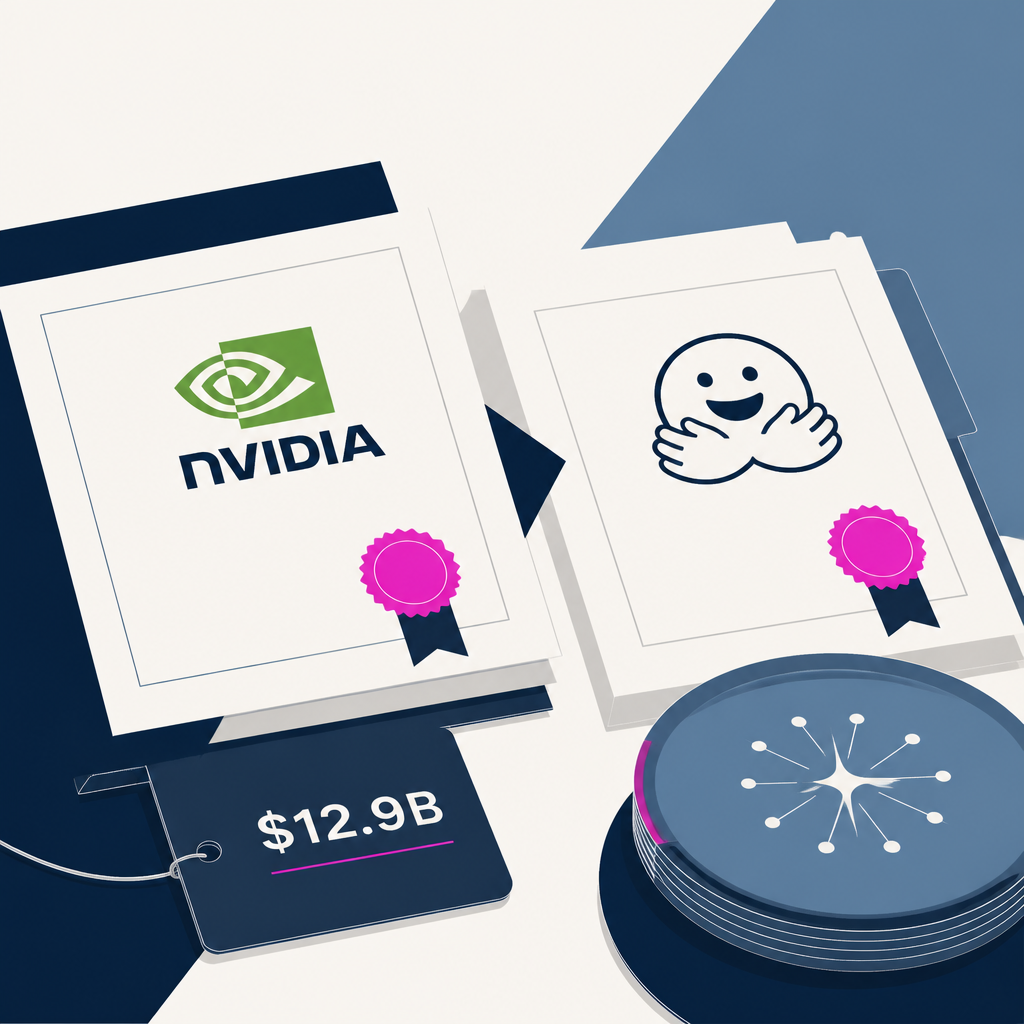
Nvidia agreed to buy Hugging Face for $12.9 billion, and OpenAI unveiled GPT-6 Astra. One looks like a bet on open models; the other is a push toward AI that can actually run your computer.
Based on reporting by Fortune, Andrew Nusca — read the original for the full story.
Summary, retelling and take written by AI under human oversight; images are AI-generated illustrations. How we work · Report an error
Nvidia just made a very large, very pointed bet on where AI money goes next. The chipmaker has agreed to buy Hugging Face for $12.9 billion, pulling one of the best-known developer hubs in AI into its orbit and signaling that open-weight models matter more to its future than just serving the big closed systems that helped make its GPUs essential in the first place.
That matters because Nvidia’s biggest customers are not sitting still. OpenAI, Microsoft, Amazon, Meta and the rest are all working on their own chips to reduce dependence on Nvidia hardware. Hugging Face, meanwhile, sits in the middle of the developer ecosystem: it says it has 18 million individual users and 200,000 enterprise clients, and its co-founder and CEO, Clément Delangue, says the goal is to reach 100 million AI builders in the next few years.
This is also a reversal of sorts. Hugging Face reportedly turned down a $500 million investment from Nvidia last year because its founders wanted to keep the company independent. Nvidia had already taken part in Hugging Face’s 2023 funding round, so the interest wasn’t exactly a secret. But a $12.9 billion acquisition is a different kind of embrace.
At the same time, OpenAI is pushing its own frontier further with GPT-6 Astra, a model it says is strongest at “computer use.” In practice, that means navigating machines the way a person would: zipping through spreadsheets, filling out forms, moving across web pages, and doing it all at what Greg Brockman calls superhuman speed. OpenAI says the model also brings stronger math, software engineering and defensive cybersecurity, and that it outperforms GPT-5.6 Sol and Anthropic’s Claude Fable 5.1 on a range of benchmarks.
But don’t expect an instant office takeover. OpenAI is rolling Astra out first to a limited set of enterprise customers, including those in its cybersecurity-focused Daybreak program, before wider access hits Plus, Pro and Enterprise users in the coming days. It will also be available through the OpenAI API and AWS. The agent era keeps getting louder; the actual deployment still looks a lot like enterprise caution with a shiny demo on top.
My take — AI-written commentary, not fact-checked reporting
The real story here is that the AI race is splitting in two: the model makers chasing autonomy, and Nvidia buying the pipes, the hub, and probably the mood lighting. Open-weight looks less like a philosophy now and more like a business moat with better branding. Also, if “computer use” is the start of the AGI era, then the first thing AGI is doing is spreadsheets, which is very on brand for tech.
Read more about this at: Fortune
Related stories
 Nvidia agrees to buy Hugging Face for $12.9BN, says report
Tech.eu · 1 month ago ·
15
Nvidia reportedly acquires AI project hosting platform Hugging Face for $12.9B
SiliconANGLE · 1 month ago ·
39
Nvidia agrees to buy Hugging Face for $12.9BN, says report
Tech.eu · 1 month ago ·
15
Nvidia reportedly acquires AI project hosting platform Hugging Face for $12.9B
SiliconANGLE · 1 month ago ·
39