
Elon Musk warns more than 200 AI cloud companies face 'guppy-level death' as the AI boom runs into a debt crisis
Fortune Mia Osmonbekov ● Covered by 3 sources

Musk says more than 200 AI cloud firms may not survive the boom. Their debt and chip costs are colliding with a capital squeeze.
Based on reporting by Fortune, Mia Osmonbekov — read the original for the full story.
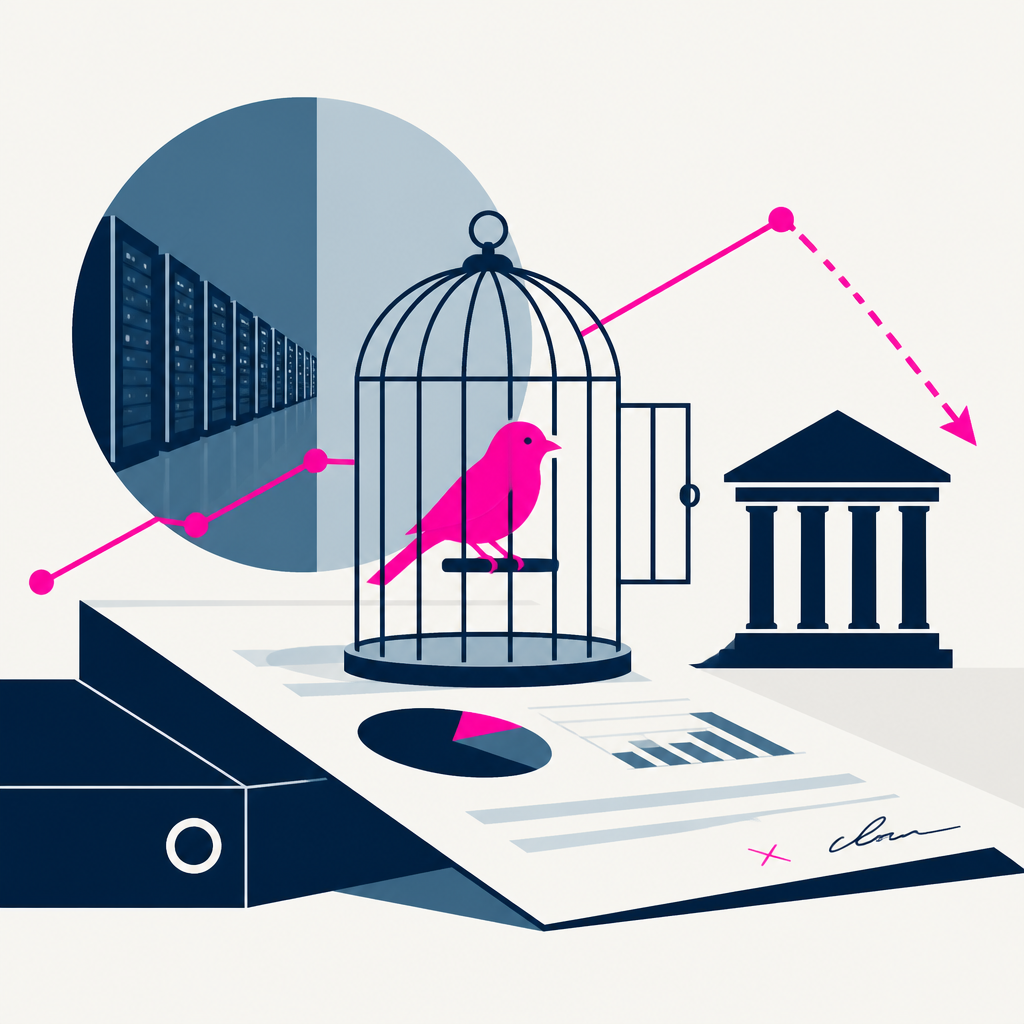
Summary, retelling and take written by AI under human oversight; images are AI-generated illustrations. How we work · Report an error
Elon Musk has put a brutal label on the AI cloud crowd: “guppy-level death and consolidation.” In a post on X on Sunday, he said more than 200 neoclouds could get squeezed out because lenders are pulling back from businesses that live and die on AI demand.
His argument is simple, and ugly. These firms borrow to buy expensive Nvidia chips, build data centers, and then rent out the computing power. That works only if customers keep coming and financing stays open. Musk said debt markets have “almost entirely shut off” for companies that do not have meaningful revenue outside AI data centers.
He drew a line between smaller players and the giants. SpaceX, he said, is insulated because it already closed $40 billion in debt financing and has Starlink bringing in revenue that is not tied to AI. Hyperscalers such as Google and Meta can also lean on other businesses when they spend on chips and infrastructure. Neoclouds do not have that cushion.
CoreWeave shows why people are nervous. At the end of the second quarter, it had a $104 billion revenue backlog, and it added $25 billion more in commitments early in the third quarter. But its latest filing also showed $35.6 billion in debt at the end of June against $5.5 billion in cash and cash equivalents. Last month it borrowed another $4.2 billion, and the cost of insuring its debt against default hit a record high last week, with credit default swaps implying more than a 60% chance of default over five years.
The pressure is not just on one company. Gartner said on Oct. 14 that 80% of neoclouds could stop operating by 2030 because of cost pressure and a weak business model. Apollo Global Management chief economist Torsten Slok told CNBC there is a shortage of capital for AI infrastructure because it is competing with government debt and deficit financing. Meanwhile, data center owners need $8.6 trillion in revenue to cover financing and capex, while forecast AI revenue tied to those data centers is only $3.6 trillion.
CoreWeave, for its part, says lenders can tell the difference between speculative capacity and businesses with real customers and contracted revenue. The company says it is not being treated like every other AI cloud provider, and that its scale and technology are what let it keep financing growth.
My take — AI-written commentary, not fact-checked reporting
This is what happens when a market starts believing that every rack of chips is a business model. A lot of these companies sound less like infrastructure and more like leveraged bets on demand that may or may not show up. The ugly part is that the capital is getting soaked up by the giants, which leaves the smaller AI clouds looking very much like the toll booths on a road nobody promised to finish.
Read more about this at: Fortune
Related stories
 'How many canaries have we killed in the coal mine?' — Wall Street debates if the latest AI bubble warnings are another head fake or the real thing
Fortune ·
38
I.M.F. Warns of a Debt Spiral in the A.I. Build-Out
Trending Topics · 1 week ago ·
4
Treasury's AI bubble warning sharpened today's finance-risk story
The Neuron · 3 months ago ·
28