
Dubai’s AI-Powered Vision for a Smarter, Connected City
Fortune Melissa Hancock
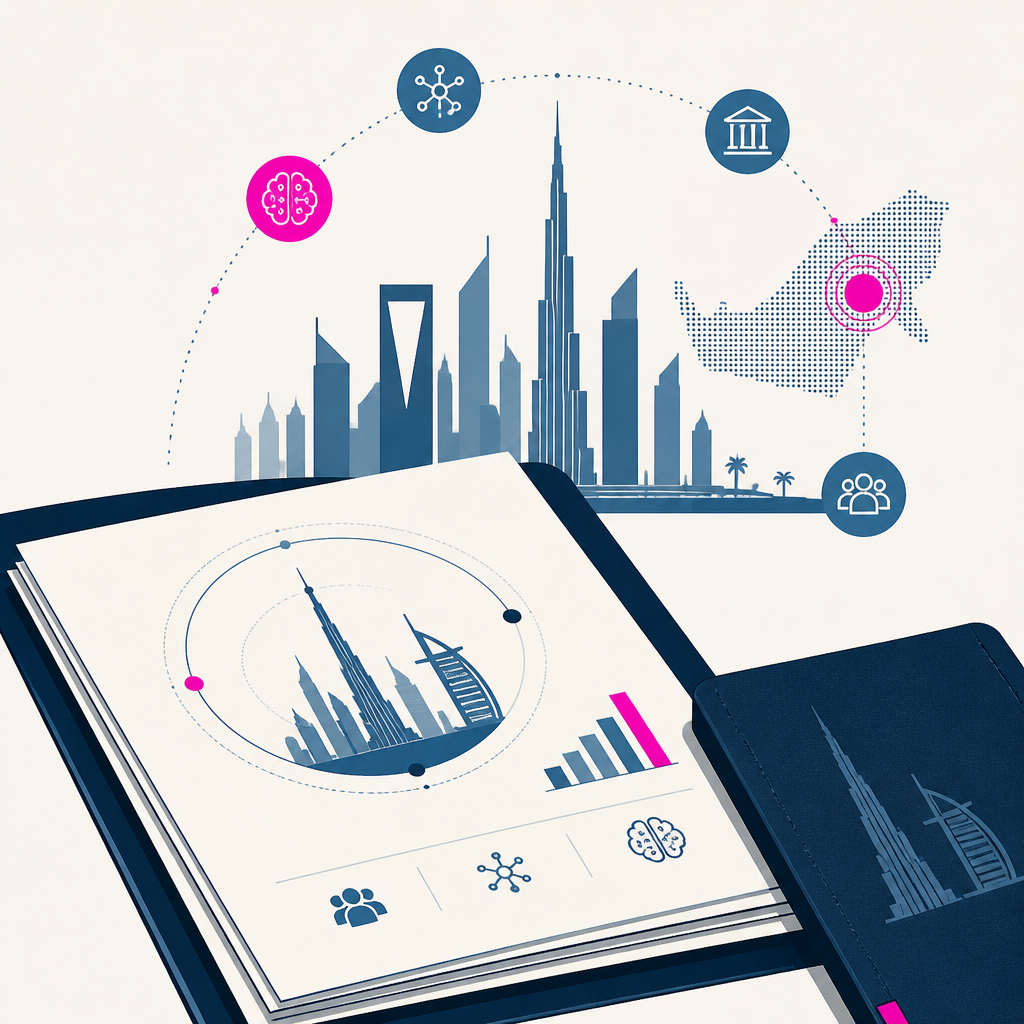
Dubai is wiring AI and data into government services, not just adding chatbots. The bet is cleaner decisions now, and a city that runs more smoothly for residents and visitors.
Based on reporting by Fortune, Melissa Hancock — read the original for the full story.
Summary, retelling and take written by AI under human oversight; images are AI-generated illustrations. How we work · Report an error
Dubai has turned its digital ambitions into a very concrete plan. The emirate’s Digital Strategy, launched in 2023, aims to digitise life across the city and strengthen the digital economy. Then there is D33, a 10-year push to double Dubai’s economy by 2033 and generate an estimated AED100 billion, or $27.23 billion, a year through digital transformation. In April, the government said its AI-driven initiatives should add more than AED10 billion, or $2.72 billion, to GDP within two years of operation.
At the centre of that effort is Digital Dubai, the government body trying to make data do more than sit in silos. Its pitch is straightforward: connect government entities, let data move between them, use AI to turn that data into decisions, and make services respond faster and with less friction. H.E. Younus Al Nasser, who leads Dubai Data & Statistics Establishment at Digital Dubai, puts it plainly: data is the glue of the city, and the goal is one holistic picture of how Dubai is performing.
That thinking shows up in how Digital Dubai is rolling out AI. In April, it introduced its AI Integration Matrix Framework to coordinate adoption across government entities, and it has already used it internally to guide more than 100 AI systems. The point is not novelty for its own sake. It is to reduce duplicated work and make deployments more consistent and reusable. That is a lot less glamorous than a flashy demo, and a lot more useful.
One of the clearest examples is Dubai Population Now. The platform combines AI, machine learning and predictive analytics to estimate, in near real time, how many people are actually in the emirate. That matters in a city where the difference between residents and the daytime crowd is huge. At the end of 2025, Dubai had 4.58 million residents, while average daytime population peaked at 6.39 million. That extra 1.81 million people, about 40% of the resident population, puts pressure on roads, hospitals, schools and housing.
Digital Dubai is also tightening the plumbing underneath all this. In July it launched an updated Dubai Data Manual covering data quality, governance, accountability and compliance, with more emphasis on AI readiness. Al Nasser’s warning is blunt: if the data is unreliable, the AI output won’t be reliable either. Dubai seems to have understood that the hard part of AI in government is not the model. It is the messiness of the data.
The city’s recent ranking suggests the approach is getting results. In August, Dubai took second place globally in Boston Consulting Group’s Intelligent Cities Index, which covered 61 cities. BCG ranked it first in AI adoption and smart city solutions. The broader message from Dubai is clear: AI is being treated less like a showcase and more like infrastructure.
My take — AI-written commentary, not fact-checked reporting
Dubai is doing the unsexy part of AI right: standards, reuse, and actual integration. That is rarer than the glossy “smart city” brochure, and far more useful. Plenty of governments want the AI halo; fewer are willing to clean the data first.
Read more about this at: Fortune
Related stories
 The way we consume energy is changing. Abu Dhabi’s integrated system has already embraced that change
Fortune ·
31
The UAE is fighting AI hackers with AI of its own
Rest of World · 2 months ago ·
4
Edge AI for Smart Cities: From Insight to Cognitive Action
Wiley Science and Engineering Content Hub · 1 week ago ·
47