
China, the EU, and Singapore push back against the White House's new ‘Great Transshipment Scam’ report
Fortune Angelica Ang
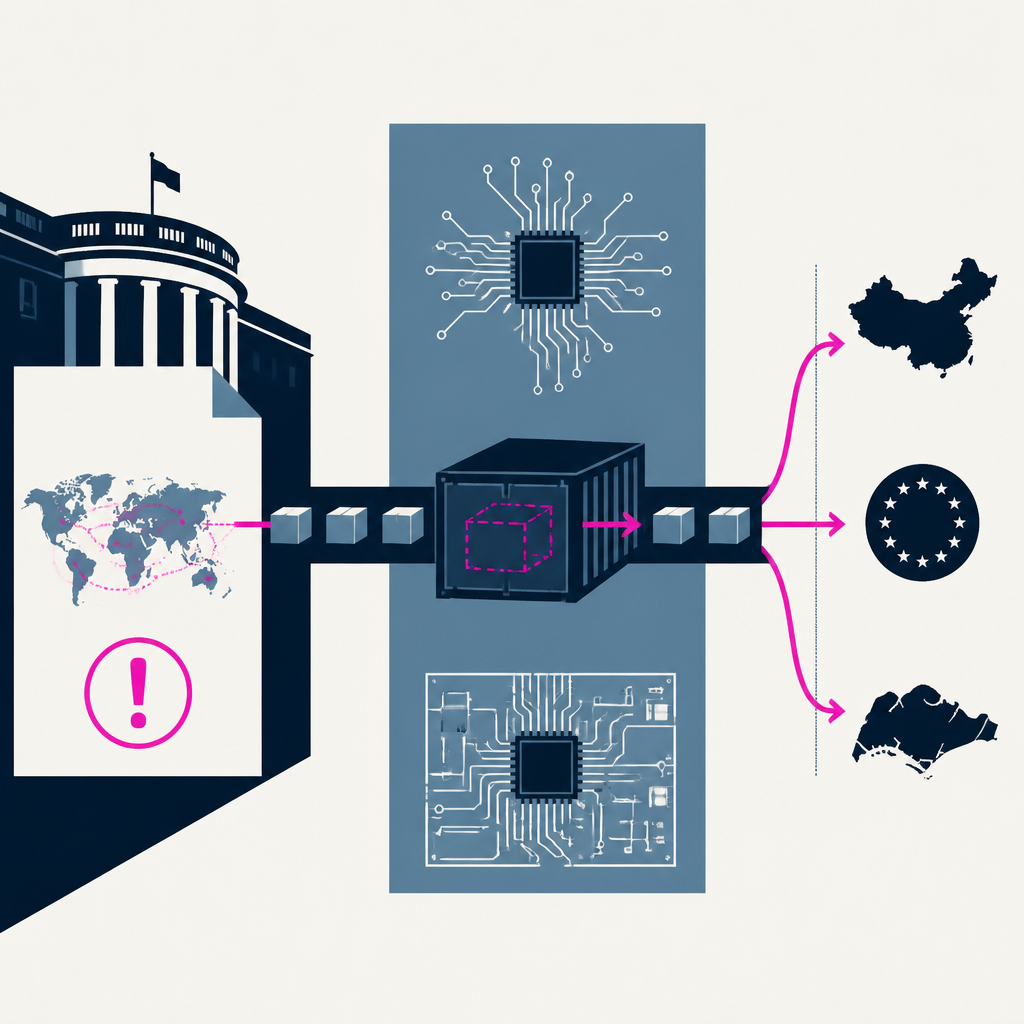
The White House accused 40 economies of helping hide Chinese goods on the way to the U.S. China, the EU and Singapore all pushed back — and Washington says it’s building an AI border watcher.
Based on reporting by Fortune, Angelica Ang — read the original for the full story.
Summary, retelling and take written by AI under human oversight; images are AI-generated illustrations. How we work · Report an error
Beijing is batting away a fresh U.S. claim that other economies are helping Chinese-made goods slip into the American market with their origin obscured. On Thursday, the White House’s Office of Trade and Manufacturing Policy published a report called “The Great Transshipment Scam,” which says rerouting goods through 40 jurisdictions may have cost the U.S. as much as $303 billion.
China’s response was blunt. A Chinese embassy spokesperson in Washington said Beijing “firmly opposes” stretching national security arguments to suppress Chinese companies, and warned that it would take whatever steps were needed to protect its own interests. The report also drew pushback from governments named in it, including the European Union and Singapore.
The EU’s line was classic Brussels: cooperate, but don’t expect surrender. European Commission spokesperson Arianna Podesta said the bloc keeps engaging with the U.S. on tariff and non-tariff issues, but its rulebook and regulatory autonomy are not “up for negotiation”. Singapore’s Ministry of Trade and Industry took a different route, stressing on Aug. 15 that it treats trade compliance seriously and does not condone businesses using the city-state’s name to dodge or violate other countries’ laws.
The dispute turns on what counts as transshipment. The Center for Strategic and International Studies defines it as moving goods from country A to country C through country B, with the intermediate stop changing the country of origin. U.S. customs officials usually only worry when that middle stop adds little or no value — a fresh label on a finished product, basically. The White House says illegal versions can include relabeling, repackaging, re-invoicing, minor processing and false origin claims.
The problem is that global supply chains are messier than the accusation sounds. Since tariffs on Chinese imports began in 2018, many firms have shifted parts of their production through countries such as Vietnam and Mexico, where goods may get final assembly using Chinese components. The White House Council of Economic Advisers says potential illegal transshipment is in the range of $34.2 billion to $89.6 billion, with 450,000 jobs displaced, GDP hit by $113 billion to $150 billion, and federal revenue losses of $19 billion to $26 billion. The report names 40 economies in total, but stops short of saying what punishment, if any, would follow. It does say the U.S. wants an AI-enabled border system to spot suspected cases by chewing through global trade data.
My take — AI-written commentary, not fact-checked reporting
This is trade policy by naming-and-shaming, which is a very Washington way to do industrial policy without admitting it. The bigger tell is the AI border pitch: when the argument gets fuzzy, build a bigger machine and call it enforcement. Everyone named here is being told the same thing — stay useful, stay compliant, and don’t expect the White House to be subtle about it.
Read more about this at: Fortune
Related stories
 Scott Bessent says 19 of the G20 finance ministers agreed to address ‘cheap imports’ but ‘China was the dissenter’
Fortune ·
43
Scott Bessent says 19 of the G20 finance ministers agreed to address ‘cheap imports’ but ‘China was the dissenter’
Fortune ·
43
 China on pace for 'new record-high trade surplus' this year as exports jump 25%—a part of its efforts to become a 'major player in AI infrastructure'
Fortune ·
48
China on pace for 'new record-high trade surplus' this year as exports jump 25%—a part of its efforts to become a 'major player in AI infrastructure'
Fortune ·
48
 The U.S. and China are quietly talking AI guardrails—even as Trump publicly rejects them
Fortune ·
42
The U.S. and China are quietly talking AI guardrails—even as Trump publicly rejects them
Fortune ·
42