
Beyond Domain-Specific World Models: JEPA-Anything Uses 1 Recipe for 7 Fields
MarkTechPost Asif Razzaq
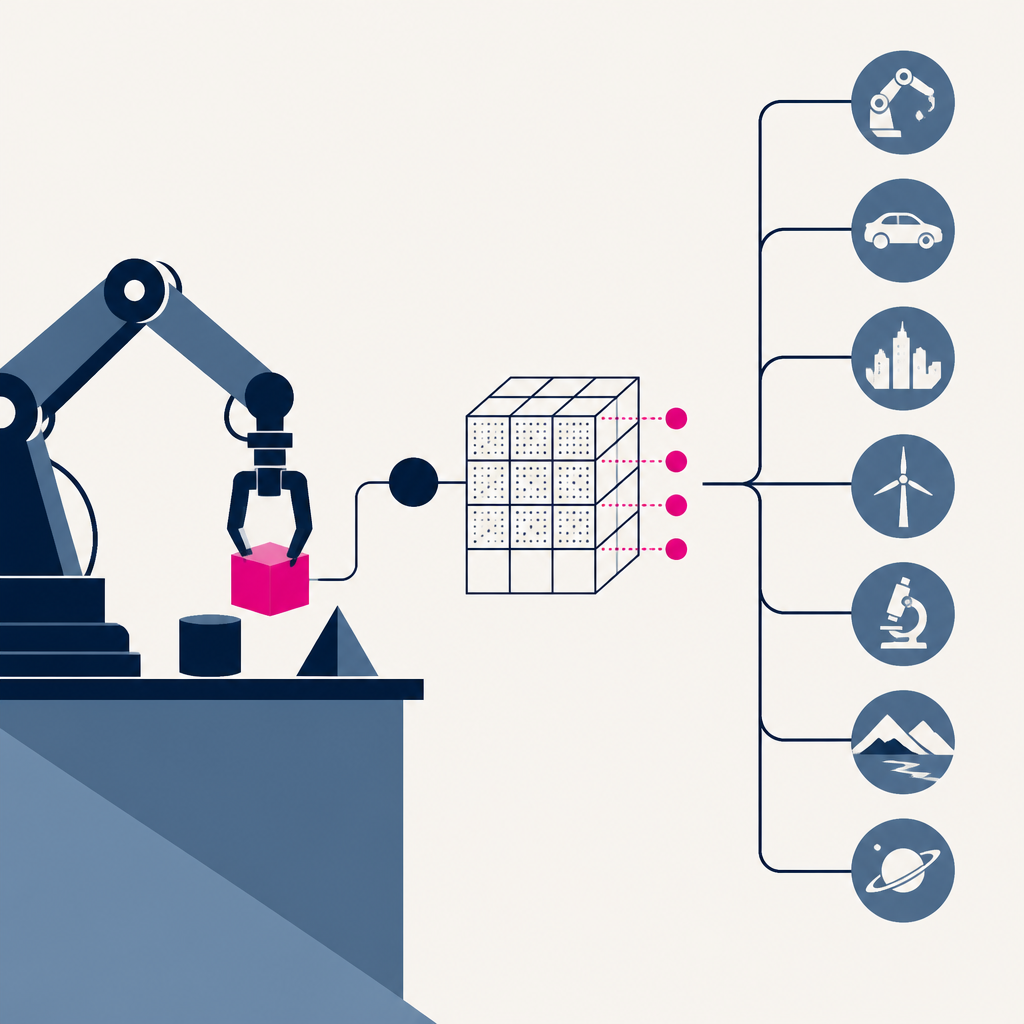
JEPA-Anything uses one world-model recipe across 7 fields, from cells to weather. It’s a bet that splitting the target into orthogonal parts beats one giant embedding.
Based on reporting by MarkTechPost, Asif Razzaq — read the original for the full story.
Summary, retelling and take written by AI under human oversight; images are AI-generated illustrations. How we work · Report an error
A research team spanning PhAI Labs, CUHK, Fudan, Stanford, Oxford and Princeton has put out JEPA-Anything, a framework that tries to make world models less domain-bound. The pitch is simple enough: stop building a fresh predictive model for every field, and use one shared recipe instead. The test bed is anything but simple. The team ran it across vision, biology, clinical trajectories, control, molecular dynamics, physical fields and weather.
The core idea is an extension of joint-embedding predictive architectures. Standard JEPAs, like I-JEPA or V-JEPA 2, use a context encoder, an EMA target encoder and a single predictor that maps into one monolithic target embedding. The authors say that creates a capacity-allocation problem: the loudest structure gets all the room, while weaker signals get tangled gradients. Their answer is Orthogonal Predictive Factorization, or OPF.
OPF breaks the latent target of width d into K learned subspaces of width r, with d = K × r. Most of the experiments use K = 4. Each factor gets its own predictor, then the results are stitched back together through the Moore-Penrose pseudoinverse of the projector matrix. That gives one latent state again, ready for decoding, planning or rollout. Three regularizers are there to keep the whole thing from drifting: one for orthogonality, one for factor activity, and one to push the online encoder away from collapse.
The gains are not uniform, but they are real in enough places to matter. On single-cell data, zero-shot PBMC clustering reached 0.7752 in AvgBIO, compared with 0.7194 for Cell-JEPA. Norman perturbation Pearson rose from 0.787 to 0.814. On UK Biobank clinical forecasting over 1,000 events, mean PRAUC came in at 0.718 versus 0.711 for the matched standard JEPA.
The bigger story is in dynamics. On Interventional Pong, single-intervention MSE dropped 34.83%, unseen combined interventions improved 12.90%, and 6-step free rollout improved 8.58%. Across 10 matched dynamics tasks, JEPA-Anything beat the standard JEPA baseline. It also improved on APEBench Burgers, where 6-step rollout error fell by about 44.7%, and it posted the lowest MAE and RMSD on 100-step molecular rollouts for water, quartz, paracetamol and benzene. Planning was more mixed, which feels honest for once: Walker2d and HalfCheetah improved under matched parameters, while Hopper preferred the standard JEPA.
There’s also a scientific-analysis angle that’s easy to ignore and probably shouldn’t be. The factor analysis pointed to IL-18 plus CD73 blockade as a cancer intervention, and wet-lab tests backed it in co-cultures, patient-derived organoids, tumor fragments and mice. The same setup also recovered Kepler’s law from latent orbital modes, with a fitted slope of -1.4991 against a theoretical -1.5. That’s the sort of result that makes a method look less like a benchmark hack and more like a reusable instrument.
My take — AI-written commentary, not fact-checked reporting
This is the right kind of boring idea: split the latent mess into parts, stop worshipping the one giant embedding, and let the math do some housekeeping. The field has spent enough time pretending every domain wants the same sludge with a different logo on it. The catch, as always, is that planning still won’t kneel just because the paper is elegant.
Read more about this at: MarkTechPost
Related stories
 Meet Open Dreamer: A JAX/Flax Reproduction of the Dreamer 4 World Model Pipeline, With the Full Training Recipe Published
MarkTechPost · 2 months ago ·
7
EMO: Pretraining mixture of experts for emergent modularity
Allen Institute (AI2) · 4 months ago ·
28
Meet Open Dreamer: A JAX/Flax Reproduction of the Dreamer 4 World Model Pipeline, With the Full Training Recipe Published
MarkTechPost · 2 months ago ·
7
EMO: Pretraining mixture of experts for emergent modularity
Allen Institute (AI2) · 4 months ago ·
28