
Meet Open Dreamer: A JAX/Flax Reproduction of the Dreamer 4 World Model Pipeline, With the Full Training Recipe Published
MarkTechPost Asif Razzaq
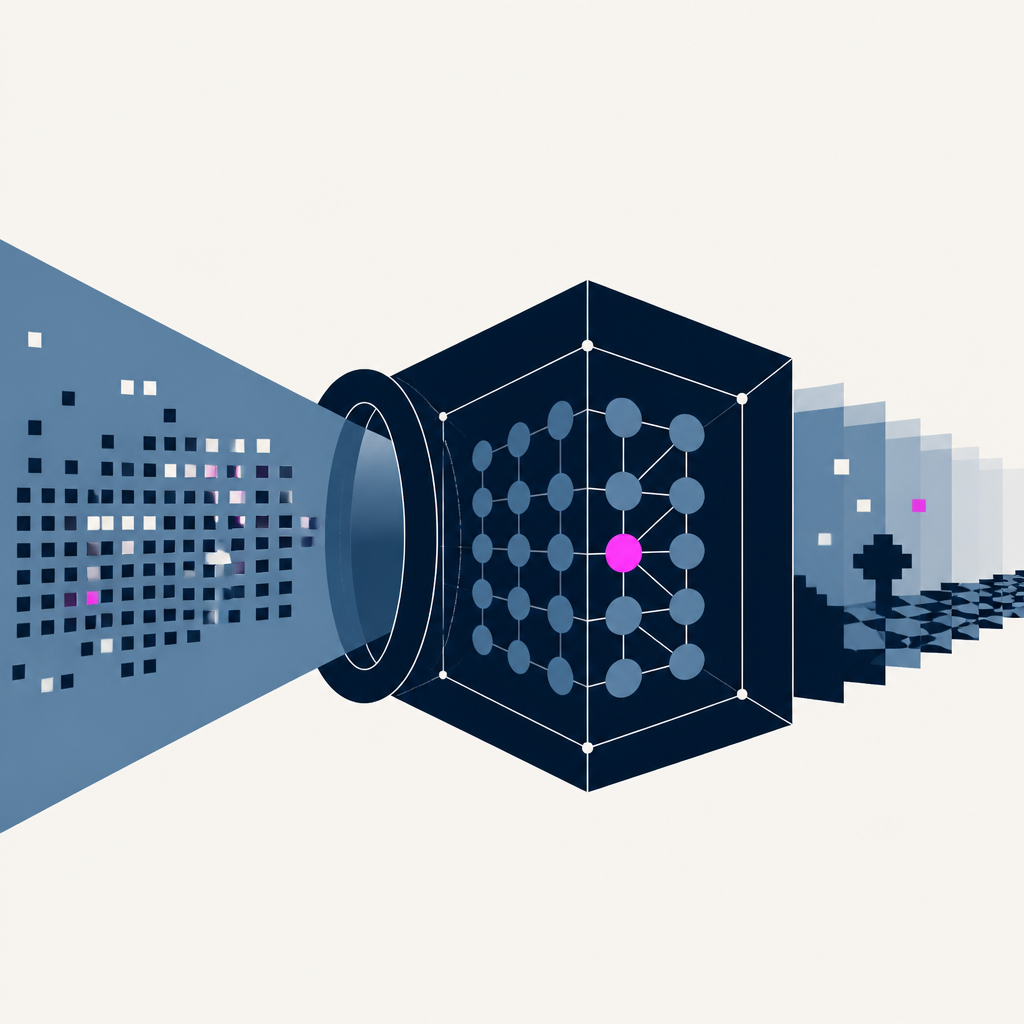
A small team open-sourced Open Dreamer, a working reproduction of Google's Dreamer 4 world model, code and all. It streams a real-time Minecraft dream you can toggle with actual gameplay, and they published exactly how it broke and how they fixed it.
Based on reporting by MarkTechPost, Asif Razzaq — read the original for the full story.
Summary, retelling and take written by AI under human oversight; images are AI-generated illustrations. How we work · Report an error
World models have been more hype than access for a while now, with the big labs showing slick demos and keeping the recipe locked away. Open Dreamer, from a small research outfit called Reactor, closes some of that gap. They've released two repos in JAX and Flax NNX: one holding the full training pipeline (tokenizer, dynamics model, rollout generation, FVD scoring), the other a minimal harness for running local rollouts from an MP4 and its action file. There's also a browser demo where you can flip a Game-to-Dream toggle and watch a real Minecraft session hand off frame by frame to the model's imagination.
The architecture is a single block-causal transformer doing double duty as both the tokenizer and dynamics model, alternating space layers that read across a frame and time layers that read across frames. Instead of a VAE, the tokenizer is a masked autoencoder claiming roughly 100x compression with no KL or adversarial loss needed, since masking alone reportedly makes the latent space easier to diffuse. The dynamics side folds action, state, and policy into a single per-timestep block, trained with diffusion forcing and flow matching, and it's built so the world-model tokens physically cannot see the agent's token — meaning any influence from the policy has to flow through the predicted next action, not sneak in sideways.
The numbers they published are unusually specific for an open release. The Minecraft dynamics model runs at 1.6 billion parameters across 30 layers, trained for 200,000 steps with the Muon optimizer and a peak learning rate of 3e-4. They hit 57-58% model FLOPs utilization on B200 GPUs, just shy of their own 60% healthy-training benchmark, and found that feeding 256 frames per GPU was what pushed the workload past the bandwidth-bound ridge point. The twist was that model state — params, gradients, optimizer state, EMA — only ate about 24 GiB, comfortably fitting on one B200. Activations were the actual budget-eater, which is why they abandoned fancier parallelism schemes and settled on plain data parallelism plus activation checkpointing.// dataloading got solved by pre-tokenizing everything into arrayrecord files, because ffmpeg decoding couldn't keep the GPUs fed.// But the section worth reading twice is on stability, which the team says ate more of their time than anything else.
Their core finding: the loss curve lies. MSE kept improving smoothly while generated video quality quietly fell apart underneath it. Switching from LaProp to Muon killed random optimizer spikes that showed up across two 400-hour B200 runs. EMA weights turned out to be non-negotiable for diffusion inference, not optional polish. And their precision recipe is oddly delicate — float32 for parameters and normalization, BF16 for most matmuls, float32 again for the flow output head — with barycentric optimal transport between noise and latent sequences smoothing out rollout generation on top of all that.
What's missing matters too. There's no behaviour-cloning or RL loop in the release; that's listed as future work, and the CoinRun policy experiments they describe never made it into the Minecraft build. No FVD scores are published either, despite an I3D-based eval script shipping in the repo. So this is a faithful, well-documented replication of the perception-and-dynamics half of Dreamer 4 — the part that makes a world model dream — with the agent half still an open question.
My take — AI-written commentary, not fact-checked reporting
Publishing the failure modes, not just the wins, is the part that actually earns trust here — anyone can claim a world model works, but showing that your loss curve smoothly improved while your Minecraft dream quietly turned to soup is the kind of honesty closed labs never bother with. This is exactly the muscle open reproduction should be flexing: not beating Dreamer 4, just making its actual engineering legible to people without a DeepMind badge. I'd rather have this than another vague benchmark chart.
Read more about this at: MarkTechPost