
As companies pour billions into Earth-based AI infrastructure, Google taking the data center race off-planet
Fortune Marco Quiroz-Gutierrez
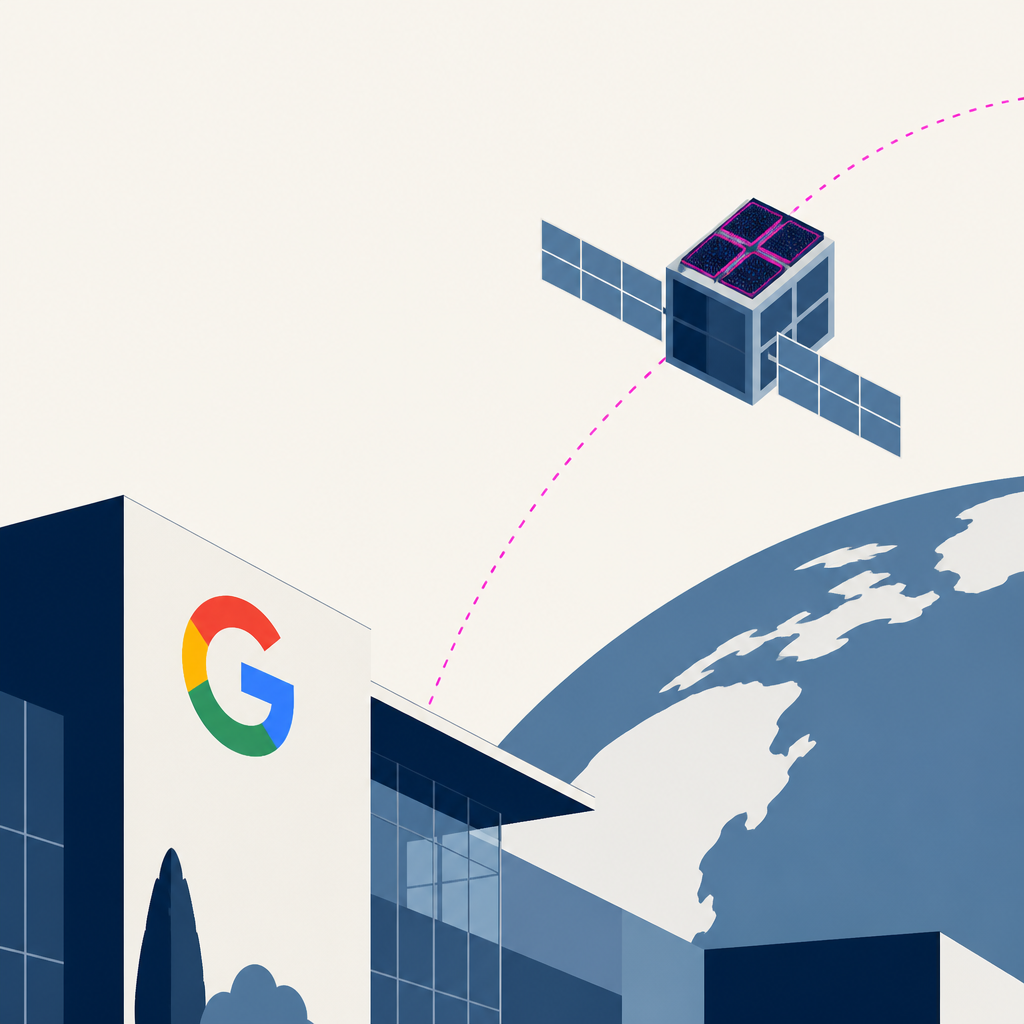
Google sent AI chips into orbit on a SpaceX rocket. It’s a small test for a very big idea: data centers in space.
Based on reporting by Fortune, Marco Quiroz-Gutierrez — read the original for the full story.
Summary, retelling and take written by AI under human oversight; images are AI-generated illustrations. How we work · Report an error
Google has started testing whether AI chips can actually work in orbit. Last week, its Project Suncatcher launched a refrigerator-sized satellite with four chips on a SpaceX rocket, a first pass at seeing whether the hardware that powers today’s thirsty data centers can survive space.
The satellite, built with Planet Labs, went up on Oct. 1 and is running normally, according to Google. For now, the mission is simple: find out how TPU chips handle launch vibration, then radiation and temperature swings once they get there. Google says the satellite will spend about a year in low Earth orbit, and because heat is such a problem in space, the chips are only being run for 15 minutes at a time before they cool down.
That cooling problem is part of why this idea has stayed more science fiction than infrastructure. Space doesn’t give you water lines or fans, so Google built heat pipes and radiators to move heat away from the chips. The satellite is solar powered, which sounds elegant until you remember the other half of the equation: big solar arrays are heavy, and heavy things cost money to launch.
And launch prices still matter, even with SpaceX having cut its estimated costs by 95% since 2008 to about $1,000 per kilogram, according to ARK Invest research. Google is also watching radiation closely. It says Earth testing showed its chips can survive more ionizing radiation than they would see in a five-year mission, but solar events and cosmic rays are still a risk, and fixing broken hardware in space is much harder than swapping a server in a warehouse.
The company is not alone in chasing this idea. Starcloud has already put an Nvidia H100 into orbit and used it to run Google’s Gemma model, while Cowboy Space Corp. flew its Reason-1 satellite on the same SpaceX rocket as Google. Google itself is already looking past this first launch, with two more satellites planned for 2027 to test laser communication, a task it compares to hitting a coin-size target from miles away while both points are moving. Even so, Google’s research chief James Manyika told the New York Times not to expect a quick win; he compared it to Google’s own long runway before products appear.
My take — AI-written commentary, not fact-checked reporting
This is the right kind of moonshot: expensive, awkward, and still more real than most of the AI grandstanding clogging up conference stages. Earth is already getting stuck with the power, water, and land bill for AI, so of course someone is trying to export the mess upward. The comedy is that space is supposed to be the easy part; the hard part is still thermodynamics, money, and not breaking the chips on the way up.
Read more about this at: Fortune