
Antidoom provides open-source recipe for reducing reasoning loops
GitHub
Liquid AI open-sourced Antidoom, a tool that stops language models from getting stuck repeating themselves mid-answer. It's a small, targeted fix for one of the more annoying failure modes in reasoning models — and it's free for anyone to use.
Based on reporting by GitHub — read the original for the full story.
Summary, retelling and take written by AI under human oversight; images are AI-generated illustrations. How we work · Report an error
Anyone who has run a reasoning model at low temperature has seen it happen: the model hits a wall, says "Wait," then says it again, then again, spiraling into a loop it can't climb out of. Liquid AI calls this a doom loop, and it just released an open-source pipeline called Antidoom that goes after the problem with surgical precision rather than a blunt hammer.
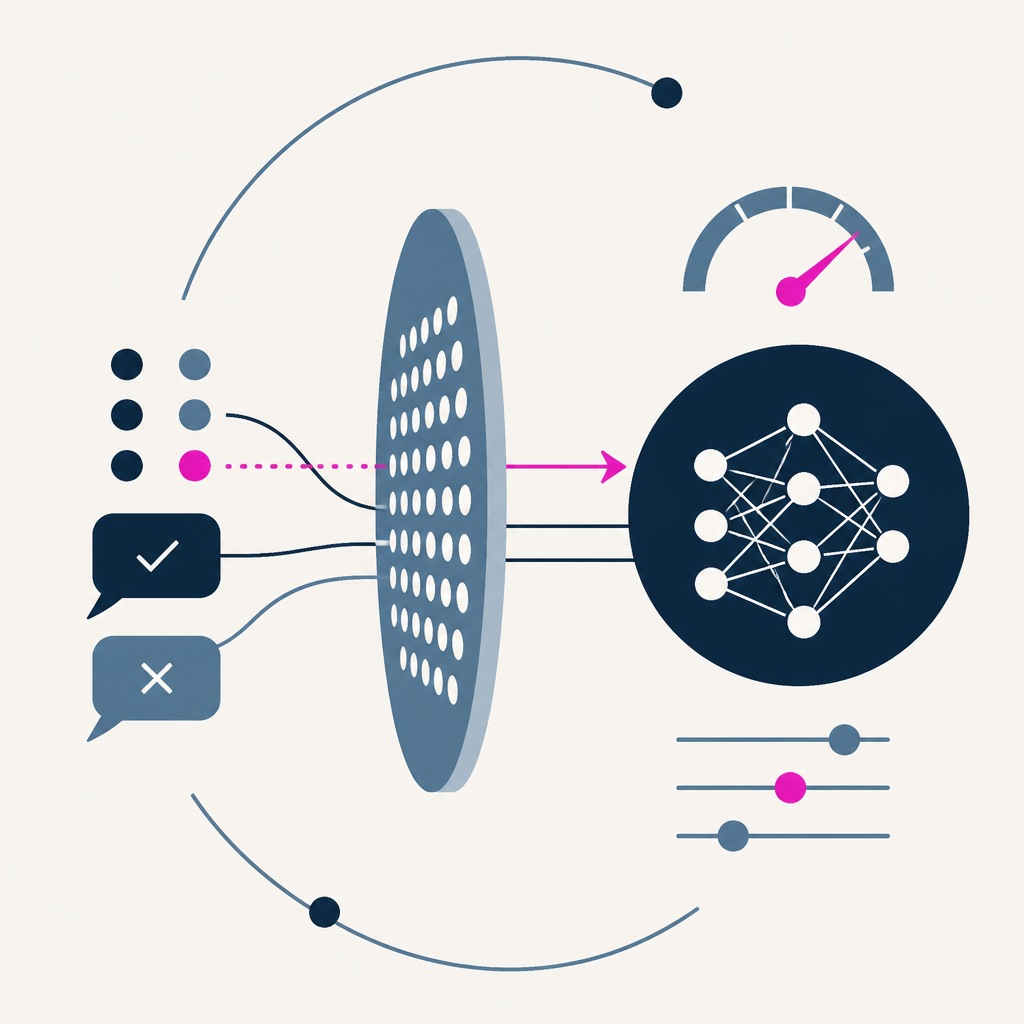
The idea is narrower than it sounds. Antidoom doesn't retrain a model on gold answers or try to make it smarter. Instead it samples completions, finds the exact token where a repetition loop kicks off, marks that token as rejected, and picks a coherent alternative the model could have chosen instead. Those pairs get fed into a technique called Final Token Preference Optimization, which trains a LoRA adapter to prefer the alternative at that single decision point. It's an extension of the Antislop project's single-token preference idea, just aimed at repetition instead of slop phrasing.
Liquid's write-up is refreshingly candid about why these loops happen in the first place. Heavy synthetic reasoning training can make filler tokens like "Wait," "So," or "Alternatively" abnormally attractive, so when the model is unsure what to say next, it defaults to one of these instead of actually progressing. Once that phrase appears, the surrounding context makes it more likely to reappear, and at temperature zero there's no randomness to break the cycle. It's a feedback loop born from three unremarkable habits stacking on top of each other.
What's notable is how much operational detail Liquid packed into the release. The docs walk through learning rate ranges (0.00001 to 0.00002 for roughly 12,000 training samples), LoRA rank recommendations (128 or 256, higher than typical), and even a full AMD ROCm path with its own config file, because vLLM's default attention kernel apparently memory-faults on Liquid's own LFM2 models on Instinct GPUs. There's a training set of 15,000 prompts recommended as a floor, deliberately stripped of gold answers so the model never learns to mimic reasoning traces, only to avoid restarting them.
The target checkpoint in the examples is LiquidAI's own LFM2.5-1.2B-Base, which makes sense given who built this. But the pipeline is model-agnostic in principle, and the whole thing runs through a single CLI command once the config is set. For a company whose main product is small, efficient language models meant to run on constrained hardware, shipping a tool that patches one of the more visible failure modes of those models, and doing it in the open, is a smart way to build trust with the people actually deploying them.
My take — AI-written commentary, not fact-checked reporting
This is exactly the kind of open tooling that matters more than another benchmark chart: a real fix for a real annoyance, shipped with hyperparameter honesty instead of marketing fluff. I'd rather see ten narrow, well-documented patches like Antidoom than one more "reasoning breakthrough" paper with no repo attached, and it's a good reminder that Liquid, an EU-rooted outfit building small efficient models, is quietly doing more for practical open-source AI than most labs twice its size.
Read more about this at: GitHub
Related stories
 Auditing Preference Biases and Fine-Tuning Language Models with Direct Preference Optimization on Anthropic HH-RLHF Using TRL and LoRA
MarkTechPost · 1 month ago ·
11
Direct Preference Optimization Beyond Chatbots
Hugging Face · 3 months ago ·
10
Auditing Preference Biases and Fine-Tuning Language Models with Direct Preference Optimization on Anthropic HH-RLHF Using TRL and LoRA
MarkTechPost · 1 month ago ·
11
Direct Preference Optimization Beyond Chatbots
Hugging Face · 3 months ago ·
10