
Google Research
·
1 month ago
Researchers found that enabling reasoning traces in large language models improves recall of simple factual knowledge stored in model weights, even though no complex reasoning is needed. The study identified two mechanisms: a computational buffer effect where extra tokens provide additional forward passes for refinement, and factual priming where generating related facts acts as a semantic warm-up to retrieve harder-to-access information. Hallucinated intermediate facts significantly reduce final answer accuracy, suggesting that training models to prioritize factually supported reasoning steps could improve reliability.
TheSequence
·
1 month ago
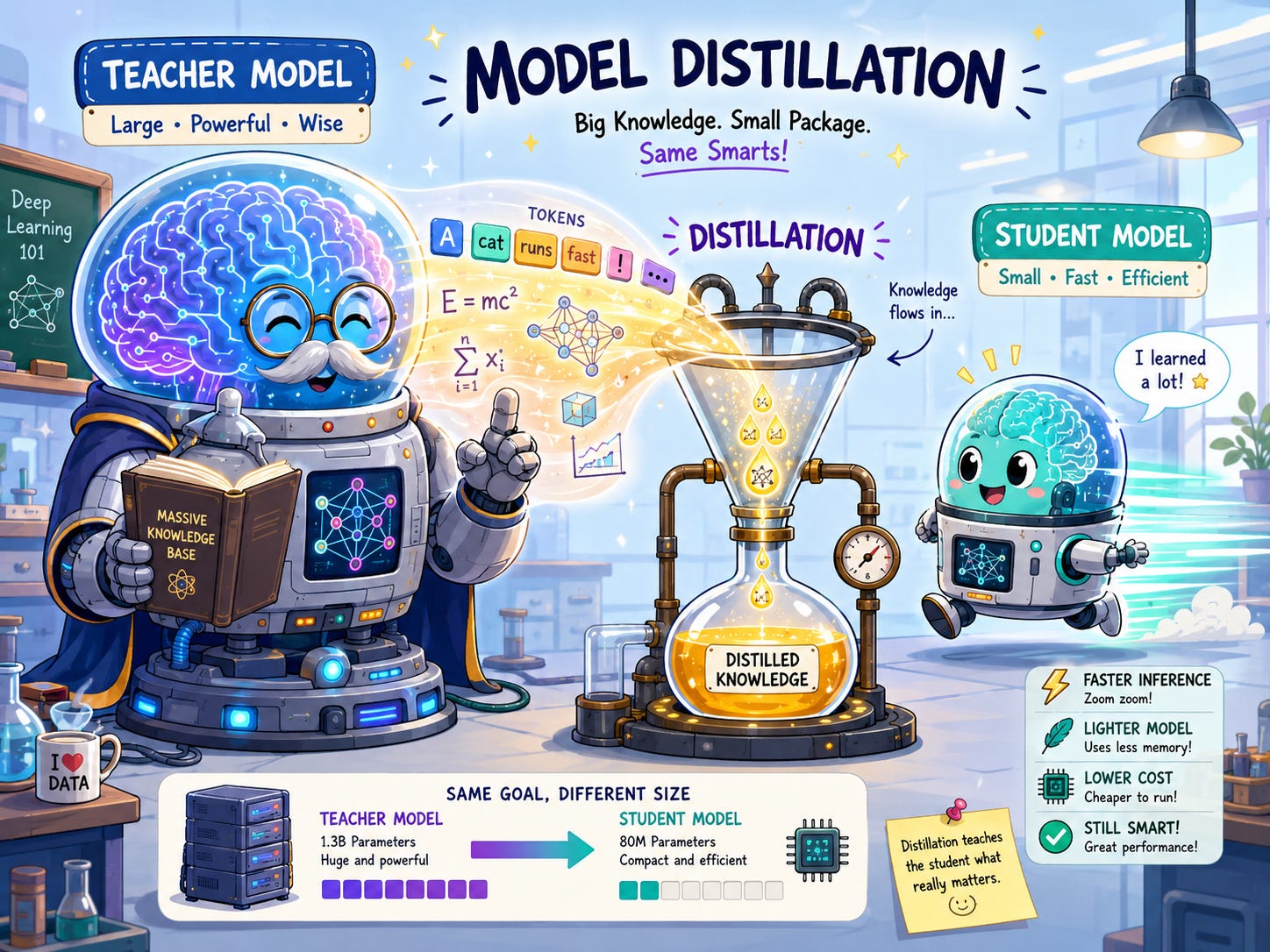
A new series explores knowledge distillation techniques in AI models, examining how to create smaller, specialized models as an alternative to the scaling approach that has dominated recent AI progress. Distillation addresses practical deployment challenges by enabling efficient, localized intelligence for specific use cases such as banking compliance, mobile devices, and coding agents. This shift reflects the industry's move from pursuing larger general-purpose models toward building domain-specific, cost-effective, and deployable solutions.
Lilian Weng
·
1 month ago
Researchers studying scaling laws in deep learning have found that training loss decreases predictably as model size, dataset size, and compute increase following power-law relationships, with the Chinchilla paper (Hoffmann et al. 2022) challenging earlier findings from Kaplan et al. (2020) about optimal resource allocation. The Kaplan et al. study recommended allocating a 10x compute increase by scaling model size 5.5x but training tokens only 1.8x, while Chinchilla argued this approach leaves large models undertrained. These scaling laws enable practitioners to fit models on small experimental runs and extrapolate predictions for larger model training requirements.

Hugging Face Blog
·
1 month ago
Treble Technologies and Hugging Face launched the FFASR Leaderboard, an open benchmark for evaluating automatic speech recognition models under realistic far-field acoustic conditions including reverberation, background noise, and varying microphone distances. The benchmark tests models across 14 simulated rooms at three signal-to-noise ratios, with performance measured against an 8-hour held-out test set, while also reporting inference speed (RTFx) on identical NVIDIA L4 GPU hardware. The leaderboard reveals that far-field word error rates at low signal-to-noise ratio are consistently several times higher than near-field performance on the same speech content, providing visibility into the gap between clean-speech benchmarks and real-world deployment that was previously difficult to measure.
