Reward AI released OM-1, an Omnibody Model 1 manipulation policy trained from human demonstrations captured with a 7-DoF sensorized glove. Electromagnetic hand tracking reduced mean overshoot error from 24.9 mm to 9.5 mm at 67 cm/s versus visual-inertial. The company also did not release weights, code, a dataset, or an API, and OM-1 is described as an in-house policy rather than immediately deployable for developers.
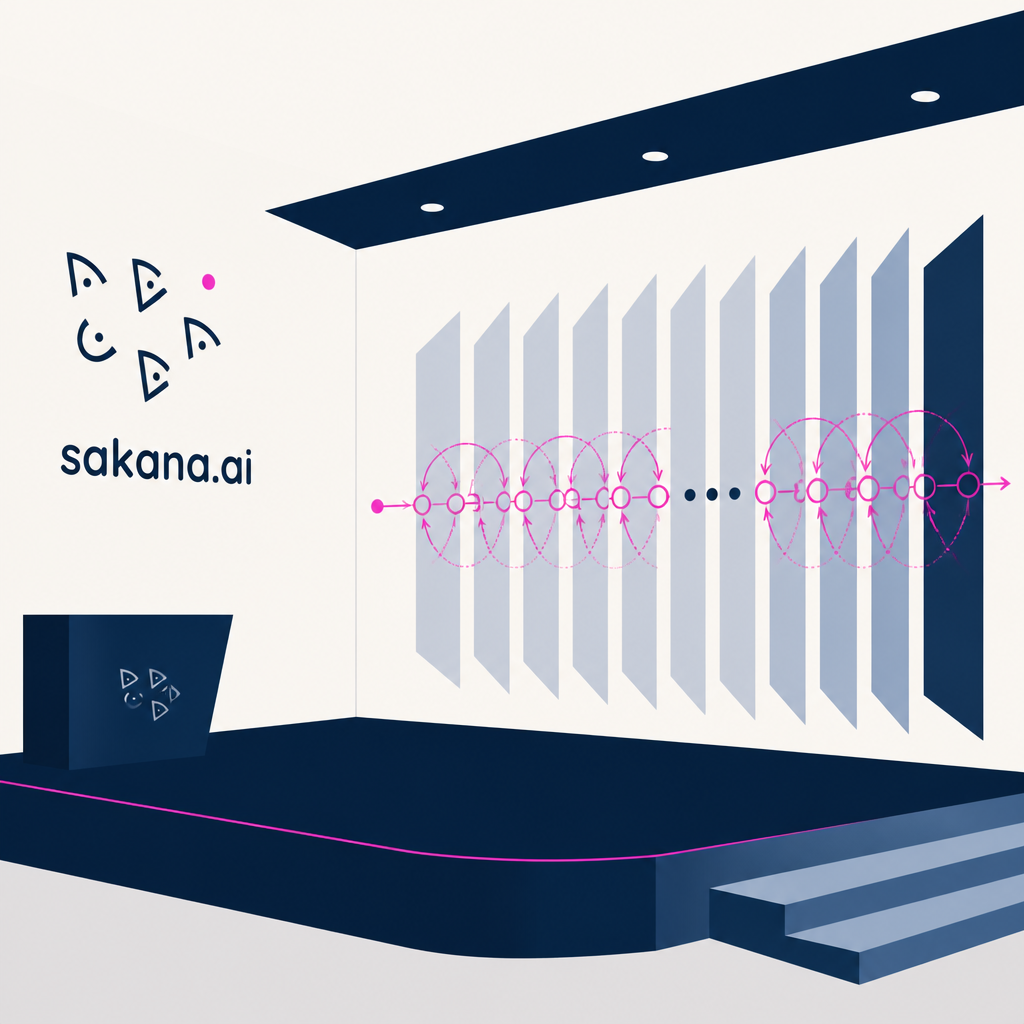
Sakana AI researchers introduced Augmented Lagrangian Predictive Coding (PC-ALM), a layer-local learning method meant to replace backpropagation’s global credit assignment with predictive-coding updates. They report training 1000-layer residual MLPs on MNIST for 5 epochs while staying within about 2 percentage points of backprop accuracy. The method adds per-layer Lagrange multipliers and improves accuracy over standard predictive coding, with released MIT-licensed JAX reference code reproducing results on CPU.
A social media post using odd capitalization that highlights the letters “RSI” sparked claims that Google DeepMind’s AI systems have reached recursive self-improvement. The only concrete technical example cited is an AlphaEvolve result improving a matrix multiplication kernel by about 23%, reducing Gemini training time by about 1%. No verified model, benchmark, or definition of “reached RSI” is provided, so the discussion shifts from proof to speculation while highlighting the gap between self-optimization in parts and a self-accelerating improvement loop.
Aeon, the Zurich health tech startup, extended its seed round and acquired Aware Health’s consumer blood diagnostics platform, technology, team and customer relationships. The seed extension brings Aeon’s total seed funding to more than USD 14 million (about EUR 12 million). Aeon will integrate Aware Health’s technology to push its European roadmap and build a recurring imaging-plus-blood dataset that its AI models can use for trend tracking and risk prediction.
Every AI story that matters,
in your inbox by 8am.
TLDRocket reads all relevant sources, removes duplicate coverage, and summarises the
day in two minutes. Follow companies and topics for alerts, or get the
briefing in Slack. Free, no spam, unsubscribe anytime.
Reading TLDRocket needs no cookies, and the readership counts we rely on come from
our own cookieless analytics. Google Analytics is the exception: it sets cookies and
reports to Google, so it stays switched off until you allow it. You can change your
mind any time from “Cookie settings” in the footer.
Strictly necessary
Session security and form protection (tldrocket-session,
XSRF-TOKEN, 2 hours). The site cannot work without them,
so they need no consent.
Always on
Google Analytics 4 (_ga,
_ga_<id>, up to 2 years). Measures which
stories and sections readers use. Google acts as a third-party processor and may
store the data outside the EU. No advertising, no profiling, no data sold.