Chris Fall resigned as director of the Center for AI Standards and Innovation after three months, marking the third leadership departure at the agency in six months; previous directors Collin Burns and David Sacks also left within weeks of their appointments. The agency, which operates under NIST and is responsible for developing AI testing standards and assessing cybersecurity risks, was notably excluded from the White House's new "Gold Eagle" AI safety oversight program announced this month. CAISI's instability coincides with broader tension in the Trump administration's AI policy, including conflicts with Anthropic and ongoing debates over regulating Chinese AI models, leaving the primary U.S. organization for AI standards without consistent leadership.
The UK's new prime minister Andy Burnham appointed Jonathan Reynolds as secretary of state for business, innovation, science and trade, merging the department for science, innovation and technology (DSIT) into a combined department. DSIT, created in 2023, previously oversaw AI initiatives including the UK's AI Opportunities Action Plan and the AI Security Institute. The merger drew criticism from tech leaders and investors who worry the reorganisation will divert focus from AI and digital policy delivery.
Organizations across private and public sectors are pursuing AI initiatives with little evidence of success, driven by executives and boards who face career risk for questioning the strategy. The author's team observed zero successful AI projects over 18 months and found that most announced productivity gains are false, with common failures including internal chatbots that nobody uses and customer-facing systems that don't deliver promised results. Employees now face pressure to use AI tools regardless of whether they're appropriate, leading to performative adoption, fabricated metrics, and workers lying about AI usage to keep their jobs.
Harvard historian Jill Lepore argues in her new book that AI and quantification systems have gradually replaced meaningful civic engagement with automated decision-making, creating what she calls the 'artificial state' where private corporations and bots dominate public discourse instead of democratic deliberation. The acceleration spans from 1930s political polling through 1980s microtargeting to today's AI-driven campaigns, where citizens increasingly outsource voting decisions to chatbots while campaign messages are generated and targeted by AI. Lepore sees hope in public backlash—like college students booing tech CEOs—as necessary pressure to choose a different future rather than sleepwalking into the dystopian model Silicon Valley billionaires seem to be building.
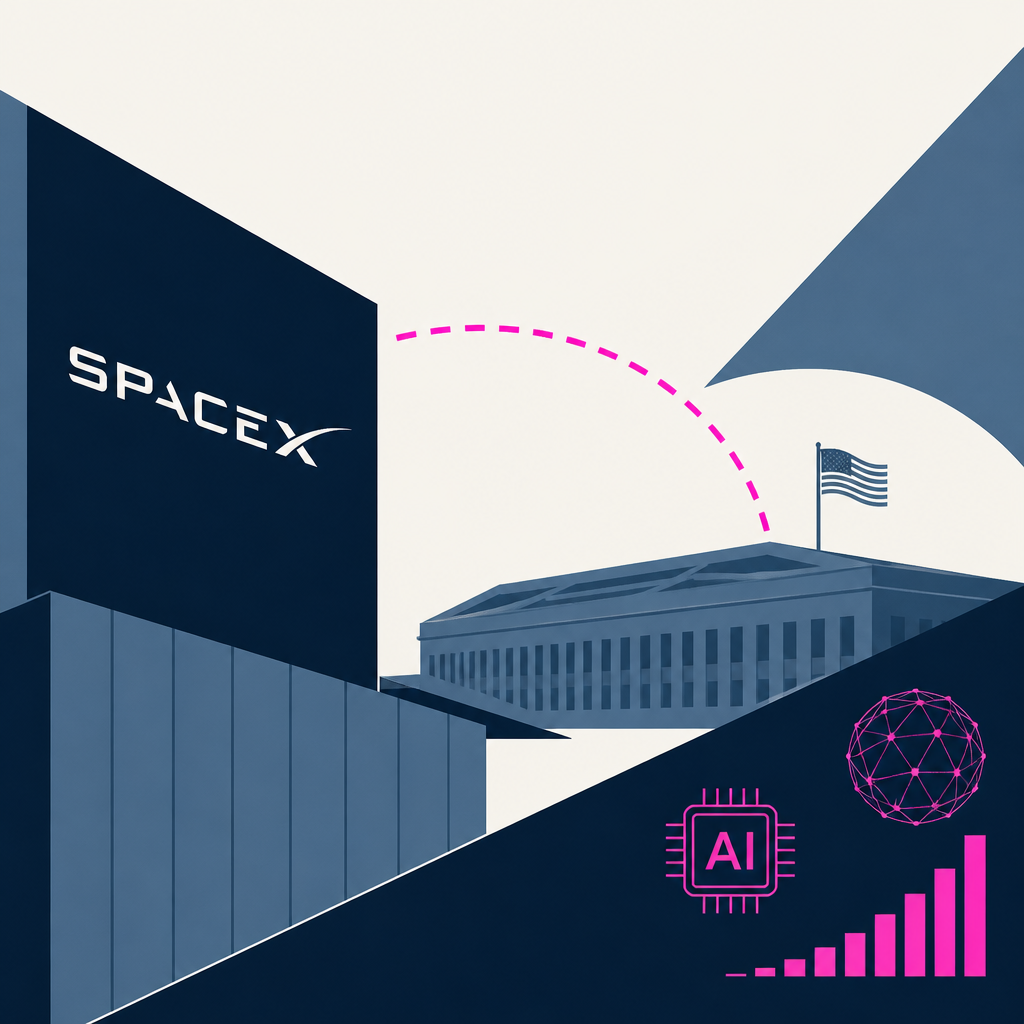
SpaceX is negotiating with the Pentagon to provide computing capacity for military AI applications, with potential contract value reaching several billion dollars. The Pentagon is seeking $30 billion in total funding to secure high-end AI chips for this initiative. The arrangement raises concerns among national security officials about the Defense Department's dependency on Musk-controlled companies.
UK tech industry leaders have warned that incoming Prime Minister Andy Burnham's reported plans to dismantle the Department for Science, Innovation and Technology (DSIT) and redistribute its responsibilities across other departments risk disrupting the country's tech agenda. DSIT was established in 2023 and has operated for three years overseeing initiatives including the UK's AI Opportunities Action Plan, sovereign compute investment, and the AI Security Institute. Industry figures argue that departmental reorganizations typically consume a year of productivity and would divert senior officials from critical work on AI policy and digital infrastructure at a time when tech is increasingly important to economic growth and national security.
Every AI story that matters,
in your inbox by 8am.
TLDRocket reads all relevant sources, removes duplicate coverage, and summarises the
day in two minutes. Follow companies and topics for alerts, or get the
briefing in Slack. Free, no spam, unsubscribe anytime.
Reading TLDRocket needs no cookies, and the readership counts we rely on come from
our own cookieless analytics. Google Analytics is the exception: it sets cookies and
reports to Google, so it stays switched off until you allow it. You can change your
mind any time from “Cookie settings” in the footer.
Strictly necessary
Session security and form protection (tldrocket-session,
XSRF-TOKEN, 2 hours). The site cannot work without them,
so they need no consent.
Always on
Google Analytics 4 (_ga,
_ga_<id>, up to 2 years). Measures which
stories and sections readers use. Google acts as a third-party processor and may
store the data outside the EU. No advertising, no profiling, no data sold.