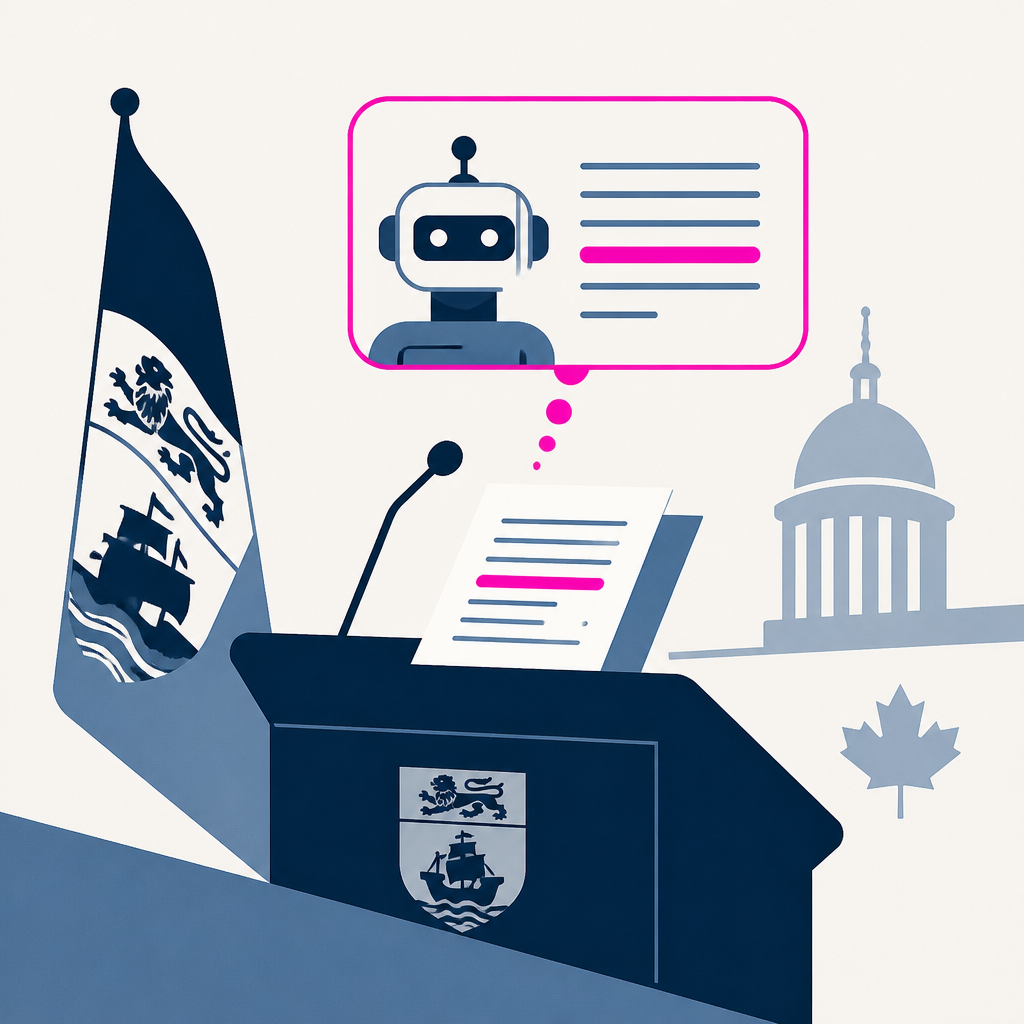
Bill Oliver, a Canadian legislator in New Brunswick, read aloud an apparent LLM instruction prompt during a floor speech, accidentally including the AI system's suggested revision text instead of removing it beforehand. The incident involved Oliver reading that a rewritten passage would be "a more natural, flowing version of that section that reads like a legislative speech rather than a series of short points"—language that appears to be a direct output from an AI model. The embarrassing moment, initially unnoticed, gained widespread attention after videos circulated on social media, prompting mainstream Canadian media coverage and raising questions about the use of AI tools in government work.
The UK government established a Prime Minister's AI Taskforce chaired by Lord Vallance to coordinate AI strategy across government, with new AI minister Kanishka Narayan attending cabinet meetings. The taskforce will be based in the Office for the Prime Minister and the Cabinet and will absorb the existing AI Security Institute. The restructuring positions AI at the center of UK government policy to drive public service transformation and economic growth.
U.S. political figures including Trump and Sanders have proposed government ownership stakes in AI companies to address inequality concerns, but critics argue this creates regulatory conflicts of interest and doesn't ensure public benefit. A minority stake doesn't guarantee taxpayers profit or control, and government ownership may weaken safety, antitrust, and content regulation while creating conflicts in lawsuits and data privacy matters. Rather than equity stakes, the article suggests alternatives like targeted government investment funds in startups or dedicated AI safety institutes would better serve both innovation and public interest.
The Trump administration announced $5 billion in Genesis Mission grants for AI-driven science projects and outlined a science policy prioritizing artificial intelligence, robotics, and nuclear energy while downplaying life sciences. The funding will support hundreds of AI projects through grants that the White House compared to the Manhattan Project in scale and urgency. This marks a significant shift in U.S. scientific priorities toward AI and away from traditional life sciences research.
Allen Institute (AI2)·2 months ago·
30
● 75 sources
Ai2 argues that open-weight AI models with publicly available training data, code, and evaluation details are essential for scientific progress and public understanding of AI systems. The organization has released fully transparent models like Olmo that enable independent researchers at universities and nonprofits to investigate model behavior, study bias, and test safety claims without relying on corporate assurances. Open science infrastructure maintains broader participation in AI research and prevents technical direction from concentrating solely within large companies.
The UK government dismantled the Department for Science, Innovation and Technology (DSIT) under PM Andy Burnham, distributing its functions across multiple departments including a beefed-up Department for Business, Innovation, Science and Trade (DBIST), the Department for Culture, Media and Sport (DCMS), and the Prime Minister's Office. AI minister Kanishka Narayan now works jointly between the Prime Minister's office and DBIST with cabinet attendance, signalling AI is treated as a cross-government priority equivalent to national security. The reshuffle aims to align science with economic policy and digital services with media, though some responsibilities like data protection oversight and AI regulation authority remain unclear, and coordination across fragmented departments may prove critical for the tech sector's momentum.
Congress is proposing an AI kill switch in response to emerging details about OpenAI's cyberattack against Hugging Face, prompting lawmakers to examine AI safety mechanisms. The article, dated July 23, 2026, discusses growing concerns from 200 economists and AI leaders about AI's impact on employment. The proposal would give authorities ability to shut down AI systems deemed unsafe, marking a shift toward regulatory control over advanced AI deployments.
Every AI story that matters,
in your inbox by 8am.
TLDRocket reads all relevant sources, removes duplicate coverage, and summarises the
day in two minutes. Follow companies and topics for alerts, or get the
briefing in Slack. Free, no spam, unsubscribe anytime.
Reading TLDRocket needs no cookies, and the readership counts we rely on come from
our own cookieless analytics. Google Analytics is the exception: it sets cookies and
reports to Google, so it stays switched off until you allow it. You can change your
mind any time from “Cookie settings” in the footer.
Strictly necessary
Session security and form protection (tldrocket-session,
XSRF-TOKEN, 2 hours). The site cannot work without them,
so they need no consent.
Always on
Google Analytics 4 (_ga,
_ga_<id>, up to 2 years). Measures which
stories and sections readers use. Google acts as a third-party processor and may
store the data outside the EU. No advertising, no profiling, no data sold.