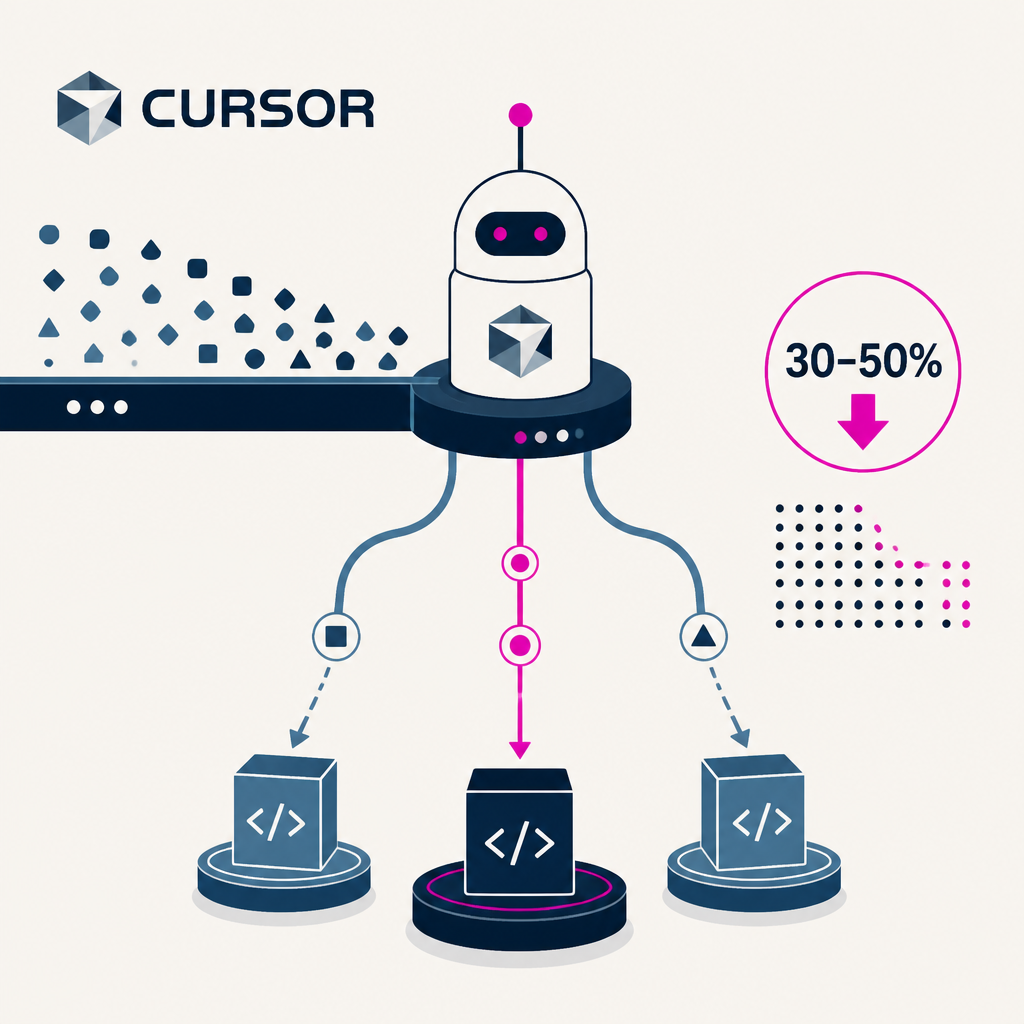
Cursor released Cursor Router, a request-level classifier that directs coding tasks to the most appropriate model before execution runs, achieving 30–50% cost savings in early-access deployments by routing routine work away from frontier-priced models. The system was trained on 600,000+ live requests and evaluated across millions of real requests using user satisfaction as the reward signal, accounting for cache misses when switching models mid-conversation. Cost reduction comes from routing simple and UI tasks to cheaper models while keeping complex, long-horizon problems on frontier reasoning models, addressing a usage pattern where 60% of developers default to a single expensive model for all work.
Greptile researchers tested whether AI code review models catch bugs in code written by other models versus their own code, finding both Claude and GPT detect more bugs in code written by the competing model. Testing on 1,000 PRs with 1,500 verified bugs showed Claude Opus achieved 39% recall on GPT-authored code but only 28% on Claude-authored code, while GPT showed the opposite pattern. The team launched Model Inversion, a feature that routes code reviews to the opposite model based on author detection, leveraging the finding that cross-model reviews outperform same-model reviews.
Niobium open-sourced its fully homomorphic encryption (FHE) developer toolkit on GitHub under Apache 2.0, including a domain-specific language, design methodology, and client tools for building encrypted computation applications. The toolkit includes a Niobium DSL compiler, an FHE Application Design Skill for Claude Code agents, example applications like similarity search and network monitoring, and a simulator that runs on standard CPUs. Developers can now experiment with FHE applications locally before deploying to Niobium's Fog hardware platform, removing barriers to building privacy-preserving server applications that compute on data without ever decrypting it.
Every AI story that matters,
in your inbox by 8am.
TLDRocket reads all relevant sources, removes duplicate coverage, and summarises the
day in two minutes. Follow companies and topics for alerts, or get the
briefing in Slack. Free, no spam, unsubscribe anytime.
Reading TLDRocket needs no cookies, and the readership counts we rely on come from
our own cookieless analytics. Google Analytics is the exception: it sets cookies and
reports to Google, so it stays switched off until you allow it. You can change your
mind any time from “Cookie settings” in the footer.
Strictly necessary
Session security and form protection (tldrocket-session,
XSRF-TOKEN, 2 hours). The site cannot work without them,
so they need no consent.
Always on
Google Analytics 4 (_ga,
_ga_<id>, up to 2 years). Measures which
stories and sections readers use. Google acts as a third-party processor and may
store the data outside the EU. No advertising, no profiling, no data sold.