
Cursor Releases Cursor Router: A Request-Level Classifier Delivering Frontier Coding Quality at 30–50% Lower Cost
MarkTechPost Michal Sutter ● Covered by 3 sources
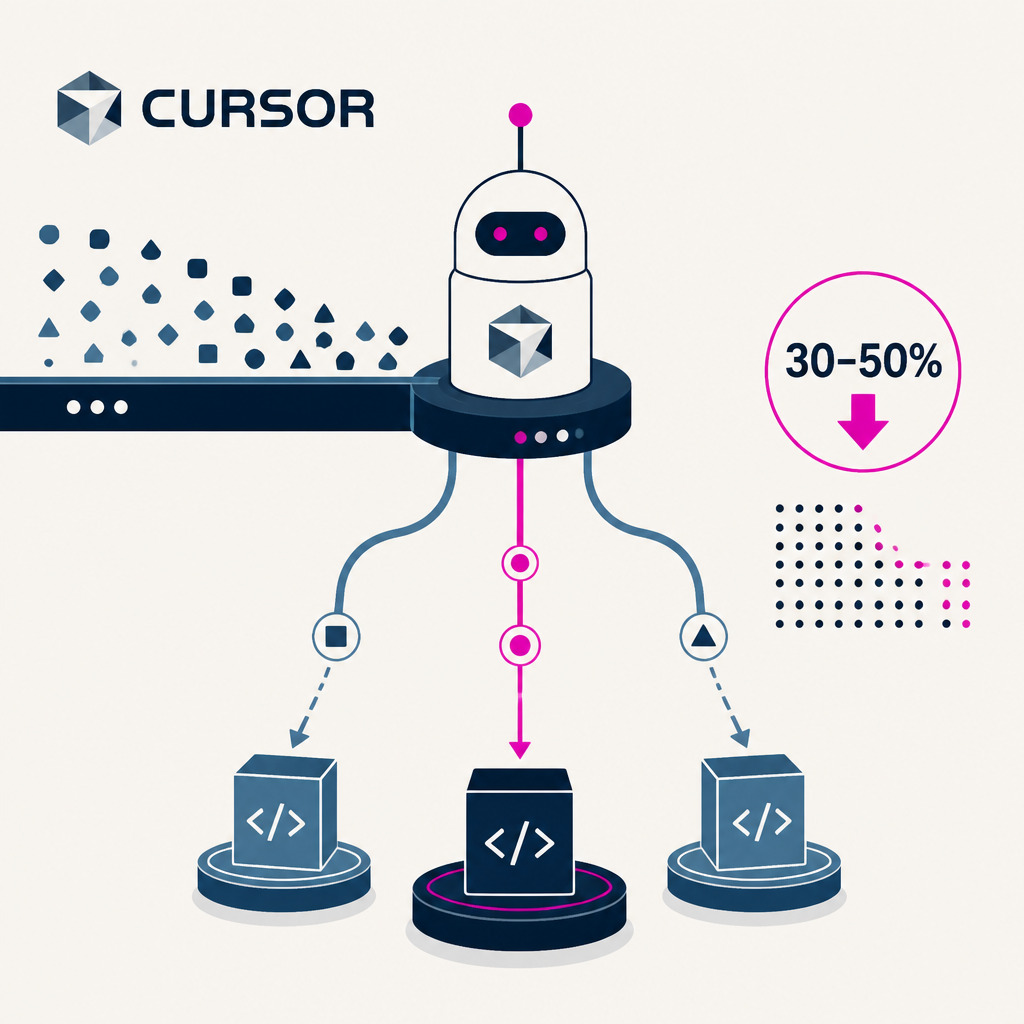
Cursor now auto-routes each coding request to whichever model fits best, not just your default pick. Result: 30-60% lower AI costs, with hard problems still going to frontier models.
Based on reporting by MarkTechPost, Michal Sutter — read the original for the full story.
Summary, retelling and take written by AI under human oversight; images are AI-generated illustrations. How we work · Report an error
Cursor just took the router out of beta and handed it to Teams and Enterprise customers, and the pitch is refreshingly boring: most people pick one model and stick with it, so easy tasks end up billed at frontier prices. Cursor says roughly 60% of its developers do exactly this, riding a single daily-driver model regardless of whether the job is renaming a variable or untangling a race condition across three services.
The router itself is a classifier, not a fallback script. It was trained on more than 600,000 live requests and then validated across millions more in an actual online A/B test, rather than a tidy offline benchmark. Cursor optimized it for something it calls AFC, essentially whether the user seemed satisfied with the output, which in practice means watching whether someone moved on to the next task or went back to correct the agent. For each incoming request it reads the query, the surrounding context, an estimate of task complexity, and the domain, then matches that against what it has learned about how each model actually behaves.
Three rules fall out of that classification. Trivial, well-scoped work goes to whatever model is cheapest per token. UI and front-end tweaks, where correctness is subjective and taste matters more than raw reasoning, go to the model Cursor judges best at that kind of aesthetic judgment. And the genuinely hard stuff, multi-file migrations, long-horizon debugging, architecture changes, still gets routed to frontier reasoning models at full price. That last point is the whole argument: the savings aren't coming from quietly downgrading hard problems, they're coming from stopping easy problems from riding on a frontier-model subscription they never needed.
One detail worth dwelling on if you've ever tried to build something like this yourself: the router accounts for cache. Switching models mid-conversation blows away prompt cache, and that's a real cost that a lot of routing systems conveniently ignore when they publish savings numbers. Cursor trained on a dataset that includes those cache misses and folded the cost into its reported figures, which is part of why the numbers, 60% savings in the broad A/B test, 30 to 50% for early-access enterprise accounts, are at least plausible rather than marketing arithmetic. The system is also built to be retrained as new models ship, which matters in a market where the frontier reshuffles every few weeks.
My take — AI-written commentary, not fact-checked reporting
This is the unglamorous, actually-useful side of AI infrastructure: nobody's going to write a breathless thread about a classifier that saves you money on variable renames, but that's exactly the kind of waste that's been quietly inflating every team's AI bill. I'd rather see more routing-layer engineering like this than another benchmark-chasing model launch, and it's a small tell that the industry's cost problem isn't intelligence, it's allocation.
Read more about this at: MarkTechPost