
Why AI Compute Comes in Rectangles — Erik Bernhardsson, Modal CEO
Latent Space Latent.Space ● Covered by 2 sources
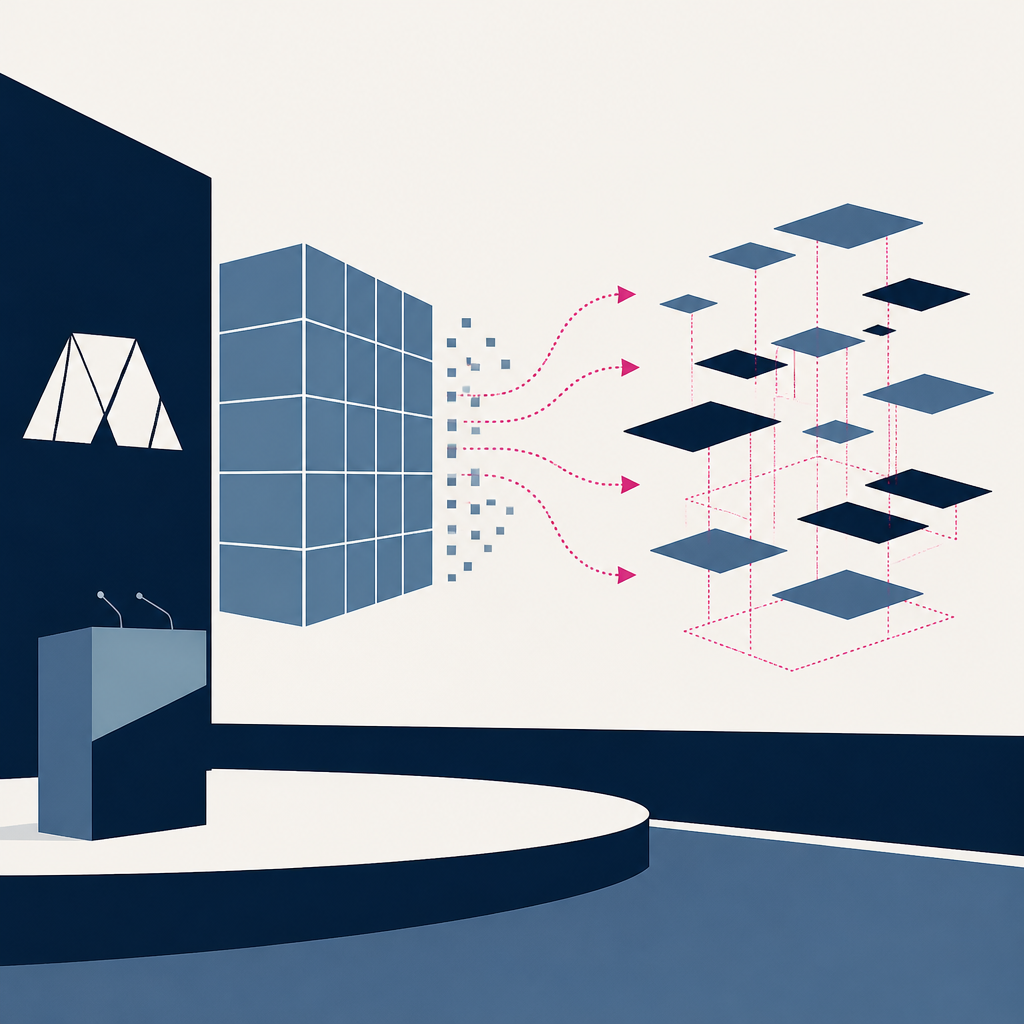
Modal says it hit $1B ARR and raised $750M at a $16B valuation. Its bet: AI compute doesn’t really arrive in neat rectangles.
Based on reporting by Latent Space, Latent.Space — read the original for the full story.
Summary, retelling and take written by AI under human oversight; images are AI-generated illustrations. How we work · Report an error
Modal’s CEO Erik Bernhardsson has a simple pitch: the company sells the compute and storage layer that lets customers build and run AI apps without babysitting the infrastructure. That means inference, sandboxes, some training and fine-tuning, plus batch jobs. The customers he names include Dacagon, Suno, Runway, and Cognition. The company also says it has crossed $1 billion in annualized run rate, closed a $750 million Series D at a $16 billion valuation, and spun up nearly three billion sandboxes.
The sharpest idea in the conversation is that GPU demand is bad at being a rectangle. A normal capacity contract gives someone a fixed number of GPUs for a fixed time. Real usage doesn’t behave like that. It spikes, it slumps, it changes during the day. So Modal’s bet is to pool demand across thousands of customers, buy capacity underneath, and let each customer take what they need when they need it. The smoother that shared demand gets, the more useful the pool becomes.
That setup has a flip side. If a provider locks in capacity at today’s prices and GPU prices fall later, it can end up stuck with expensive supply. Bernhardsson says he does not expect a sudden collapse, but he does think that risk matters when you build the business. The whole model is really a bet on timing as much as silicon.
The company’s sandbox product shows how that plays out in practice. Modal launched sandboxes after Bernhardsson and cofounder Akshat Bubna saw that language models could write code, and somebody would need a place to execute it. Early on, adoption was weak enough that the team talked about killing the product. Then coding agents, background agents, and reinforcement learning changed the picture. Bernhardsson says sandboxes now make up roughly a third of revenue.
And the technical trick is speed. An agent can create an environment, run code, inspect the result, and try again, over and over. So startup time and restore time are not just infra details; they are part of the product. Modal says its serverless GPU system uses a buffer of available GPUs, a custom filesystem, process checkpointing, and GPU memory snapshots to make that loop feel fast enough to matter.
My take — AI-written commentary, not fact-checked reporting
This is one of those rare AI businesses that sounds boring until you notice it is quietly attacking the real problem: not model hype, but compute getting used badly. Rectangular contracts are a neat way to describe an industry that still loves pretending demand is polite. It isn’t.
Read more about this at: Latent Space
Related stories
 [AINews] Modal’s $1B ARR, $16B Series D makes it NYC’s newest AI Infra Decacorn, 3x usage and 3x valuation in 5 months, 15x in 1 yr
Latent Space · 1 week ago ·
31
Modal Labs in talks to raise at $15B, tripling its valuation in four months: Report
Tech Funding News · 1 month ago ·
43