
The table Carney wants a seat at? Big Tech already owns it
Fortune Lindsay Newman
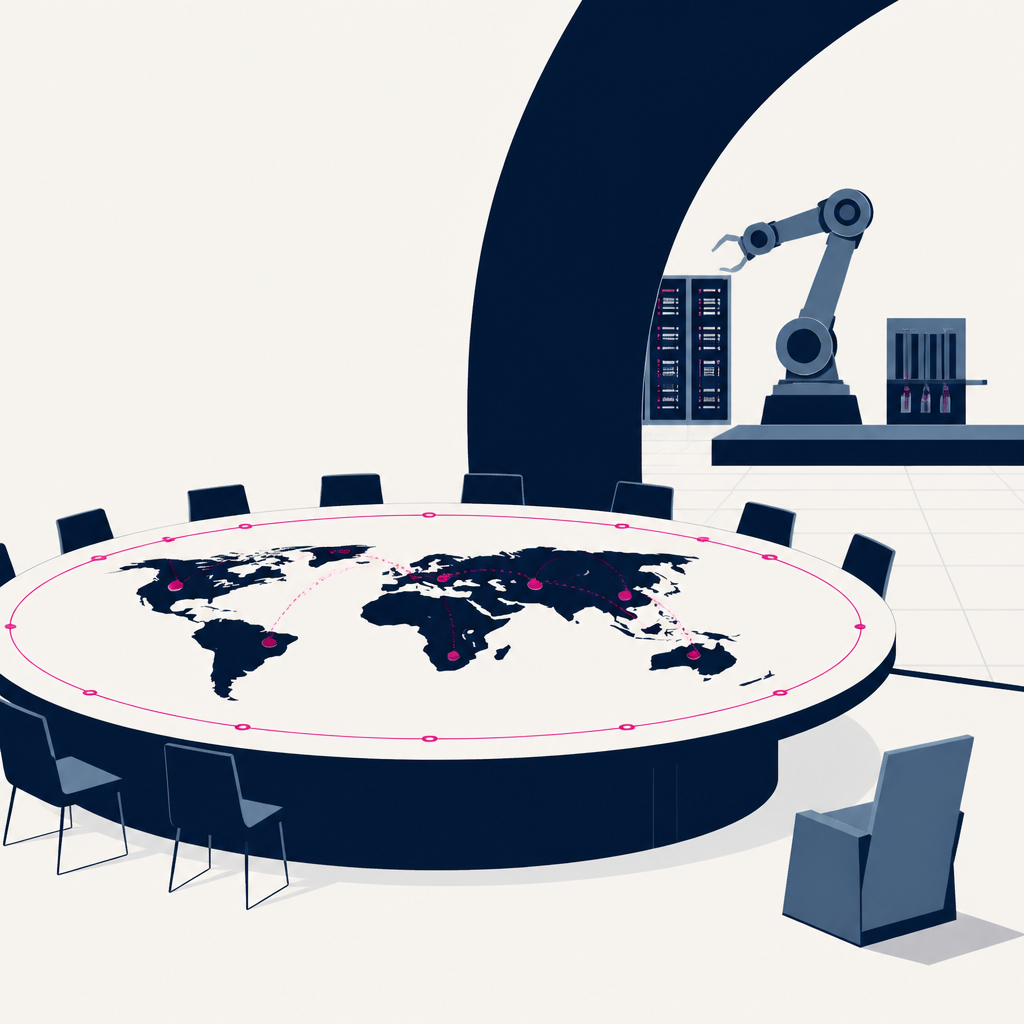
Carney wants middle powers to matter again, but Big Tech already has the front-row seats. AI firms and chip giants are helping shape geopolitics faster than most states can keep up.
Based on reporting by Fortune, Lindsay Newman — read the original for the full story.
Summary, retelling and take written by AI under human oversight; images are AI-generated illustrations. How we work · Report an error
Mark Carney’s pitch for middle powers starts from a comforting assumption: that states still sit at the center of great-power rivalry. The problem is that the ground has already shifted. The article’s core argument is simple and uncomfortable — private companies are no longer just tools of governments. They are becoming geopolitical actors in their own right.
The scale is hard to ignore. Nvidia’s market value sits just below Germany’s annual GDP and just ahead of Japan’s. Apple ranks below Japan but above India. Amazon is wedged between Canada and Brazil. Those numbers don’t just flatter Silicon Valley; they show how much economic weight now sits outside the state system that old foreign-policy instincts still assume is in charge.
And this isn’t only about valuations. Biotech companies helped develop and distribute the mRNA vaccines that ended up helping close out the COVID-19 pandemic. Taiwan Semiconductor Manufacturing Company sits at the center of the world’s electronics, consumer products, and innovation sectors. Trump, in his own way, has reflected the same shift: he offered investment deals during a state visit to the United Kingdom last year, and at a September White House dinner for Xi Jinping he brought in a large group of corporate chiefs and finance leaders.
The AI story makes the case even more sharply. SpaceX and Blue Origin are driving space exploration. Starlink has reportedly shown up across conflict zones from the Sahel to Iran and is providing internet access and battlefield intelligence in Ukraine. AI models are already being folded into planning, simulations, and cyber operations, while Anthropic says its Claude model has been misused or nearly misused in cases tied to a Southeast Asian government agency, a China-based effort to advance an undersea weapons system, suspected Russia-based attempts to build a kamikaze drone swarm, and an Iran-linked plot targeting U.S. Navy warships.
That leaves middle powers in a weak spot. Stanford’s 2026 AI Index shows development is still heavily concentrated in the U.S. and China, with 59 notable models for the U.S., 35 for China, and South Korea the only other country with more than one. So yes, Carney can talk about remaking the order. But if you are not building the models, funding the chips, or sitting in the supply chain, you’re not at the table — you’re waiting outside while the room gets rearranged.
My take — AI-written commentary, not fact-checked reporting
This is the bit policymakers keep ducking: power has already leaked out of the state and into firms with better balance sheets and faster product cycles. Middle-power speeches sound noble until they hit the AI supply chain, where the actual seats are handed to whoever builds, funds, and ships the thing. The new order is less Westphalian chessboard, more corporate boardroom with flags in the corner.
Read more about this at: Fortune
Related stories
 Trump meets AI giants, Senate Dems decry ‘unpredictable’ governance—and cheap Chinese AI looms as giant security risk
CSET Georgetown · 2 months ago ·
18
7 Consequences of America Finally Losing Its AI Edge to China
The Algorithmic Bridge · 2 months ago ·
42
Politics hits data centers, OpenAI falls behind Anthropic and now AI is too big to fail… quietly
SiliconANGLE · 1 month ago ·
36
Trump meets AI giants, Senate Dems decry ‘unpredictable’ governance—and cheap Chinese AI looms as giant security risk
CSET Georgetown · 2 months ago ·
18
7 Consequences of America Finally Losing Its AI Edge to China
The Algorithmic Bridge · 2 months ago ·
42
Politics hits data centers, OpenAI falls behind Anthropic and now AI is too big to fail… quietly
SiliconANGLE · 1 month ago ·
36