The Fed doesn't know who's financing the $3 trillion AI boom
Fortune Joao Gomes
Opinion — commentary, not a factual news event.
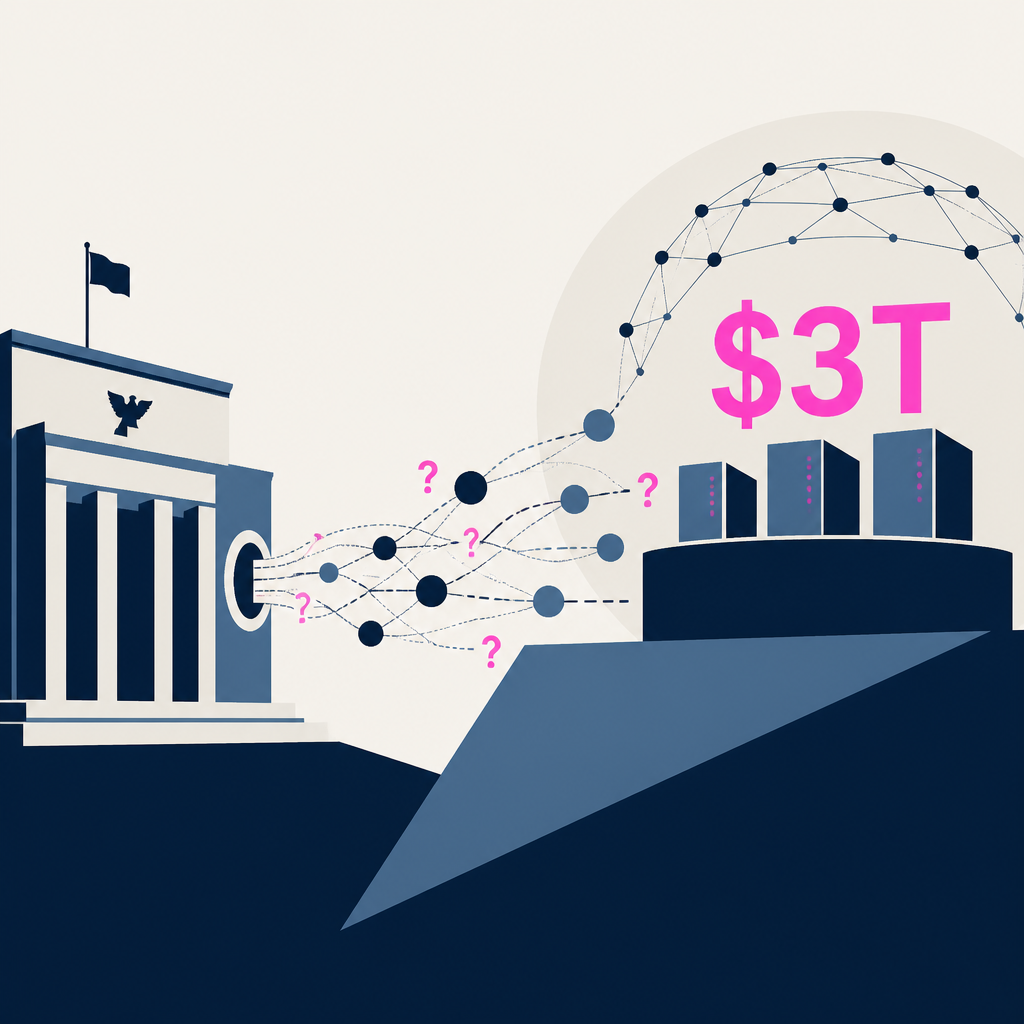
The Fed is staring at a $3 trillion AI buildout and doesn't know who'll foot the bill. That matters because hidden leverage could hurt the economy before AI's gains show up.
Based on reporting by Fortune, Joao Gomes — read the original for the full story.
Summary, retelling and take written by AI under human oversight; images are AI-generated illustrations. How we work · Report an error
The Fed is getting pulled into the AI boom for two reasons at once: inflation and finance. The inflation part is familiar. AI construction is already soaking up semiconductors, electricity, skilled labor and concrete, and Morgan Stanley puts global AI-related infrastructure investment near $3 trillion through 2028. But the financing side is the messier story, with an estimated $1.5 trillion gap still to be filled.
That matters because a central bank can choke off investment while trying to cool prices. And AI investment is not just another overheated sector trade. It is building data centers, power capacity, technical know-how and the funding channels around them. If the Fed leans too hard on rates now, it could slow the very capital formation that is supposed to raise future productivity and lower costs.
The source argues that this is exactly the kind of mistake policymakers made in the 1990s. Alan Greenspan, facing unemployment below what the Fed then thought was the economy’s natural rate, held back from more tightening as productivity accelerated. Inflation stayed tame. The point is not that the 1990s can be replayed, but that models miss shifts in supply all the time. They are also blind to productivity that never happens.
There is a second, sharper warning here: the Fed may be looking at the wrong kind of risk. Standard policy models give financial conditions only a supporting role, while the AI buildout is creating a fast-changing web of private markets, intermediaries and leverage. The piece argues that credit spreads can reveal financing distortions that inflation and the output gap miss, and that the central bank still knows far more about banks and mortgages than about the next wave of funding structures.
That is the real tension. Higher rates can expose hidden leverage and still fail to fix the problem if the problem is financial fragility rather than overheating demand. Meanwhile, the U.S. could lose AI investment, expertise and infrastructure to somewhere else. The Fed’s next job is not just watching prices. It is figuring out who is financing the boom before the boom becomes the vulnerability.
My take — AI-written commentary, not fact-checked reporting
This is the part central banks hate most: the risk is not clean enough to fit the spreadsheet. The Fed spent years learning to fear inflation, and now it may be about to make the classic bureaucratic move of fighting the last war while a new one is assembling private debt off to the side. That is how “prudence” turns into self-inflicted stagnation, which is a very modern way to lose a race.
Read more about this at: Fortune