
The AI boom is lifting economies across Asia. But for Southeast Asia, it might just be a ‘short-term blip’
Fortune Angelica Ang
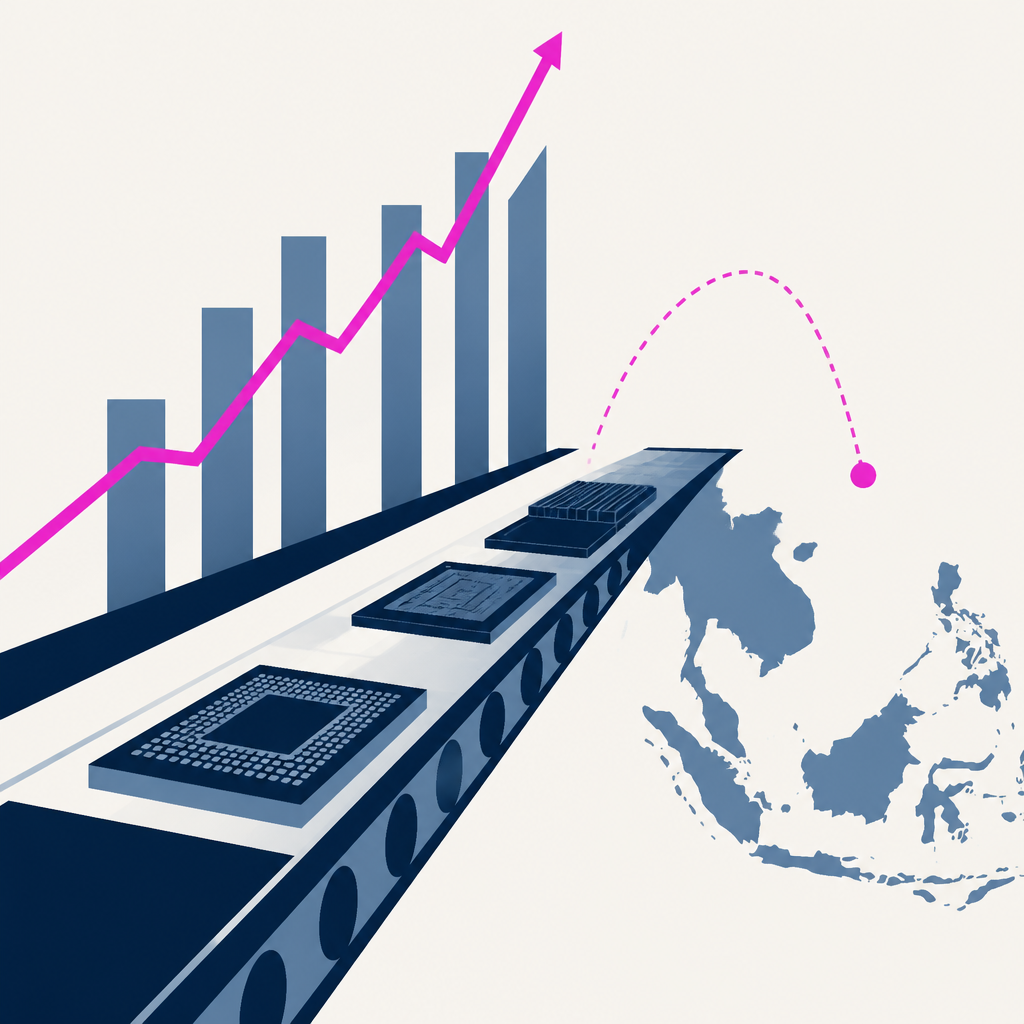
Asia’s AI boom is boosting exports and stocks. Southeast Asia may only get a temporary lift, not the big prize.
Based on reporting by Fortune, Angelica Ang — read the original for the full story.
Summary, retelling and take written by AI under human oversight; images are AI-generated illustrations. How we work · Report an error
Taiwan is heading toward its first year of double-digit GDP growth since 2010, and AI hardware demand is a big reason why. The rest of the region is feeling it too: Japan, Malaysia, Singapore and mainland China all posted export growth above 20% in July, while South Korea’s exports jumped by more than 60%.
The money is showing up in growth figures as well. Second-quarter GDP beat expectations in Singapore, Hong Kong and Taiwan, helped by electronics exports. Markets have been quick to price in the excitement. ChangXin Memory Technologies and robot maker Unitree both saw their shares surge by more than 450% on their first trading days, and the Nikkei 225, Thailand’s SET and South Korea’s KOSPI are all sharply higher this year.
But the benefits are not spreading evenly. Economists warning about the boom say Southeast Asia sits lower in the AI value chain, where the work is often supporting rather than leading-edge: semiconductors, power supply, land, and data center infrastructure. Danny Quah of Singapore’s Lee Kuan Yew School of Public Policy calls it a “sugar rush” and says those advantages are easy to copy.
Singapore has raised its growth forecast to 4.5-5.5% for the year, citing AI-related sectors and exports. Malaysia is pushing chip assembly, testing and packaging, while Thailand and Vietnam are drawing data center, cloud and electronics investment. Kuala Lumpur is also rolling out a National AI plan and wants local firms to move up the supply chain. Still, the region faces familiar limits: cheap labor can lock countries into low-value work, skilled workers keep leaving, and Malaysia is projected to become an aged nation by 2048.
There’s also a physical ceiling. Grid reliability, water shortages and energy supply issues are already slowing how fast data centers can expand. And while Washington and Beijing build competing AI blocs, Southeast Asia’s old strategy of staying open to both sides looks a lot harder to maintain. The ASEAN Digital Economy Framework Agreement may help keep trade rules aligned, but it won’t fix the bigger problem: middle powers are being asked to pick sides in a race they didn’t start.
My take — AI-written commentary, not fact-checked reporting
The region’s AI story is already getting sold as broad-based progress, which is generous. What’s really happening is a familiar split: the U.S. and China race for frontier models while Southeast Asia gets the wiring, the cooling, and the bill for the electricity. That’s not a strategy; that’s subcontracting with better branding.
Read more about this at: Fortune