
Taiwan Wants to Make A.I. Chip Smuggling to China a Crime
Trending Topics Jakob Steinschaden
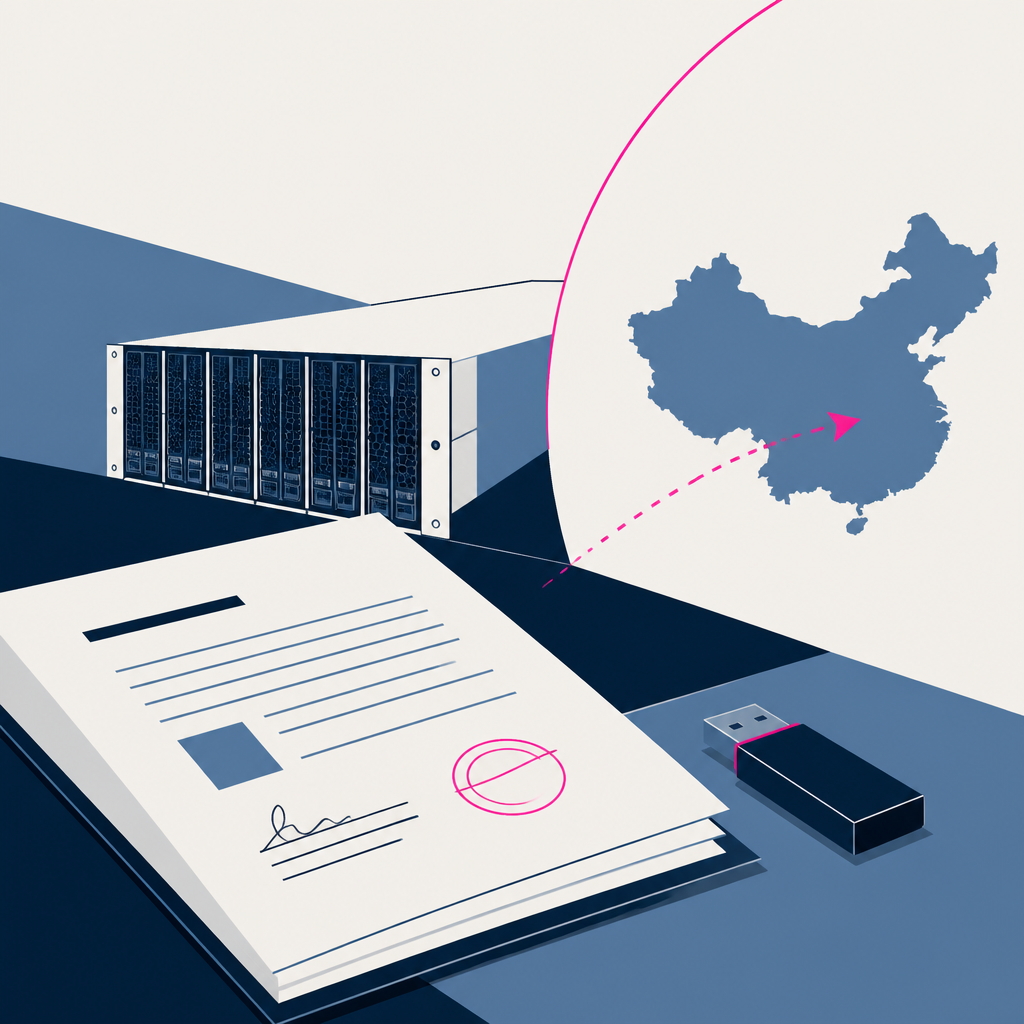
Taiwan wants chip smuggling to China treated as a crime, not just a fine. That would hit A.I. servers and advanced chips across the board, not just a blacklist of named firms.
Based on reporting by Trending Topics, Jakob Steinschaden — read the original for the full story.
Summary, retelling and take written by AI under human oversight; images are AI-generated illustrations. How we work · Report an error
Taiwan is getting ready to turn A.I. chip smuggling into a criminal matter. Economy Minister Kung Ming-hsin told Bloomberg that Taipei plans to tighten export controls on A.I. servers and advanced semiconductors headed for Chinese buyers, with unauthorized shipments prosecuted under the Foreign Trade Act instead of treated as an administrative violation.
That is a sharper tool than the one Taiwan has used so far. Since mid-2025, Huawei and SMIC have been on a blacklist of strategic high-tech goods, which meant Taiwanese companies needed permits to sell to them. Everyone else in China could still sometimes buy, as long as the chips did not run afoul of the 2022 U.S. export rules. The new plan would widen the net and put A.I. servers and cutting-edge chips on the controlled list for all buyers in China, according to Startup Fortune’s report citing Bloomberg.
The change is already moving through politics. Chung Chia-pin, a lawmaker from the governing Democratic Progressive Party, has drafted an amendment to the Foreign Trade Act. The exact penalties and when the new rules would start still have not been decided.
The timing tracks Taiwan’s broader alignment with Washington. In January, Taiwan and the U.S. signed a trade deal that cut U.S. tariffs on most Taiwanese goods from 20 percent to 15 percent, while Taiwanese companies pledged $250 billion in U.S. investment in semiconductors, energy and A.I., backed by another $250 billion in credit guarantees. Taiwan is also riding the A.I. boom: semiconductor exports reached a record $87.2 billion in September, up 60.9 percent from a year earlier, and TSMC posted a record profit.
But the smuggling problem is not hypothetical. Bloomberg says Nvidia chips are already reaching Chinese buyers through routes in Southeast Asia. Taiwan arrested suspected A.I. chip smugglers in May, and prosecutors went after Super Micro managers in July, though on forgery charges. Officials say the existing law did not give them a criminal weapon specifically aimed at diverted chips.
My take — AI-written commentary, not fact-checked reporting
This is what export control looks like when a government stops pretending paperwork is enough. Taiwan is following the same hard line Washington wants, and that’s not subtle diplomacy so much as supply-chain trench warfare. The market noise will be loud, but the real message is simpler: if chips are strategic, then the smuggling ring gets treated like one too.
Read more about this at: Trending Topics
Related stories
 Nvidia senior manager linked to Supermicro scheme smuggling AI servers to China
Ars Technica · 1 month ago ·
30
Chip Expert Tzi-Dar Chiueh: “China Wanted Taiwan Long Before Our Chip Industry Succeeded”
Trending Topics · 3 weeks ago ·
43
Trump administration’s AI crackdown opens door for China to close gap
CSET Georgetown · 3 months ago ·
46
Nvidia senior manager linked to Supermicro scheme smuggling AI servers to China
Ars Technica · 1 month ago ·
30
Chip Expert Tzi-Dar Chiueh: “China Wanted Taiwan Long Before Our Chip Industry Succeeded”
Trending Topics · 3 weeks ago ·
43
Trump administration’s AI crackdown opens door for China to close gap
CSET Georgetown · 3 months ago ·
46