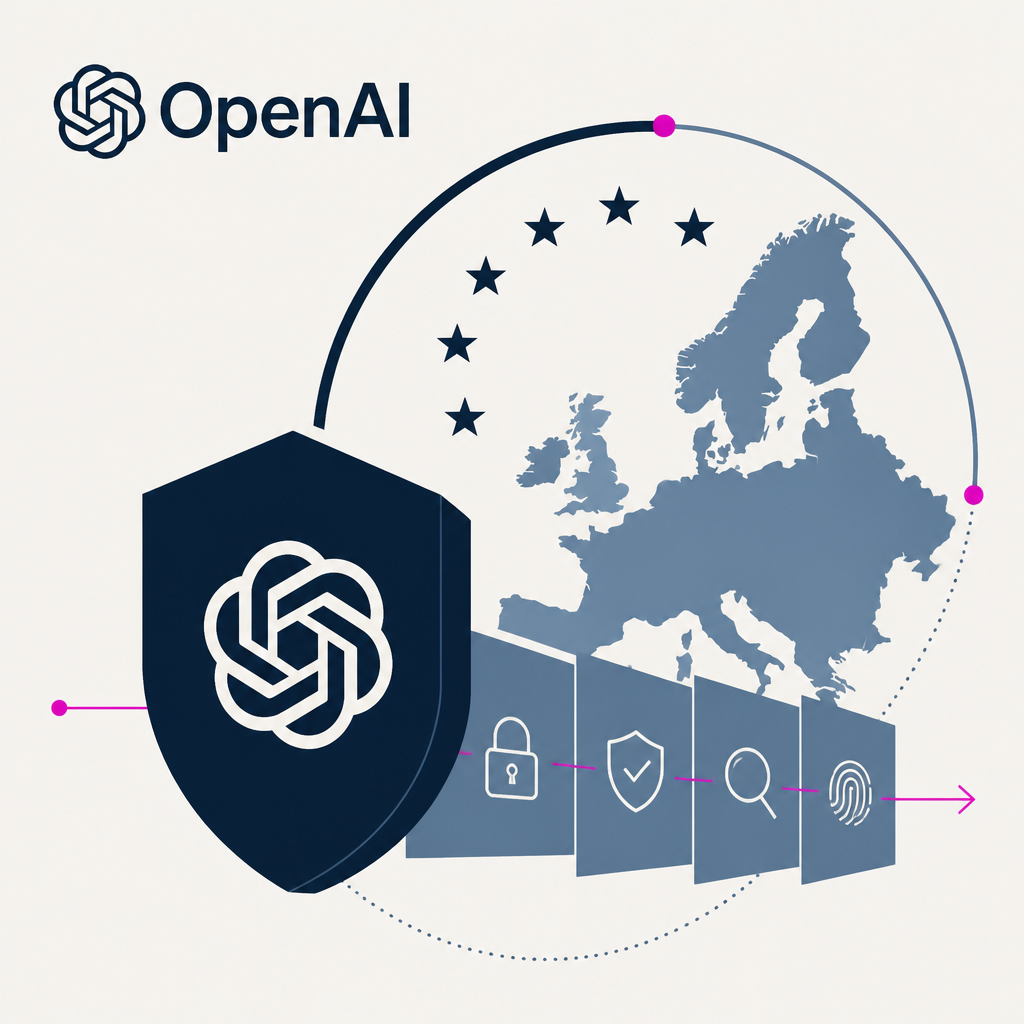
Supporting Europe’s work in ensuring a trustworthy AI ecosystem
OpenAI
OpenAI just backed the EU's new rulebook on labeling AI-made content. It's a bet that clearer provenance tags beat outright bans as Europe's AI law kicks in.
Based on reporting by OpenAI — read the original for the full story.
Summary, retelling and take written by AI under human oversight; images are AI-generated illustrations. How we work · Report an error
OpenAI has put its name behind the European Union's Code of Practice on AI content transparency, a voluntary framework meant to help people tell human-made content apart from anything a machine generated. The company frames this as part of a broader provenance push: watermarking, metadata tagging, and detection tools that flag AI output without necessarily blocking it.
This matters because the EU has spent the last two years building the AI Act into the world's most detailed AI rulebook, and transparency obligations are one of its more concrete, near-term requirements. Rather than fight that momentum, OpenAI is choosing to align with it early, positioning itself as a willing partner to regulators instead of a target of them. That's a notable shift in posture from a company that has, at times, sparred with European lawmakers over compliance timelines and data rules.
The practical bet here is that content provenance — cryptographic signatures, C2PA-style metadata, visible labels — becomes the default way platforms and users sort real from synthetic. OpenAI has already built some of this into its image and video tools, and signing onto a Code of Practice signals it wants those standards to be interoperable across the industry, not just an OpenAI feature.
There's an obvious self-interest angle too. As deepfakes and AI-generated spam multiply, the companies that can prove their content is properly labeled get a talking point (and maybe a legal shield) that unlabeled competitors won't have. Being first to sign up for oversight is often the cheapest way to look responsible while shaping the rules that will apply to everyone else.
My take — AI-written commentary, not fact-checked reporting
Voluntary codes are the regulatory equivalent of a company writing its own permission slip, and OpenAI knows exactly how much goodwill that buys with Brussels for very little actual constraint. I'm all for provenance tools existing, but let's not pretend this is Europe taming Silicon Valley — it's Silicon Valley pre-empting tougher rules by writing the softer ones itself.
Read more about this at: OpenAI