South Korea Pushes Free AI for Citizens to Reduce Dependence on the U.S.
Trending Topics Jakob Steinschaden
South Korea is giving free AI to everyone through phone, chat and TV. It’s a state-backed push to make Korean models the default, not the U.S. apps.
Based on reporting by Trending Topics, Jakob Steinschaden — read the original for the full story.
Summary, retelling and take written by AI under human oversight; images are AI-generated illustrations. How we work · Report an error
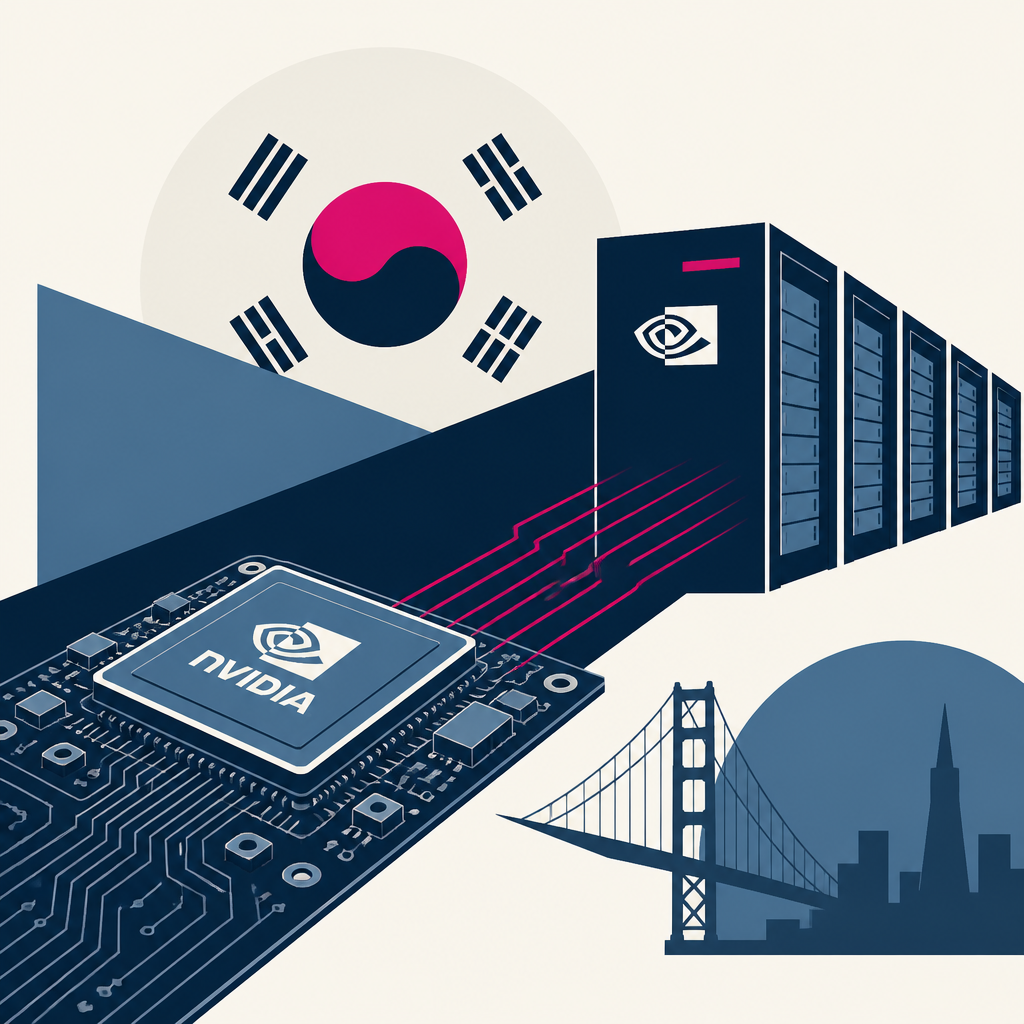
South Korea is treating AI less like a product and more like utility. The Ministry of Science and ICT has picked three consortia, led by SK Telecom, KT and Kakao, to provide free AI services to the whole population under a programme called AI for All.
Six groups applied. Three survived an evaluation that looked at model quality, service design, user acquisition, safety and how the teams planned to use GPUs. The government says the point is an “AI-basic society”, where people can use AI no matter their income, age or digital skills. That means chatbots and agents for everyday tasks and for dealing with public authorities, with no charge and no token limits.
This is not a normal procurement. The firms are not building something for the state and billing it later. They will run the services themselves for the public, while the government provides the compute: 512 Nvidia B200 GPUs across the three operators. From next year, the running costs are due to come from the budget too. And even if demand runs beyond what that money covers, the core functions still have to stay free.
There’s another twist. The operators can build their own revenue models, including ones based on the prompts and usage data the services generate. At the same time, at least half of each system must run on domestic models that meet the ministry’s standards for independent foundation models. That ties the programme to Korea’s sovereign AI push, and it explains the model mix: SK Telecom is using A.X K2, Solar Open 2, Motif 3 and K-EXAONE 2.0; KT is using Mi:dm K Pro 2.5, Solar Pro 4 and Motif 3; Kakao is using Kanana, EXAONE and K-EXAONE 2.0.
The three consortia are chasing users in very different ways. SK Telecom is aiming for an action-oriented assistant that can plan, do and check a task from a single request, via app, web, phone call or text message. Kakao is leaning on KakaoTalk, the country’s default messenger, and wants chatbots and agents to handle reservations, applications and payments there. KT is pushing through Daum search, news and content, then linking that traffic to partners across mobile and IPTV. Naver sat this one out, saying the deadlines were too tight and the multi-model requirement too costly alongside its own AI offering.
For the big U.S. players, this is the part that should sting. South Korea is already a strong market for them, and ChatGPT is among the most used apps there. But once free domestic AI is built into the phone network, the messenger and the IPTV box, the first touchpoint changes. The competition stops being about model quality alone and starts being about where AI appears in daily life.
My take — AI-written commentary, not fact-checked reporting
This is the sort of industrial policy that actually has teeth. South Korea isn’t just cheering for “sovereign AI”; it is putting distribution, compute and user habits on the same side of the table. The U.S. giants can keep calling that competition, but it looks a lot like a country deciding it would rather own the front door than rent it forever.
Read more about this at: Trending Topics