
Sakana Translate translation model updated to the new generation "Sakana Namazu"
Sakana AI

Sakana AI updated Sakana Translate with its new Namazu model. It keeps Japanese, English, and Chinese support, but the translations should read more naturally now.
Based on reporting by Sakana AI — read the original for the full story.
Summary, retelling and take written by AI under human oversight; images are AI-generated illustrations. How we work · Report an error
Sakana AI has swapped in its new Sakana Namazu model for Sakana Translate, the company’s free translation service. The update doesn’t change the service’s reach: it still handles Japanese, English, and Chinese in both directions. What changes is the output. Sakana AI says the new model makes the translations sound more natural.
The company says Namazu was built with a heavy focus on Japanese language, plus the culture and context around it. This update pairs a refreshed base model with improved training methods, which Sakana AI says pushes its idea of “translating Japanese, deeply” further than before. The company points to examples like “omiyamairi,” a newborn’s first shrine visit, as the kind of culturally loaded phrase where a literal translation misses the point.
To back that up, Sakana AI used its own evaluation method, TransEvalnia. It compares two translations across things like word choice and naturalness. On an in-house set of 160 Japanese-to-English tasks, Sakana Translate was judged better than the other model in every head-to-head comparison, with its output preferred more than 50% of the time against each system tested.
The broader argument here is straightforward: bigger general-purpose models are not automatically better at translation, especially when the source text is packed with Japanese-specific nuance. Sakana AI is betting that a model tuned for language and culture beats a brute-force approach, and the company says this post-training method is what lifted quality here.
The service remains free, and anyone can use it after creating an account. Sakana AI also says all three features now run on the new model, and it plans to add file translation for PDFs and Microsoft Office files, along with glossary support, industry-specific models, API access, and enterprise features such as SSO, audit logs, and on-premises deployment.
My take — AI-written commentary, not fact-checked reporting
This is the right kind of boring AI story: less “bigger is better,” more “actually understands the sentence.” Translation is one of those tasks where a model can sound fluent and still completely miss the point, which is very on-brand for the industry. If Sakana can keep winning on nuance instead of bragging rights, that’s more useful than another demo full of smooth nonsense.
Read more about this at: Sakana AI
Related stories
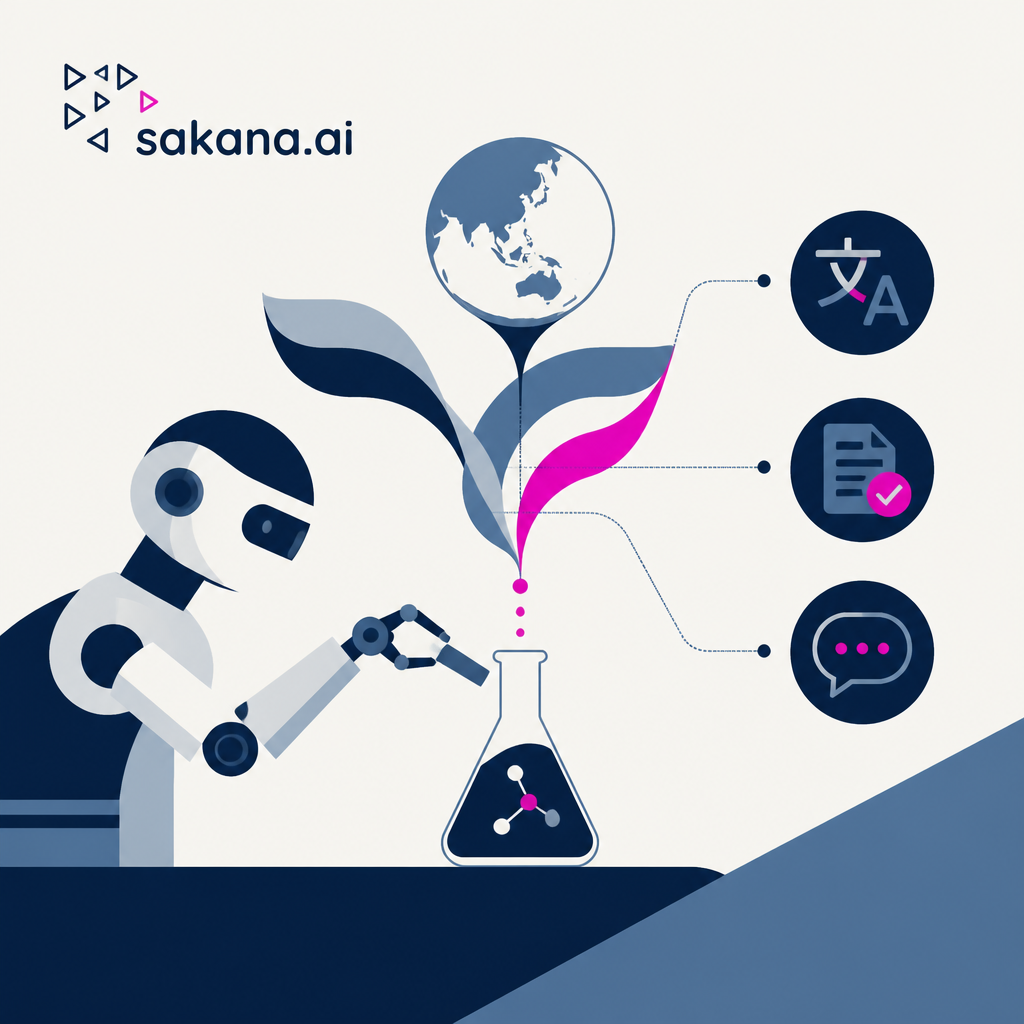 Sakana Translate: Sakana Chat Now Supports Translation with Three Functions - Translation, Proofreading, and Q&A
Sakana AI ·
11
Sakana Translate: Sakana Chat Now Supports Translation with Three Functions - Translation, Proofreading, and Q&A
Sakana AI ·
11
 Sakana Chat gets an update: Sakana Fugu and the new-generation Sakana Namazu are now available
Sakana AI ·
28
Sakana Chat gets an update: Sakana Fugu and the new-generation Sakana Namazu are now available
Sakana AI ·
28
 Sakana AI Launches Sakana Namazu, a Japanese-Specialized LLM API
Sakana AI ·
20
Sakana AI Launches Sakana Namazu, a Japanese-Specialized LLM API
Sakana AI ·
20