
Robots that learn
OpenAI
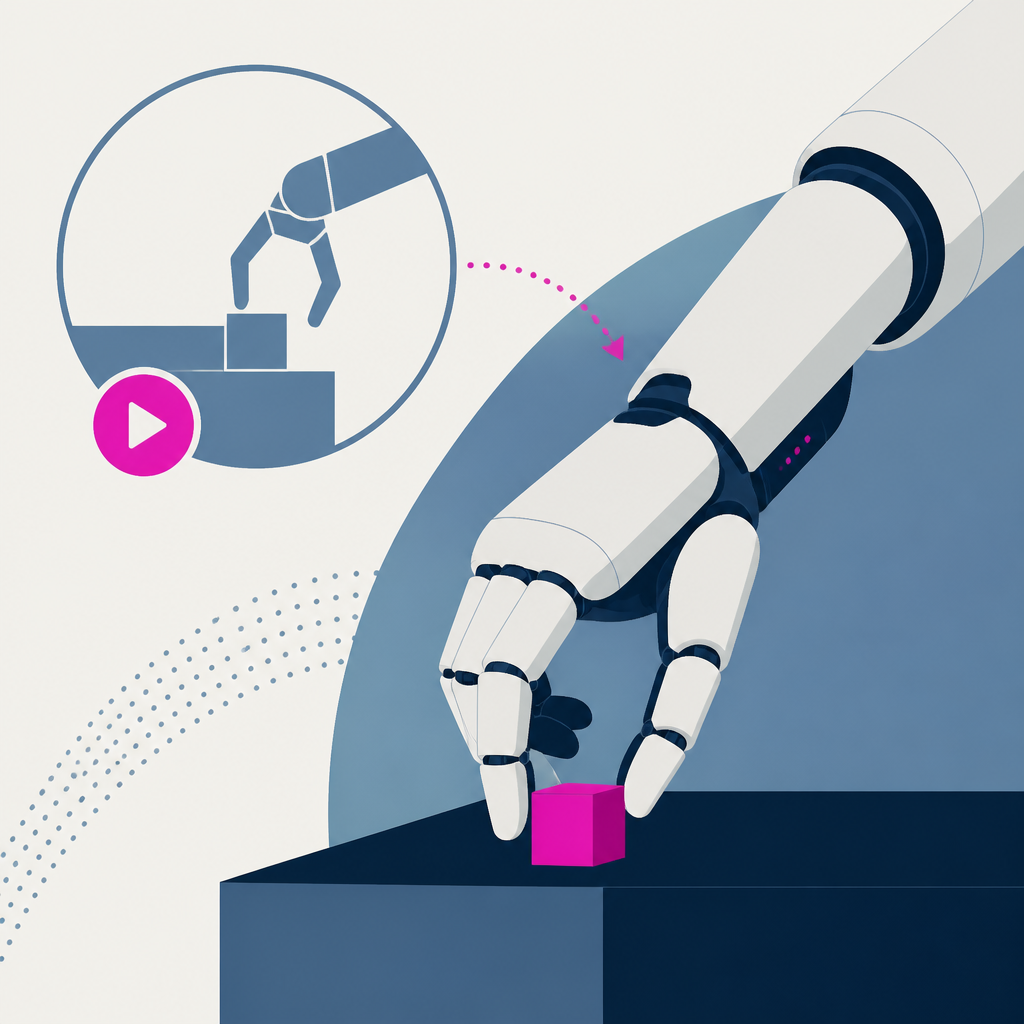
OpenAI built a robot that learns a brand-new task just by watching it done once. The trick: it trained the whole system in simulation, then set it loose on real hardware with no extra tweaking.
Based on reporting by OpenAI — read the original for the full story.
Summary, retelling and take written by AI under human oversight; images are AI-generated illustrations. How we work · Report an error
OpenAI's latest robotics project skips the usual grind of training a physical arm through thousands of trial-and-error attempts. Instead, the system learns entirely inside a simulated world, absorbing patterns and physics before ever touching a real motor. Then it gets deployed onto an actual robot and, after a single human demonstration, it can copy the task. No fine-tuning on the real machine, no weeks of recalibration.
This is the sim-to-real problem robotics researchers have wrestled with for years. Simulations are cheap and fast, but the real world is messy: friction behaves oddly, cameras have noise, joints don't move exactly as modeled. Getting a robot trained purely in a virtual sandbox to perform reliably in a cluttered lab has been one of the harder unsolved puzzles in the field, and it's the reason so many robotics demos either stay confined to simulation or require expensive real-world data collection.
What OpenAI is describing sounds like a one-shot imitation setup: show the robot a task once, and it generalizes the underlying goal rather than memorizing the exact motion path. That's a meaningfully different skill than repeating a scripted sequence. It implies the model built some internal understanding of the task's structure during simulation training, robust enough to survive the jump to physical hardware and to novel demonstrations it never saw during training.
OpenAI doesn't say much yet about the range of tasks, the robot hardware, or how many simulation hours went into training the underlying model. Those details matter a lot for judging how far this generalizes beyond a curated example. But the core claim, if it holds up outside a single showcase clip, points toward robots that adapt on the fly instead of needing task-specific programming for every new job on a factory floor or in a warehouse.
My take — AI-written commentary, not fact-checked reporting
I've watched enough robotics demo reels to know that 'learns from one demonstration' often means 'learns this one demonstration we picked very carefully,' so I want to see this outside a highlight video before getting excited. Sim-to-real transfer has burned researchers for a decade, and OpenAI's one-liner here glosses over exactly the messy details that decide whether this scales to a real warehouse or just looks great in a lab. Cool if true, but I'd bet on incremental progress over an instant leap.
Read more about this at: OpenAI
Related stories
 Skild AI Taps NVIDIA Physical AI to Teach Robots New Tasks From a Single Video
NVIDIA Blog · 1 month ago ·
45
Skild AI trained a humanoid to play soccer via 140 years of simulated self-play—then transferred to a real robot
skild.ai · 3 weeks ago ·
28
Skild AI Taps NVIDIA Physical AI to Teach Robots New Tasks From a Single Video
NVIDIA Blog · 1 month ago ·
45
Skild AI trained a humanoid to play soccer via 140 years of simulated self-play—then transferred to a real robot
skild.ai · 3 weeks ago ·
28