
Skild AI Taps NVIDIA Physical AI to Teach Robots New Tasks From a Single Video
NVIDIA Blog Sasa Docca
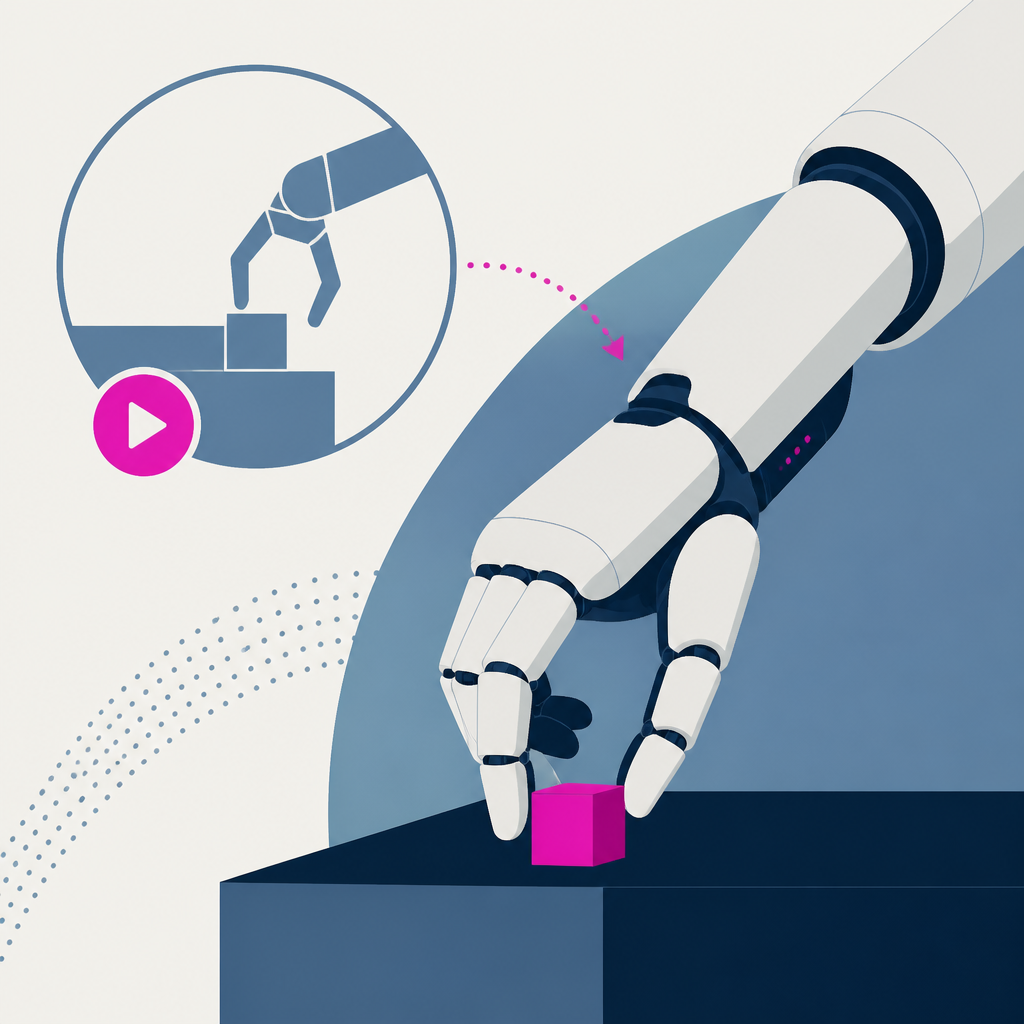
Skild AI says one robot model can learn a new task from a single video. That could cut the endless retraining that keeps factory robots stuck in place.
Based on reporting by NVIDIA Blog, Sasa Docca — read the original for the full story.
Summary, retelling and take written by AI under human oversight; images are AI-generated illustrations. How we work · Report an error
Skild AI is pushing robots toward something closer to imitation than programming. Its new S1 foundation model, launched last week, takes a single video demonstration and turns it into action, without retraining the model or doing task-specific post-training. The pitch is simple: show the robot what to do once, then let it figure out the sequence, the objects and the intent on its own.
That matters because the real world keeps changing. Factory floors get rearranged. Warehouses get new products. Production lines don’t sit still just to make a robot’s life easier. Skild says S1 is built for that messier reality, where a task can run for up to 10 minutes and span dozens of steps, from plant potting to pancake making, pour-over coffee brewing and kit assembly.
The company says it can move from a recorded demo to autonomous execution on hardware in 11 minutes in one plant-potting test. It also says the model can recover from errors, handle moved objects and string together skills that weren’t explicitly programmed. On Skild’s own tests of new multistep tasks, S1 succeeded about 66% of the time at each step, versus 9% for a similar AI system. Skild also estimates that one short video example can be as useful as about 380 hands-on training examples.
NVIDIA is all over the stack here. Skild built S1 and ran the research on NVIDIA AI infrastructure, and the companies say they are working together across synthetic data generation, model training, simulation and deployment. NVIDIA’s Cosmos models help turn video into structured descriptions and diversify data. Isaac Lab, Omniverse, Isaac Sim and TensorRT cover the rest, from simulation to inference. The point is to keep robot learning tied together instead of treating data, training and deployment like separate planets.
The commercial part is moving too. Skild says it has reached a $100 million annual revenue run rate 10 months after its first commercial deployment, and now has more than 60 deployment partnerships across manufacturing, logistics, inspection, security and food preparation. It is also working with NVIDIA and Foxconn on dual-arm manipulators for high-precision assembly of NVIDIA Blackwell systems, including a workflow that installs a busbar and limit block, fastens 16 screws and adapts to disturbances. That is the sort of slog robots have always struggled with. If video can teach it, the old factory playbook starts looking very expensive.
My take — AI-written commentary, not fact-checked reporting
This is the right direction, and a pretty damning comment on how much robot progress has been held back by boring old reprogramming. The flashy part is the single video; the real story is that industrial robotics is finally being pushed toward generalisation instead of one-off demos that die on the factory floor. NVIDIA’s bet here is obvious: own the whole pipeline, from simulation to inference, and make every robot learning problem look like an infrastructure problem.
Read more about this at: NVIDIA Blog
Related stories
 Generalist AI Releases GEN-1.5: A Robot Foundation Model That Learns New Tasks From One 3–12 Second Demo
MarkTechPost · 3 weeks ago ·
8
Import AI 463: Self-improving robots; a 10k Chinese GPU cluster; and an elegiac essay for the human era
Import AI · 2 months ago ·
49
Generalist AI Releases GEN-1.5: A Robot Foundation Model That Learns New Tasks From One 3–12 Second Demo
MarkTechPost · 3 weeks ago ·
8
Import AI 463: Self-improving robots; a 10k Chinese GPU cluster; and an elegiac essay for the human era
Import AI · 2 months ago ·
49