
Principle wants companies to stop predicting the future — and start simulating it
Tech.eu Cate Lawrence
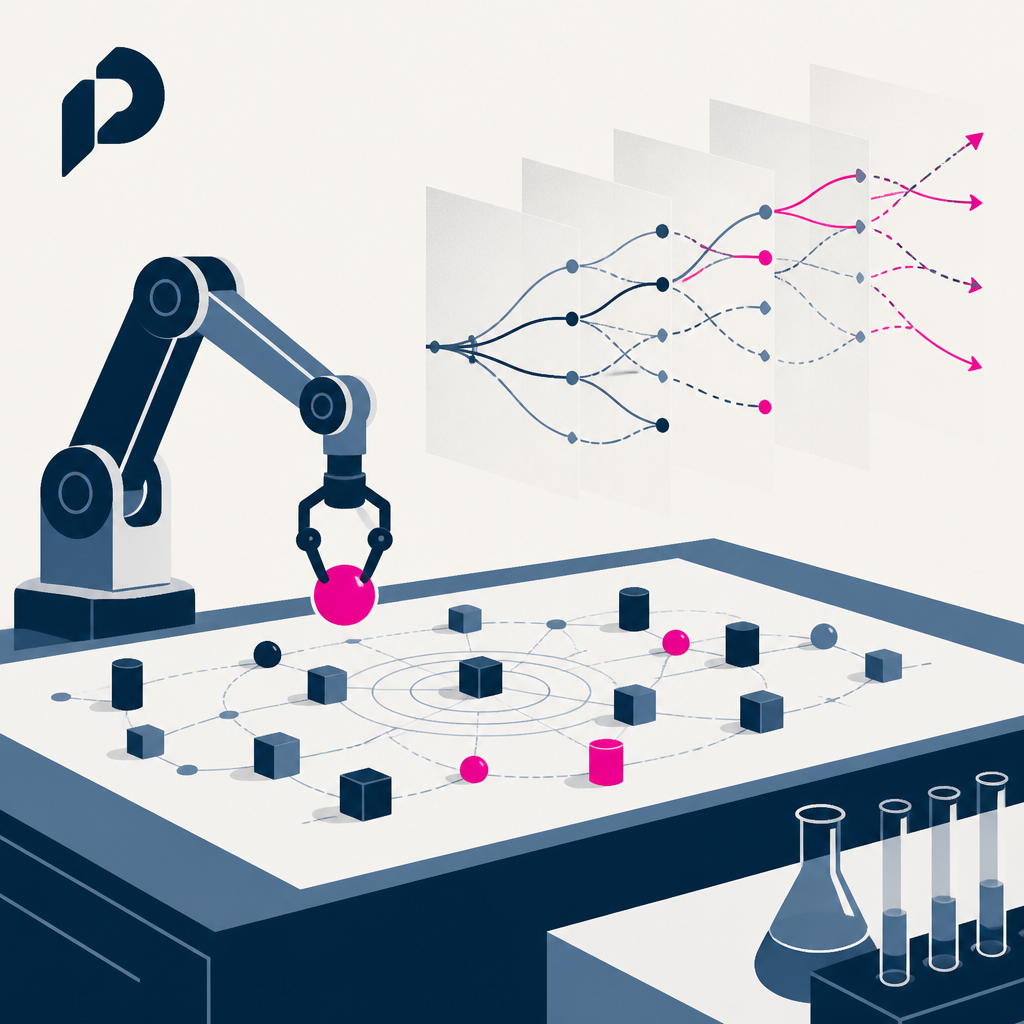
Principle says companies should simulate futures, not predict them. It’s already helping firms test strategy against shocks, rivals, and regulators.
Based on reporting by Tech.eu, Cate Lawrence — read the original for the full story.
Summary, retelling and take written by AI under human oversight; images are AI-generated illustrations. How we work · Report an error
Principle has a simple pitch with a slightly less simple machine behind it: stop pretending the future can be predicted, and start stress-testing the choices that might matter when it arrives. The platform builds digital models of organisations, competitors, regulators, and other market forces, then runs them through hundreds of plausible futures so teams can see what breaks, what holds up, and what to do next.
Founder Artur Kiulian is blunt about the company’s stance. Principle is not trying to be a crystal ball. It uses an LLM as a compressed world model, maps the market state, asks each digital twin what it would do next, and then keeps stepping the simulation forward as the actors react to one another. The point is to help companies think through moves like entering a market, making an acquisition, responding to a rival, reallocating capital, or preparing for regulatory and geopolitical change.
That philosophy comes straight out of Kiulian’s own history. He started building startups after Russia’s first invasion of Ukraine in 2014 pushed capital out of the country and forced him to follow it to the US. Later, during lockdown, he worked on AI for COVID response and saw 1,500 data scientists join a project within two weeks. When Russia’s full-scale invasion of Ukraine began, that infrastructure was deployed in the first hours for evacuations, then housing support and humanitarian aid, before it expanded into government work and even led to NVIDIA donating supercomputers.
But government contracts were hard to turn into a stable business. By the time Kiulian and his team were talking to people at the Dubai Future Forum, they kept hearing the same comparison: this looked a lot like what Shell had done for years with scenario planning. Shell told him about 100 people doing that work manually. The problem was obvious enough. If only giant organisations could afford the old version, most companies were still making strategy with too much guesswork and too little speed.
Principle is trying to close that gap. The company launched in January and raised $2.5 million in pre-seed funding this year. One MacPaw engagement ran for five weeks, mapping more than 500 strategic directions, 480 scenarios, and 90 market actors. The result wasn’t just a prettier strategy deck. The company has since been using Principle continuously, with around 50 competitive topics tracked and monthly re-simulations fed by updated data.
Kiulian’s bigger claim is that strategy is changing from a yearly ritual into a living process. He also thinks bias should be modelled, not erased, because the world itself is biased. That’s a provocative line, but it fits the product: Principle is less interested in promising certainty than in making uncertainty usable. In a market where plans age quickly and shocks keep arriving, that’s probably the more honest sales pitch.
My take — AI-written commentary, not fact-checked reporting
This is the right kind of AI pitch: not “the model will save you,” but “your plan might already be stale.” The lazy part of strategy is still pretending a quarterly slide deck can survive contact with the real world. If AI is useful anywhere, it’s in making executives feel the cost of being wrong before the bill comes due.
Read more about this at: Tech.eu
Related stories
 Simulation: the new Scaling Law — Joon Sung Park, Simile AI
Latent Space · 1 month ago ·
22
Anthropic CEO outlines plan to ‘pace the frontier’
TechCrunch · 1 month ago ·
53
Simulation: the new Scaling Law — Joon Sung Park, Simile AI
Latent Space · 1 month ago ·
22
Anthropic CEO outlines plan to ‘pace the frontier’
TechCrunch · 1 month ago ·
53
 Top futurist Amy Webb sees Fortune 500 firms suffering from 'learned helplessness' with AI, like taxi drivers who need Google Maps
Fortune ·
33
Top futurist Amy Webb sees Fortune 500 firms suffering from 'learned helplessness' with AI, like taxi drivers who need Google Maps
Fortune ·
33