Open-source AI is just “4 months behind” closed frontier models — and 10x cheaper
The New Stack Adrian Bridgwater ● Covered by 3 sources
Open AI models are now just months behind GPT and Claude, but way cheaper to run. Experts say the AGI fear talk hides that you're paying for features, not intelligence.
Based on reporting by The New Stack, Adrian Bridgwater — read the original for the full story.
Summary, retelling and take written by AI under human oversight; images are AI-generated illustrations. How we work · Report an error
Boris Renski, founder of AI agent integration startup Apelogic, argues that the fear-mongering about AGI coming out of the big labs is a distraction from benchmark data showing open-weight models trail the closed frontier by roughly four months, at a fraction of the price. He's seen this movie before, he says, having spent two decades building open-source infrastructure and watching open alternatives eventually catch up to, and often overtake, proprietary rivals — Windows versus Linux, Oracle versus MySQL, Docker Enterprise versus Kubernetes. His point is blunt: enterprises paying OpenAI or Anthropic aren't really buying intelligence, they're buying commoditized extras like connectors and observability tooling wrapped around the model.
Jonathan Bryce, executive director of the Cloud Native Computing Foundation, backs that read, calling a ten-times price tag for a four-month lead "not an enterprise AI strategy" but a very expensive form of lock-in. Featherless, a serverless inference platform, put numbers behind the idea this week. It says native optimization of the open-weight Z.ai GLM 5.2 model on AMD private cloud infrastructure cuts inference costs by roughly 94% against frontier options. For a team burning through 100 billion tokens a month, Featherless pegs the annual cost of GPT-5.5 at $1,557,600 and Claude Opus 4.8 at $1,506,000; its own private-cloud plan runs a flat $90,000 a year, saving more than $1.46 million. For scale, a Deloitte-cited study found one healthcare enterprise used a trillion tokens over six months.
Isaac Gemal, developer relations lead at Featherless, says GLM 5.2 has upended the assumption that open-weight models can't handle real work, though getting it running natively on AMD instead of Nvidia hardware wasn't trivial — demand outstripped Featherless's own forecasts and GPU allocation was a challenge early on. He also flags privacy as a selling point of its own: big labs' promises not to log requests, he says, often carry vague "unsafe" exceptions that let them retain data indefinitely at their own discretion.
Real-world testing backs some of this up, imperfectly. Kacper Michalik, a software engineer at Screen Studio in Poland, ran GLM 5.2 against Opus 4.8 and GPT on tech research and coding tasks. For research, GLM matched or beat Opus 4.8, he says, and it produced a properly typed React form component without trouble. But it couldn't correctly render a 3D scene built with React and TypeGPU, and he ran into usage-limit warnings by late afternoon.
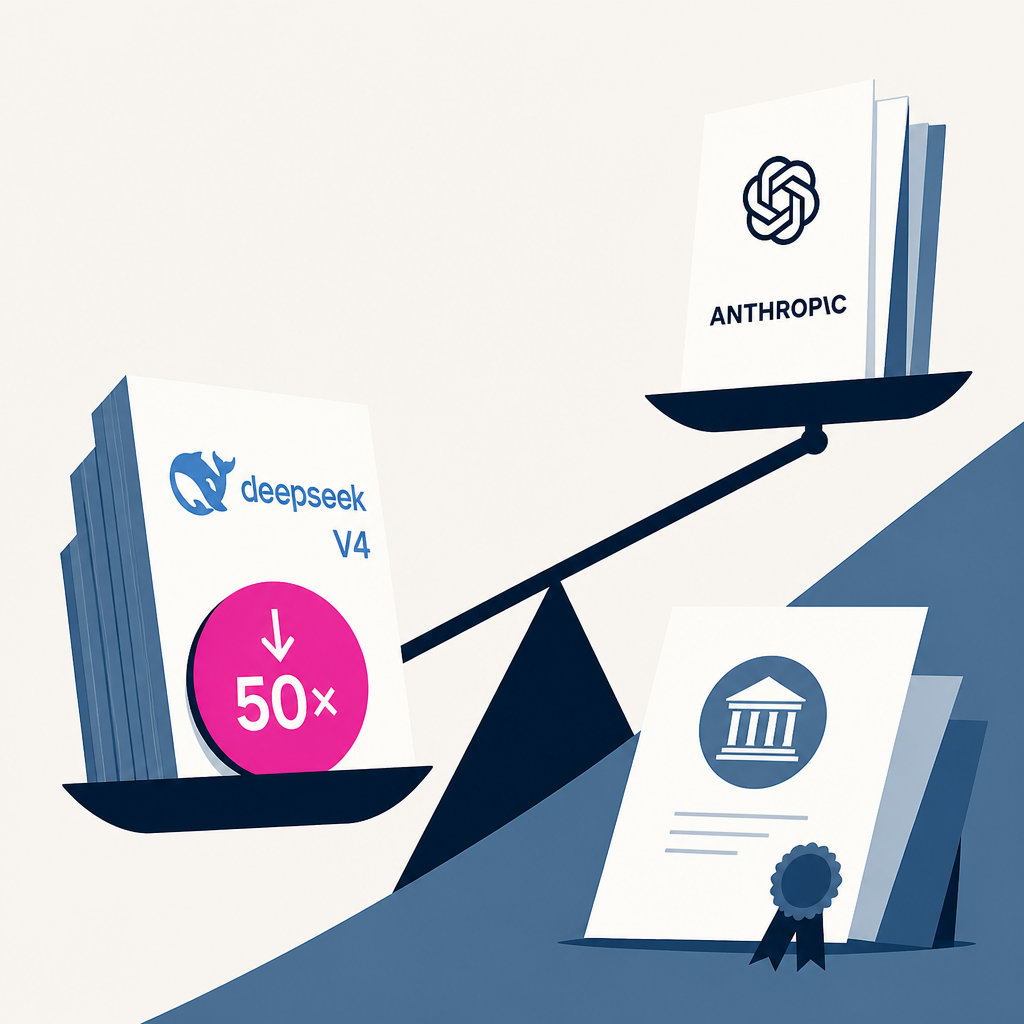
Not everyone is sold on the "10x cheaper" framing wholesale. Phil Whittaker, staff engineer at Umbraco, agrees open-weight models sit four to five months behind the frontier, but says the cost savings depend entirely on scale and goals — differences in tokenizers alone could shrink the discount to as little as 50%, and self-hosting brings its own upfront and ongoing costs. He also notes that most open-weight models come from Chinese labs, which raises separate security and privacy questions when connecting directly to their endpoints. GLM 5.2, he says, is approaching Opus 4.8's level of intelligence but runs slower, making it better suited to long, independent tasks than to latency-sensitive agentic coding tools.
My take — AI-written commentary, not fact-checked reporting
The Oracle comparison lands hard: enterprises signing multi-year frontier-lab contracts today are the ones who'll be paying a nostalgia tax in a few years. A four-month capability gap has never justified a ten-times markup anywhere else in tech, and there's no obvious reason LLMs get to be the exception. The AGI-fear marketing is a nice touch too — nothing distracts from an awkward pricing conversation quite like suggesting the other guy's model might get too smart for its own good.
Read more about this at: The New Stack