
NVIDIA Releases Personal AI Router (PAIR): An Open Source Virtual Inference Router that Distributes Local AI Requests Across RTX, DGX Spark, and Mac Nodes
MarkTechPost Asif Razzaq ● Covered by 7 sources
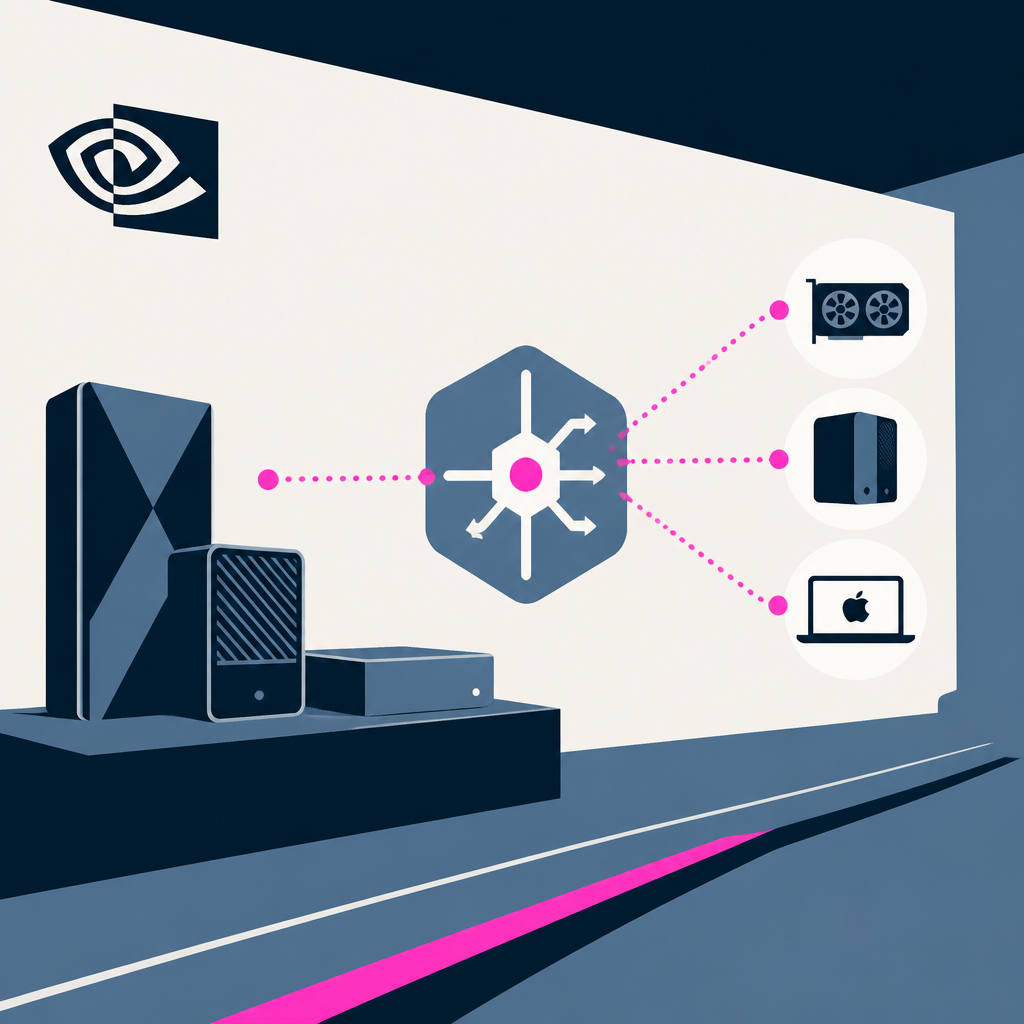
NVIDIA’s new PAIR spreads local AI requests across nearby PCs, Macs, and DGX Spark boxes. It can cut wait times without changing your agent setup.
Based on reporting by MarkTechPost, Asif Razzaq — read the original for the full story.
Summary, retelling and take written by AI under human oversight; images are AI-generated illustrations. How we work · Report an error
NVIDIA has shipped Personal AI Router, or PAIR, a local router for inference traffic that hands requests to whichever nearby machine can handle them. The point is simple: when a single local model gets swamped by a pile of subagent calls, other idle machines on the same network can pick up the slack.
PAIR is not a new model server. Ollama or LM Studio still does the actual inference; PAIR just decides where each request should land. It works by proxying the interfaces those tools already expose, so existing agent harnesses do not need to be rewritten. The repository also includes OpenAI-compatible proxy endpoints, which should make it easier to slot into current setups.
The system discovers machines over mDNS, though you can also add one by IP address if discovery misses it. Trust comes from a six-digit PIN shown on the inviting machine and entered on the other side, and paired nodes communicate over mTLS with generated certificates. Once paired, traffic stays on the local network. Internet access is only needed for model downloads.
Routing is strict. A node only qualifies if its engine is enabled and it has the exact requested model. PAIR then weighs node readiness, engine status, model presence, current job load, and GPU utilization before assigning the request. Each request stays on one node for its full lifetime. There is no VRAM pooling, no GPU merging, and no sharding a single request across machines.
NVIDIA’s demo used Hermes Desktop to spin up a five-subagent household inbox task. On one RTX Spark laptop, that workload averaged 18 minutes. Spread across an RTX Spark laptop, a DGX Spark, and an RTX 5090, it averaged 8 minutes and 48 seconds. PAIR is out now as a public beta, version 0.1.1, with signed installers for Windows, macOS, and Linux and source on GitHub under Apache 2.0.
My take — AI-written commentary, not fact-checked reporting
PAIR is the rare NVIDIA release that looks useful instead of ceremonial. The company didn’t bolt on another glossy cluster story; it made the boring, practical move of routing around idle hardware on a home network. That’s exactly the kind of unsexy plumbing local AI has been missing, and it’s a good sign when the pitch is less “bigger model” and more “stop wasting the machines you already bought.”
Read more about this at: MarkTechPost